
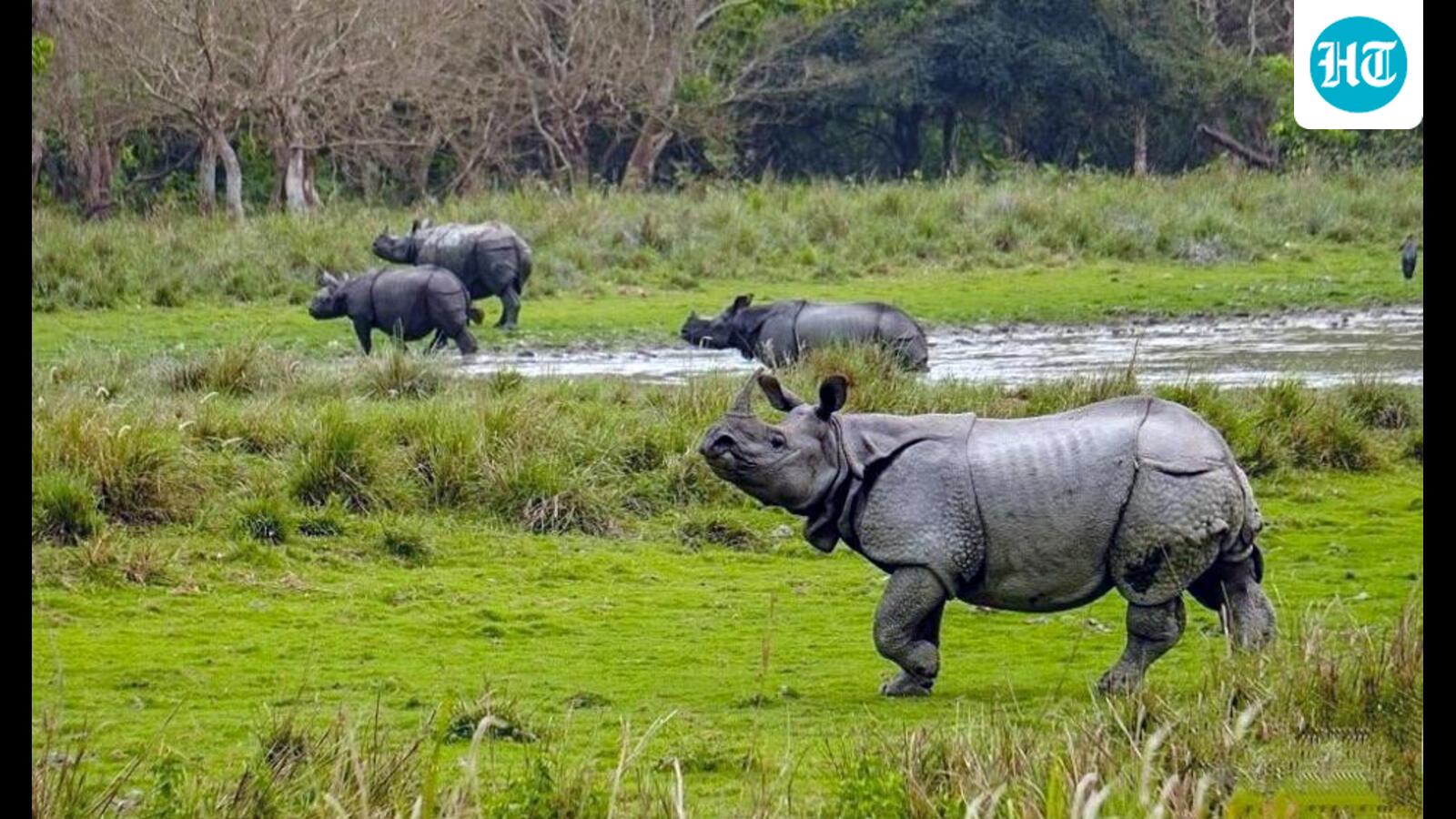
The Indian Rhino Vision 2020 helped the rhino population grow to over 3,200 today. Once just 20 animals survived in Kaziranga, but strict protection and local support changed everything. Now, these rhinos thrive in safe sanctuaries. This success shows how India saved a species while also protecting vital green grasslands.
As the Indian Forest Service marks the 60th year of its inception, the spectacular revival of the rhinoceros in Indian jungles is one of the greatest conservation success stories in modern history.
Centuries ago, the animal roamed freely across the Indo-Gangetic Plain. Relentless hunting and rapid agricultural expansion left just 20 animals surviving in Assam's Kaziranga by the early 20th century. By the mid-2000s, India's herd stabilised at 2,500. The Indian Rhino Vision 2020 (IRV2020) was launched in 2005 to push up the population to 3,000 across seven protected areas in Assam. Today, the count exceeds 3,200, with Kaziranga alone housing 2,600.
This resurgence has occurred alongside a broader environmental milestone: India significantly expanded its green cover despite a growing human population.
To anchor these habitat gains, the Wildlife Institute of India is currently mapping a National Grassland Atlas. This initiative supports India's 2070 net-zero carbon target, a goal that the rhino naturally champions. Using its prehensile upper lip to pluck grass cleanly without uprooting it, the rhino mirrors sustainable land management. Protecting them also safeguards dense grasslands, which act as vital carbon sinks.
Unlike elephants, rhinos rely on a solitary, reactive, and localised instincts, depending entirely on intense, site-specific territorial attachment. Consequently, saving the species requires strict, localised "fortress protection" rather than expansive landscape corridors.
While Africa holds larger populations across its vast savannas, India's rhinos are packed into tiny, high-density sanctuaries in Assam, West Bengal's floodplains, and Uttar Pradesh's Dudhwa National Park. Operating under immense demographic strain, the available area per animal in Pobitora has shrunk drastically, resulting in the highest rhino density in the world. Surrounded by human settlements, these sanctuaries have become ecological islands. Under IRV2020, translocating rhinos to restored habitats like Assam's Manas National Park has successfully mitigated epidemic risks.
When organised poaching syndicates targeted the park, the threat forced a swift enforcement evolution. The forest department deployed armed police commandos, drone surveillance, and advanced real-time satellite tracking. Today, the annual poaching rate in Kaziranga has dropped to zero.
Crucially, this model was built alongside local communities. The government publicly burned thousands of confiscated horns to shatter medicinal myths, while forest departments transformed local youth into active anti-poaching stakeholders. Tourism revenue now funds village schools and health care, ensuring that when rhinos stray into fields, communities herd them back safely. Karbi elders tell a beautiful folktale: "The Goddess Kajir used the rhinos to till her heavenly fields. When a rhino wanders into our paddies and eats our grain, it is not a loss; it is the footprint of the Goddess bringing good fortune."
Yet, challenges loom. Trapped on disconnected ecological islands, rhinos are forced by annual monsoon floods to migrate toward higher ground, crossing heavily trafficked roads where their predictable tracks make them easy targets. Expanding secure wildlife corridors remains imperative to ensure that the rhino's resonant, primitive bellow never falls silent in our wild landscapes.