
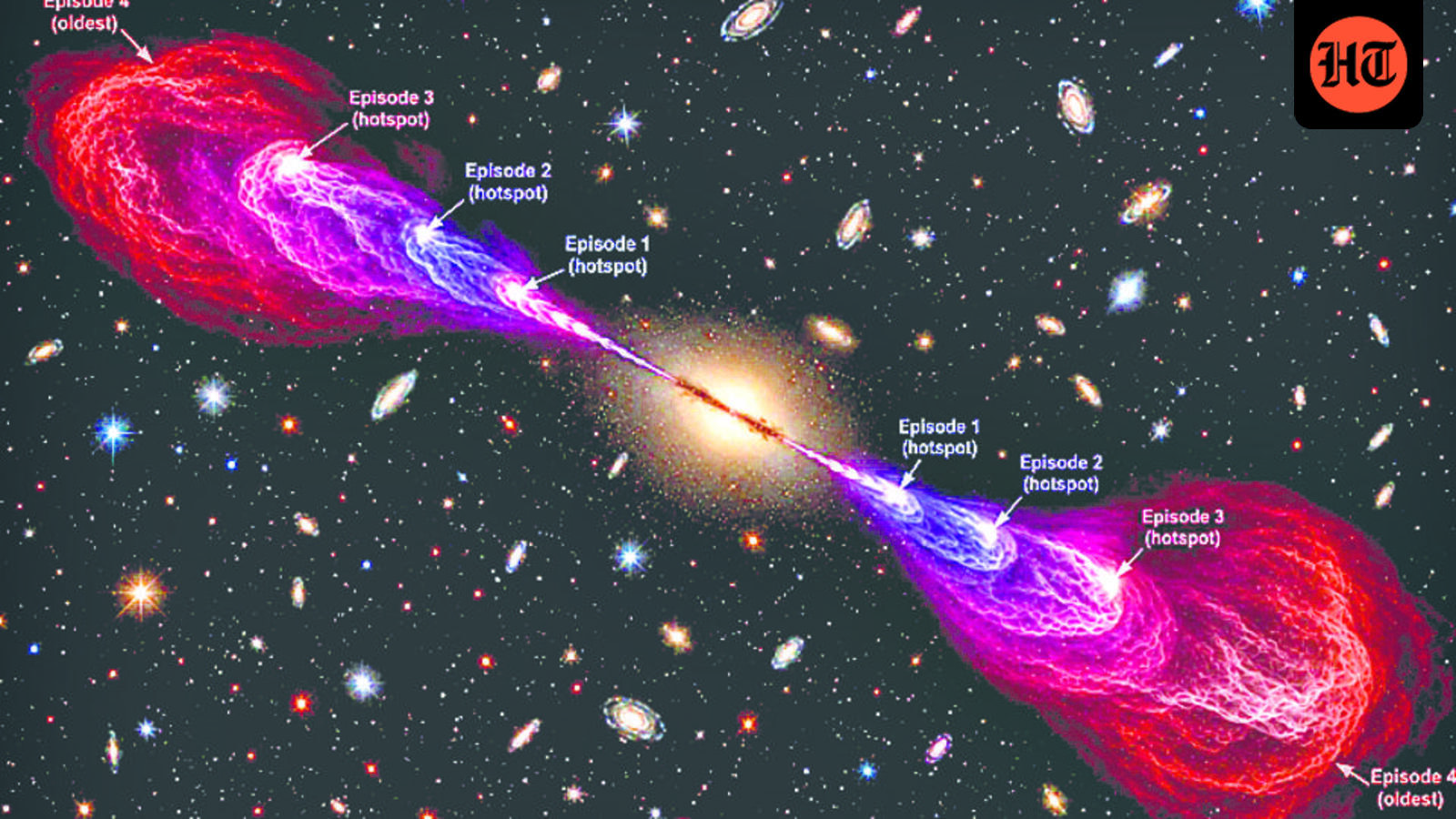
Scientists from IISER Pune and NCRA-TIFR discovered a galaxy showing four cycles of black hole activity. Published in The Astrophysical Journal on October 21, the study showed the galaxy, J023721.13-010528.5, has an S-shaped structure. Researchers used data from many radio telescopes to track these jets, which lasted millions of years.
PUNE: Scientists from Indian Institute of Science Education and Research (IISER) Pune and the National Centre for Radio Astrophysics-Tata Institute of Fundamental Research (NCRA-TIFR) have discovered the first known radio galaxy showing evidence of four separate episodes of activity from its central supermassive black hole, offering new insights into how these cosmic giants power enormous jets of energy.
The galaxy, named J023721.13-010528.5, stretches about 4.2 million light-years and has a distinctive S-shaped structure. The findings were published in "The Astrophysical Journal" on October 21.
The study was led by Pavan Khadekar, a PhD student at IISER Pune, under the guidance of professor Dharam Vir Lal of NCRA-TIFR and professor Ramana Athreya of IISER Pune.
Supermassive black holes can release powerful jets of energetic particles into space. These jets remain active for millions of years before switching off. In some galaxies, the process restarts, creating new jets alongside fading remnants of earlier activity. Most of the tens of thousands of radio galaxies studied by astronomers appear to undergo a single major episode of jet activity.
Until now, astronomers had identified only six radio galaxies showing evidence of three such episodes. The newly discovered galaxy is the first to show evidence of four.
"Initially, I was not convinced, despite Dharam's insistence, that this object was into its fourth life! It took a while to extract convincing evidence of the same. Clearly, Dharam has good scientific antennae," Athreya said.
To investigate its history, researchers combined observations from India's Giant Metrewave Radio Telescope (GMRT), the Very Large Array in the US and South Africa's MeerKAT telescope.
"Many radio telescopes freely provide their data to researchers across the world. This collaborative philosophy of observatories makes for a more comprehensive investigation, and more efficient use of data different scientists can use the same observations for exploring differing ideas," Khadekar said.
The observations revealed four pairs of bright regions, called hotspots, linked to different generations of jets. Their estimated ages ranged from six million to 21 million years. The galaxy's fourth episode of activity appears to have begun a few million years ago.
The researchers suggest that the power or duration of the jets may decrease with each successive episode. Further studies of similar galaxies could help scientists understand why black holes switch off and restart, and how their activity changes over time.
The discovery also demonstrates how radio telescopes can reveal the long history of distant galaxies by detecting traces of activity that occurred millions of years ago.