
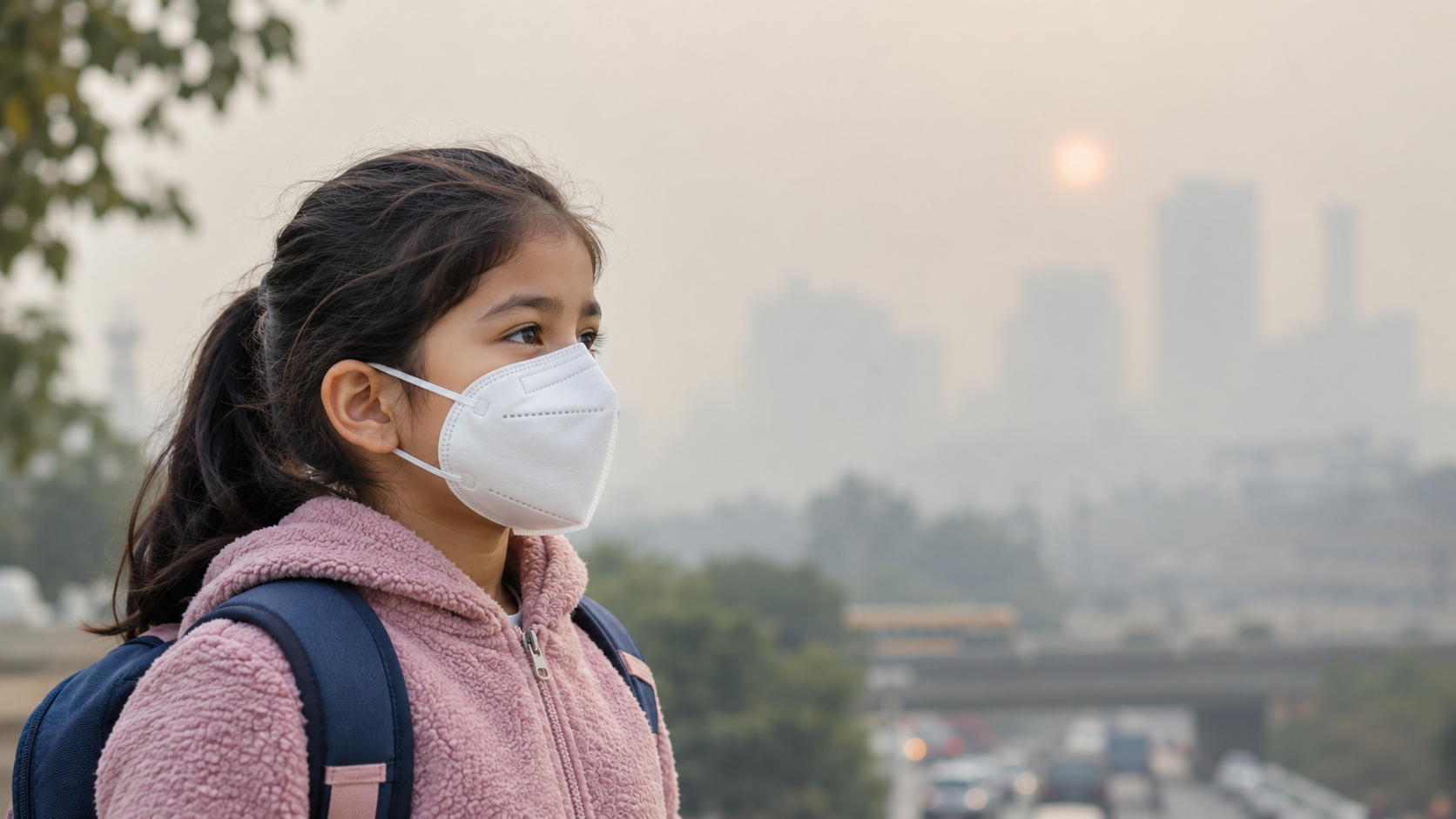
Four doctors suggest parents buy certified N95 or KN95 masks to protect children from pollution. Dr. Ravi Malik says, “A certified N95, FFP2 or KN95 respirator is the only mask that meaningfully filters PM2.5.” Ensure the mask fits well over the nose and chin without any gaps to stay safe.
1. Which mask should you buy for your child?
A properly fitted, certified respirator, such as an N95, KN95 or FFP2, can help reduce exposure to fine pollution particles when going outdoors cannot be avoided.
Dr Amit Gupta, Senior Consultant, Paediatrician and Neonatologist at Motherhood Hospitals, Sector 48, Noida, recommends child-sized N95 or KN95 masks for children above five to six years.
Parents should look for a suitable filter, a soft inner layer and adjustable straps. But don’t let cartoon prints or colourful designs make the decision for you.
“Design is not protection,” Dr Gupta tells indianexpress.com, cautioning parents against buying fancy masks without a filtration rating.
“A certified N95, FFP2 or KN95 respirator is the only mask that meaningfully filters PM2.5, the particle that harms children’s lungs,” says Dr Ravi Malik, Founder and Director of Malik Radix Health Care.
Look for ” child-specific size, a certification mark printed on the mask itself, a soft adjustable nose clip, and head or ear loops your child can tolerate”
“Avoid valved masks; they don’t filter exhaled air and fit poorly on small faces,” Dr Malik further notes.
Remember, even a good respirator cannot filter every pollutant, including harmful gases. A mask can reduce exposure to particles, but it cannot make polluted air completely safe.
2. How do you know if the mask fits?
Buying the right mask is only half the job. If polluted air can sneak in through the sides, the mask may offer much less protection than you expect.
Dr Sumera Khan, MD Paediatrics at Crescent Hospital, explains, “The mask should cover the nose and chin with no visible gaps at the cheeks or nose bridge.”
If you feel air “escaping near the eyes or cheeks”, or their glasses fog, it doesn’t fit.
Here’s what parents should check:
Cover up: The mask should cover the nose, mouth and chin completely.
Check the edges: Look for gaps around the cheeks and nose.
Talk and move: Ask your child to speak and move their jaw. The mask should not slip or obstruct their vision.
Look for leaks: Follow the manufacturer’s fit-check instructions. If air escapes around the edges, the fit needs attention.
Dr Indu Khosla, Senior Consultant in Paediatric Pulmonology at Narayana Health SRCC Children’s Hospital, Mumbai, points out that children’s faces can make it difficult to achieve a tight seal, even with a suitable respirator.
“A mask must not block vision slip while talking or need adjustment,” Dr Kholsa also notes.
If the mask keeps slipping, try a different size. The pediatricians also advise against folding or knotting an adult-sized mask to make it fit, as this can affect the seal.
3. Can toddlers wear masks?
This is one age group where parents need to be especially careful. Children under two years should never wear masks, owing to the risk of suffocation and their inability to reliably remove one or communicate distress.
“For 2 to 5, use only for short periods when going out in high pollution, under adult supervision,” Dr Gupta advises.
Dr Khan also cautions that young children may not be able to remove a mask or communicate when they are struggling. “No child” should wear a mask while sleeping.
For toddlers and younger children, reducing outdoor exposure and keeping the air indoors cleaner are particularly important. Older children may be able to use a suitable respirator, provided it fits properly and they can wear it comfortably.
4. Are cloth masks and surgical masks enough?
Unfortunately, the everyday blue surgical mask or cloth mask may not offer the protection parents are hoping for against fine pollution particles such as PM2.5.
“Cloth and surgical masks were designed to block droplets, not fine particles, and they fit loosely,” Dr Khan explains.
Dr Khosla similarly notes that a properly fitted respirator may reduce exposure more effectively when outdoor exposure cannot be avoided. However, its effectiveness depends on the fit, and it does not filter every type of pollutant.
If you cannot find a suitable, certified respirator for your child, limiting time outdoors is a better approach than assuming a loosely fitting mask will keep pollution out.
5. When should you replace your child’s mask?
There is no single replacement schedule that applies to every mask. Follow the manufacturer’s instructions for use, storage and replacement.
Dr Khosla recommends replacing a mask when it becomes wet, dirty, damaged or difficult to breathe through, or when its recommended period of use has passed.
A few rules are worth remembering:
Do not wash a disposable N95 mask, as this can damage its filtration.
Never share masks between children.
Check the straps and fit before each use.
Do not reuse a single-use respirator contrary to its instructions.
Dr Gupta suggests keeping two or three masks in rotation for school, where appropriate. However, this does not mean disposable respirators can be reused indefinitely. Follow the product instructions.
6. What if your child feels breathless or uncomfortable?
Do not insist that your child keep wearing a mask if they are struggling.
Dr Khan advises parents to stop the activity and move the child to a cleaner-air environment. Remove the mask if the child is having difficulty breathing, feels faint or becomes distressed.
If breathing difficulty continues, or your child develops wheezing, chest tightness, bluish lips or marked lethargy, seek urgent medical attention.
A mask that feels uncomfortable may need a better fit, but persistent or severe symptoms should not simply be dismissed as a mask problem.
7. What if your child has asthma?
Children with asthma or other breathing conditions need extra care during periods of high pollution.
Dr Khosla recommends discussing respirator use with the child’s treating clinician, as a tight-fitting mask may feel harder to breathe through for some children. Parents should follow the child’s asthma action plan and seek medical advice if coughing, wheezing or breathlessness worsens.
Dr Malik also advises parents to keep prescribed inhalers and other rescue medicines available as directed by their child’s doctor. If the child cannot comfortably tolerate a mask, reducing exposure is preferable to forcing them to wear one.
8. Is a mask enough on a bad-air day?
No. Think of a mask as an additional layer of protection, not a free pass to spend hours outdoors.
“A mask is a supplementary measure and should not replace reducing exposure,” Dr Khosla clarifies.
Here’s what parents can do:
Check local air-quality alerts before planning outdoor activities.
Skip outdoor sports, strenuous play and outdoor school assemblies when pollution is high.
Keep windows closed when outdoor air is worse, and ventilate when air quality improves.
Use a HEPA-filter air purifier indoors if available.
Avoid indoor smoke from cigarettes, incense sticks and mosquito coils.
Seek medical advice if your child develops a persistent cough, wheezing or breathlessness.
Dr Malik recommends checking the AQI daily and taking extra care on severely polluted days. A mask does not make prolonged outdoor exposure safe, particularly when pollution levels are very high.
The simplest rule to remember? Choose a mask for its filtration and fit, not its looks. But when pollution levels rise, the best first step is to reduce how much polluted air your child breathes in the first place.