
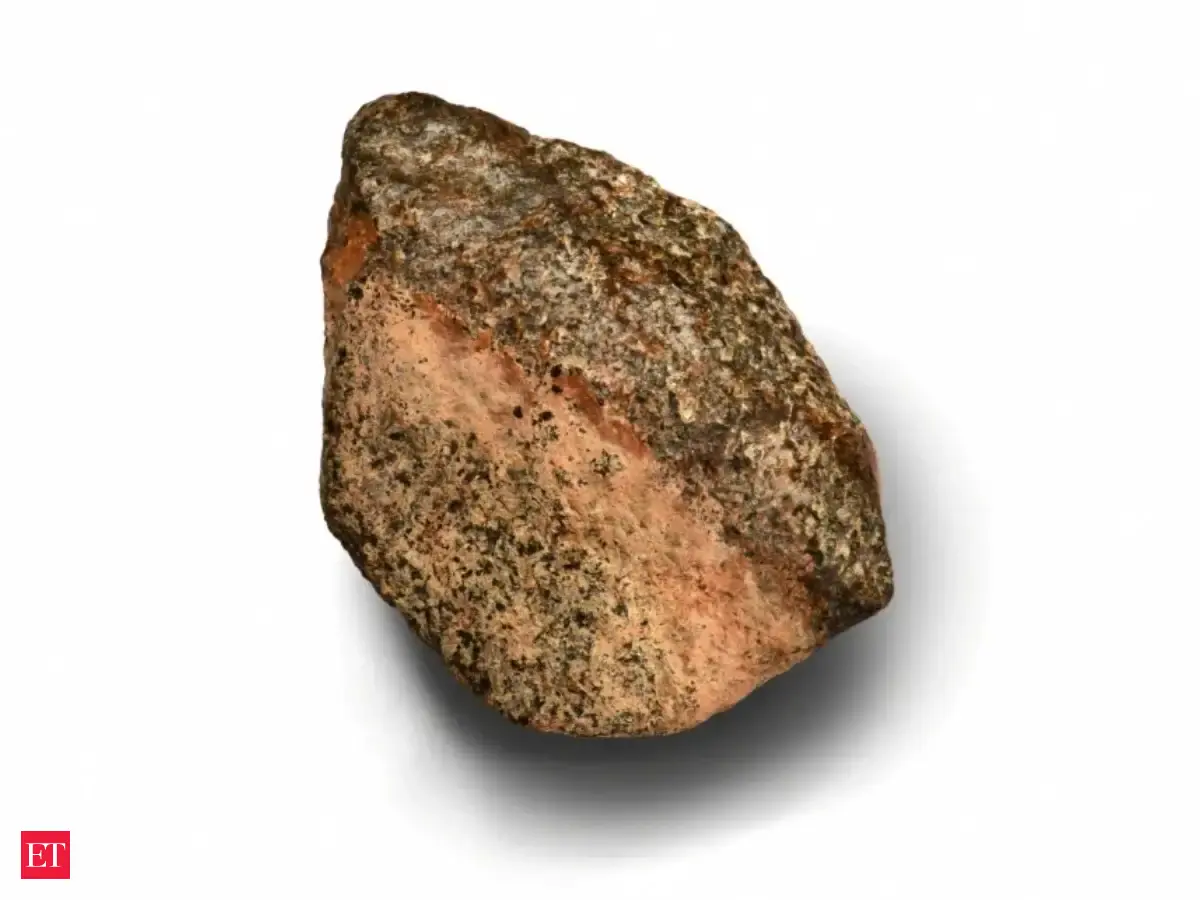
A pink rock found in the Sahara Desert is a 4.1-billion-year-old Martian meteorite named Teghaza 001. Scientists said the specimen, discovered in 2022, shows evidence of ancient volcanic activity and water. This rare find helps researchers understand how the early Martian crust formed and how the planet evolved long ago.
A meteorite named Teghaza 001, discovered in the Sahara Desert, reveals insights into ancient Martian geology. Scientists determined it originated on Mars over 4.1 billion years ago and underwent volcanic processes. Detailed analysis of zircon crystals indicated interactions with water, suggesting a more active early environment. Researchers identified potential geological regions on Mars related to the meteorite's origin.
A seemingly ordinary rose-coloured rock recovered from the Sahara Desert has given scientists a rare glimpse into Mars' earliest geological history, after analysis revealed that it originated on the Red Planet more than 4.1 billion years ago. The 800-gram specimen, named Teghaza 001, contains mineral evidence of ancient volcanic processes and changes caused by water, offering researchers clues about the conditions that existed on Mars long before it became the cold, largely dry world seen today.
The meteorite was discovered in 2022 near the Teghaza salt plain in Mali, but its age and unusual geological features became clear only after detailed laboratory examination. A NASA-funded study published in the journal Science on October 29, 2026, identified it as one of the three oldest Martian meteorites recovered on Earth. It is also among roughly 435 meteorites from Mars identified so far.
The findings are significant because Teghaza 001 preserves a sample of ancient Martian crust that could help scientists reconstruct how the planet formed, how its interior evolved and how water interacted with its rocks billions of years ago.
How scientists identified the Sahara rock as a Martian meteoriteThe specimen did not initially reveal its extraordinary history simply from its appearance. Researchers at the University of New Mexico first established its Martian origin by analysing oxygen isotopes, which act as chemical signatures that help distinguish material from different planetary bodies.
Although the rock appeared to belong to the shergottite class, a commonly found category of Martian meteorites, its internal structure and mineral composition stood out. Planetary scientist Yang Liu of NASA's Jet Propulsion Laboratory (JPL) took a closer look at the sample and identified unusual features that warranted further investigation.
The examination revealed a combination of igneous minerals, formed when molten material cools and solidifies, along with zircon crystals that preserve information about a rock's geological history. Unlike several other ancient Martian specimens that contain a mixture of different rock materials, Teghaza 001 represents a distinct type of rock, making it particularly valuable for studying the planet's early crust.
What Teghaza 001 reveals about Mars' age and ancient waterZircon crystals played an important role in establishing the meteorite's antiquity because they can retain clues about the timing and conditions of rock formation. Researchers used high-precision mineral dating techniques, including an in-situ rubidium-strontium method developed with contributions from scientists at the California Institute of Technology.
The technique allowed the team to examine individual mineral grains using a fragment smaller than a fingernail, rather than dissolving a much larger portion of the rare specimen for analysis. This helped preserve most of the meteorite for future scientific work. The University of New Mexico's account of the research also describes uranium-lead analysis of the zircon crystals as part of the age determination.
The results indicate that Teghaza 001 formed more than 4.1 billion years ago and underwent changes linked to Martian water around that period. The water-related alteration suggests that the rock existed in an environment where fluids interacted with the planet's crust. Its mineral composition, texture and oxygen isotope signatures point to a more geologically active early Mars, with a water cycle that was more complex than the conditions seen on the planet today.
A separate study published in Science Advances in June 2026 examined hydrogen and water signatures preserved in the meteorite's minerals. That research found evidence of an ancient Martian water reservoir and interactions between migrating magma and water-altered crust. The results also support the view that Mars lost hydrogen from its early atmosphere over time, contributing to the planet's gradual drying.
Where on Mars did the ancient meteorite originate?Despite establishing the rock's planetary origin and age, scientists have not been able to pinpoint the exact location from which it was ejected. By comparing Teghaza 001's chemical and mineral characteristics with observations collected by NASA's Mars Reconnaissance Orbiter, researchers identified 13 possible locations that could match the specimen.
Several of these candidate areas are situated in the Red Planet's ancient southern highlands, a region marked by extensive cratering. However, the available evidence is not sufficient to establish a specific birthplace for the meteorite.
Like other Martian meteorites found on Earth, Teghaza 001 is believed to have been launched into space when a powerful impact struck the planet's surface. The resulting fragments travelled through space before eventually reaching Earth. The precise impact that sent this particular rock on its journey has not been identified.
Its possible origin is of interest beyond reconstructing the meteorite's journey. Identifying the geological region it represents could help scientists decide where future Mars landers, rovers or sample-return missions should investigate, particularly because the specimen may represent crust from an area not previously sampled through meteorites.
Why the 4.1-billion-year-old Mars discovery mattersTeghaza 001 offers researchers an unusually old and relatively distinct sample of Martian rock. Its record of volcanic formation and later interaction with water provides evidence about a period when the planet's geological and environmental conditions differed significantly from those prevailing today.
The discovery does not establish that life existed on Mars. However, evidence of ancient water and a more active early environment gives scientists additional material for investigating whether parts of the planet once had conditions that could have supported life.
Researchers expect further examination of the meteorite to provide more information about the evolution of Mars' crust, the movement of water through its interior and surface, and the changes that eventually transformed the planet into the arid world observed today