
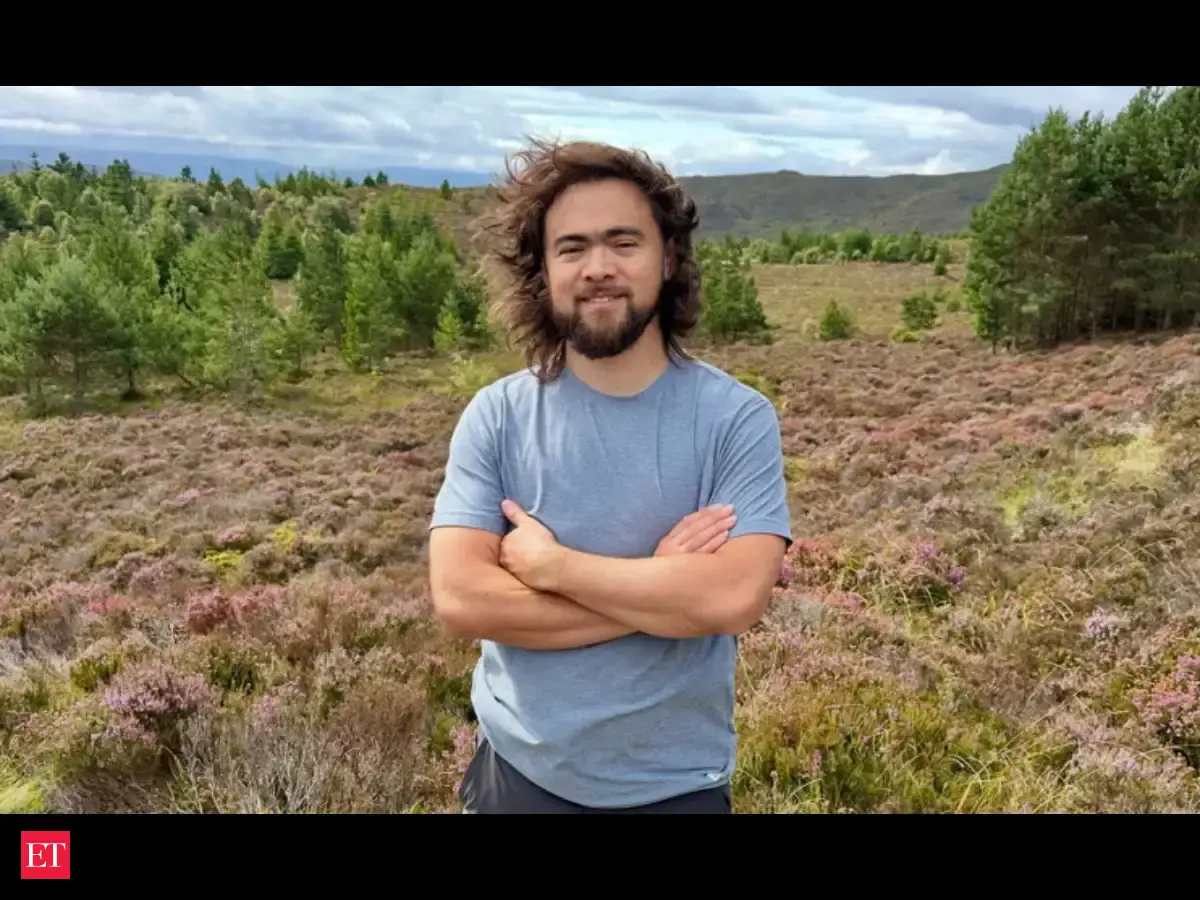
Eliot Bohr, the great-grandson of Niels Bohr, invited descendants of famous scientists to connect on Instagram. His video got over 1.5 million views, drawing responses from relatives of Oppenheimer and Heisenberg. "If you're a descendant of a famous scientist, let's connect," Bohr said. Many families shared their unique stories.
Eliot Bohr, a postdoctoral physicist and the great-grandson of the legendary scientist Niels Bohr, has taken to Instagram with an open call for descendants of esteemed scientists. He invites them to share their stories and experiences, a move that has captivated over 1.5 million viewers. Notably, relatives of iconic figures like Oppenheimer and Heisenberg have responded, sparking a renewed interest in the scientific heritage passed down through generations.
17 of the 29 scientists who attended the world's most influential gathering on Physics, the 1927 Solvay Conference, went on to win a Nobel Prize. Nearly a century after they debated the foundational laws of the universe that govern the known world, a new generation of physics royalty is getting back in touch, and the reason is an Instagram Reel.
Eliot Bohr, a postdoctoral physicist at JILA (a joint institute of the University of Colorado Boulder and NIST) and the great-grandson of Nobel laureate Niels Bohr, recently posted a video where he invited the living descendants of history's most famous scientists, specifically naming Albert Einstein, Werner Heisenberg, Ernest Rutherford, and J. Robert Oppenheimer, to reach out, compare notes, and share family lore.
"If you're a descendant of a famous scientist, let's connect," Bohr urged in the clip. "I'm Enrico Fermi's granddaughter," wrote Olivia with her website link. The internet delivered his magic; it's crossed 1.5 million views, and his inbox began filling up with messages from some of science's most recognizable surnames. Famous Indian quantum physicist S. N. Bose's descendants also joined in the comments.
Another most engaged comment was "We (are) getting the
Physics Avengers vol. 2 in 2026". In a follow-up update on October 29, Bohr revealed in a Facebook post that he had already heard from relatives of Oppenheimer and Heisenberg, alongside descendants of foundational thinkers from other eras, including Charles Darwin, James Watt, and James Prescott Joule.
The 1927 Solvay Conference in Brussels, attended by 29 physicists, 17 of whom were Nobel laureates.(Photo: Benjamin Couprie / Institut International de Physique Solvay, via Wikimedia Commons)
The 'Avenger' style callout was so well received by the commenters largely because Eliot Bohr himself defies the traditional academic stereotype. Adjacent to his experimental research in atomic, molecular, and optical physics, and carrying the weight of a family tree that includes two Nobel Prizes (his grandfather, Aage Bohr, also won in 1975), Eliot leads a double life as a multi-platinum music producer who has worked with major American hip-hop artists.
His great-grandfather, Niels Bohr, published his groundbreaking quantum model of the atom in 1913 and won the Nobel Prize in Physics in 1922. In his 1913 discovery, Bohr revolutionized
atomic physics by proposing that electrons orbit the nucleus in specific, quantized energy levels and emit or absorb radiation only when jumping between them. His theory explained the spectral lines of hydrogen.