
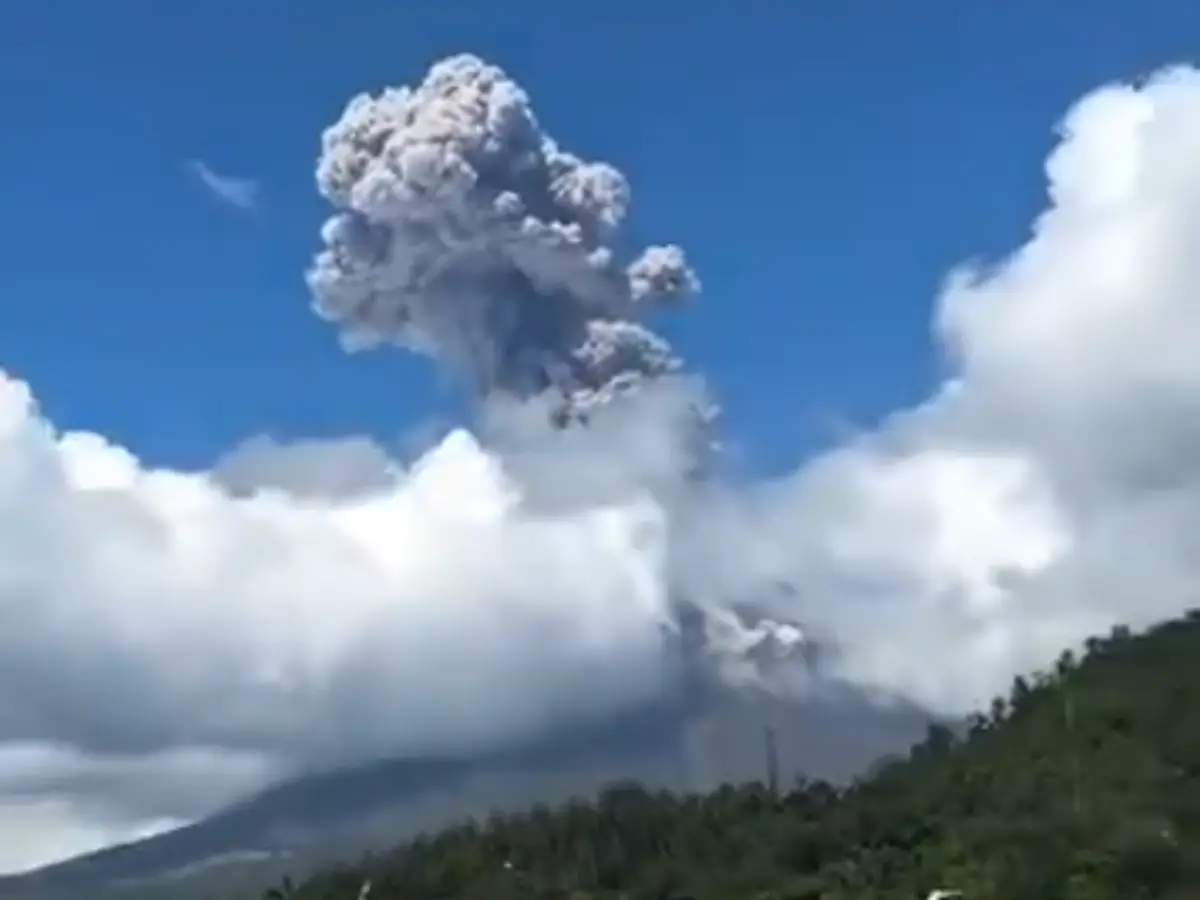
Philippines' Mayon volcano erupted on Friday (October 30), sending a 3,000-metre ash column into the sky. The state seismology office raised the alert to Level 3, calling for evacuations within six kilometres of the crater. Officials warned that "Mayon is in a new phase of magmatic eruption" following the blast.
One of the most active volcanoes in the Philippines, Mayon, fired a dark column of ash over thousands of metres into the sky in a "moderately explosive eruption" on Friday (October 30). The eruption lasted nearly six minutes, sending alert status up to Level 3 in Albay, according to the state seismology office.
Following the eruption, there were no immediate reports of casualties or damage in towns and in the vicinity of Mount Mayon. In response, the country's volcano institute raised the alert level from 2 to 3 on its 0-5 scale, calling for evacuations within six kilometres (3.7 miles) of the crater.
The Philippine Institute of Volcanology and Seismology confirmed in its bulletin that the 3,000-metre (nearly 10,000 feet) ash column gradually moved southwest onto nearby population centres. "Mayon is in a new phase of magmatic eruption, with increased chances of lava flows and hazardous PDCs (pyroclastic density currents)... affecting the upper to middle slopes of the volcano in the immediate days to weeks," the bulletin said.
It called on local officials to evacuate areas near the crater, citing the threat "due to PDCs, lava flows, rockfalls and other volcanic hazards", and warned aircraft to steer clear of flying close to the mountain. Standing 2,462 metres (8,000 feet) tall in a striking, near-perfect cone shape roughly 330 kilometres southeast of Manila, Mayon is one of three Philippine volcanoes that have shown heightened activity this year, though none has produced a major eruption so far.
Back in June 2023, authorities relocated more than 12,000 people from Mayon's lower slopes to evacuation centres as a precaution against ash and toxic gas emissions from the crater. Seismic and volcanic activity are routine occurrences in the Philippines, a consequence of its location along the Pacific "Ring of Fire," where shifting tectonic plates meet. The country's deadliest eruption in modern history remains Mount Pinatubo's 1991 blast, which claimed more than 800 lives and sent an ash cloud drifting thousands of kilometres across the region.