
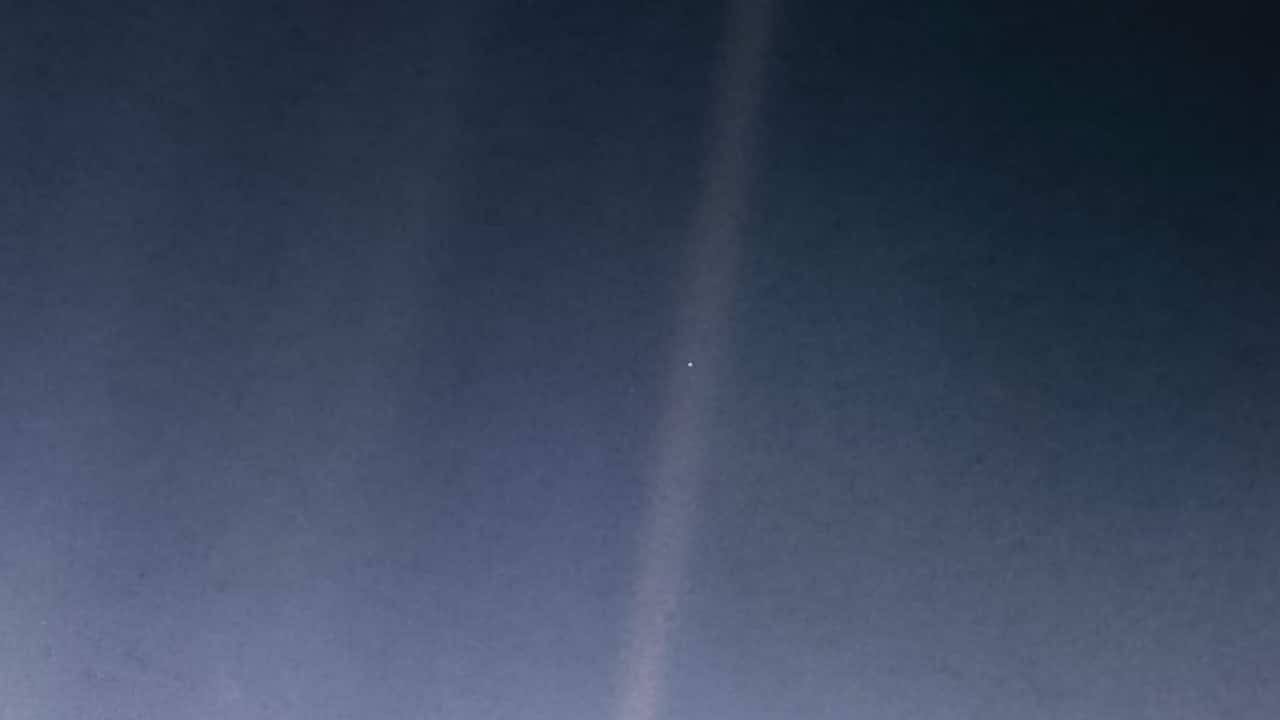
NASA’s Voyager 1 captured the iconic 'Pale Blue Dot' photograph on February 14, 1990. The image showed Earth as a tiny speck from 6 billion kilometres away. Just 34 minutes later, NASA switched off the cameras to save power. Carl Sagan said, "Look again at that dot. That's here."
NASA's Voyager 1 captured one of the most extraordinary photographs of Earth in space exploration history just 34 minutes before its cameras were permanently switched off in 1990. The image, famously known as the 'Pale Blue Dot', showed our planet as a tiny blue speck against the vast darkness of space. Taken from approximately 6 billion kilometres away, the photograph offered humanity a rare perspective of its home planet. More than three decades later, Voyager 1 continues its journey through interstellar space. What is Voyager 1's "Pale Blue Dot" photograph? The Pale Blue Dot is a photograph of Earth taken by Voyager 1 on February 14, 1990.
At the time, the spacecraft was approximately 3.7 billion miles (6 billion kilometres) from Earth. The plant appears as a tiny point suspended in a streak of sunlight. It occupies less than a single pixel in the original image. The photograph was part of a collection of 60 images called the 'Family Portrait of the Solar System'. Voyager 1 captured views of six planets during this imaging sequence. Why did Voyager 1 photograph Earth? The idea came from astronomer Carl Sagan, who wanted to show humanity how small Earth appeared from the outer Solar System. After years of discussions, NASA approved the request.
Voyager 1 turned its cameras towards the inner Solar System on February 14, 1990, capturing the historic image. The photograph inspired Sagan's 1994 book, 'Pale Blue Dot: A Vision of the Human Future in Space'. He famously wrote, "Look again at that dot. That's here. That's home. That's us." Did NASA switch off Voyager 1's cameras? Voyager 1 captured the Pale Blue Dot at 04:48 GMT. Just 34 minutes later, at 05:22 GMT, NASA permanently switched off its cameras. The decision was taken to conserve the spacecraft's limited electrical power. It was moving farther away from the Sun and had completed its planetary photography objectives.
However, Voyager 1 did not stop working. It continued sending scientific data to Earth. What historic milestone did Voyager 1 achieve in 2026? Nearly 49 years after its launch, Voyager 1 reached another historic milestone in November 2026. The NASA spacecraft became the first human-made object to travel one light-day away from Earth, covering approximately 25.9 billion kilometres (16.1 billion miles). A light-day is the distance light travels in 24 hours. This means radio signals sent from Earth now take approximately 24 hours to reach Voyager 1. Any response from the spacecraft takes another 24 hours to return.