
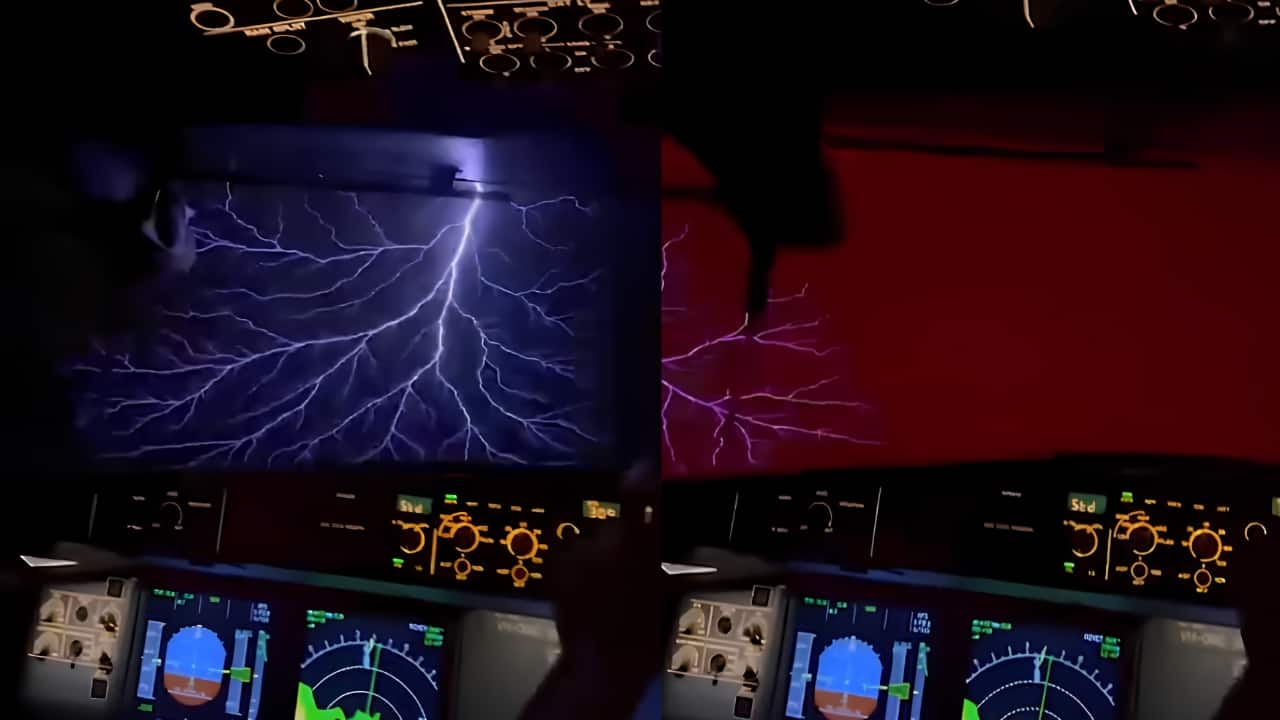
A pilot flying in Australia captured a rare electric glow known as St. Elmo's Fire on October 25, 2026. This blue or violet light appears when strong electric fields ionize the air around an aircraft. Experts said, "The phenomenon itself isn't dangerous, but it can be a warning sign."
A strange electric glow appeared around an aircraft during a flight in Australia, drawing attention to a rare atmospheric phenomenon known as St. Elmo's Fire. The blue or violet light can make an aircraft's windscreen, nose or wings appear to glow with electricity. But despite its fiery name, the phenomenon is neither a real flame nor a conventional lightning bolt. St. Elmo's Fire occurs when a strong electric field ionises the air around an object. The resulting electrical discharge produces a luminous glow, sometimes visible to pilots flying near thunderstorms. The phenomenon is scientifically understood, although its appearance can be startling. What is St. Elmo's Fire? St. Elmo's Fire is a type of electrical discharge that can appear around pointed or exposed parts of an aircraft. It has also been observed around ship masts, lightning conductors and other elevated objects. The phenomenon is named after St. Erasmus, the patron saint of sailors. Mariners historically regarded the mysterious glow on their ships as a supernatural sign. Scientists now understand it as an electrical effect involving ionised air. This isn't lightning, but it's still electric! ⚡ A pilot flying in Australia captured a phenomenon known as St. Elmo's Fire. It occurs when strong electric fields ionize the air, creating glowing plasma along parts of the aircraft, including the windshield. The phenomenon itself isn't dangerous, but it can be a warning sign of nearby thunderstorms and lightning. -- AccuWeather (@accuweather) October 25, 2026 Blue Or Violet lights that pilot witnessed! The glow forms when a strong electric field gives charged particles enough energy to ionise surrounding air molecules. This creates plasma, an electrically charged state of matter. As excited nitrogen and oxygen molecules release energy, they emit light. The result can be a blue or violet glow around parts of an aircraft, particularly near areas where the electric field becomes concentrated. The process is known as a corona discharge. Is St. Elmo's Fire the same as lightining? No. Both involve atmospheric electricity, but they are different phenomena. Lightning involves a much larger electrical discharge, while St. Elmo's Fire is a luminous discharge around a surface exposed to a strong electric field. It can persist as a glow rather than appearing as a sudden lightning bolt. How dangerous is St. Elmo's Fire for aircrafts? The glow itself is generally not considered dangerous. However, the conditions that produce it can indicate a strongly charged atmosphere, often associated with thunderstorms. Electrical discharges can also cause radio interference or affect some onboard measurements. Can St. Elmo's fire occur outside thunderstorms? Yes. Although thunderstorms are a common setting, the World Meteorological Organization notes that St. Elmo's Fire can also occur in strong electric fields associated with heavy snow, strong winds and aircraft flying through volcanic ash. The phenomenon is a reminder that the atmosphere is electrically active, even when the resulting glow looks more like science fiction than ordinary weather.