
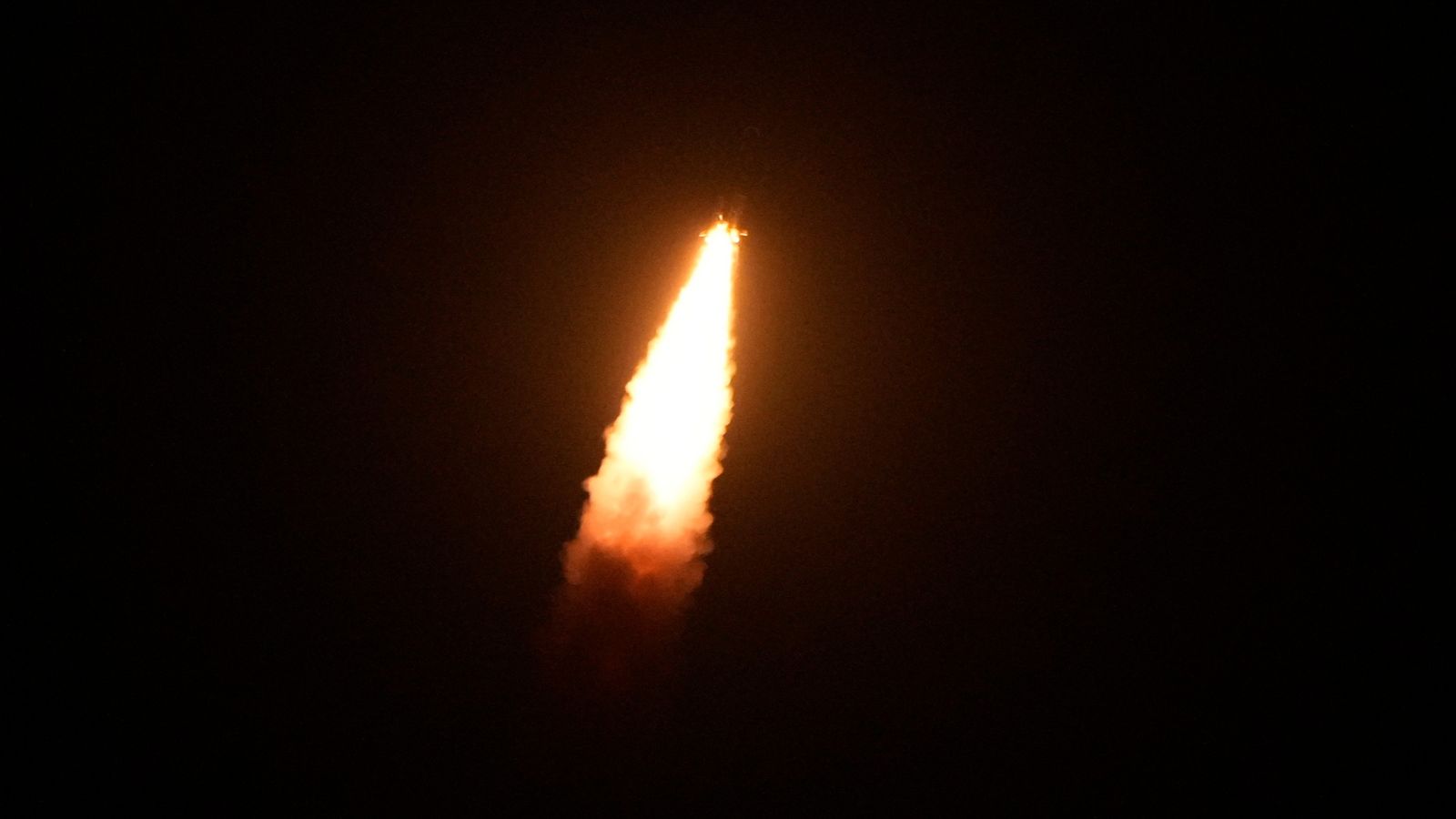
ISRO’s GSLV-F18 rocket placed the NVS-03 satellite into orbit on Friday, restoring critical services for India's NavIC network. ISRO Chairperson V Narayanan said, "This mission was accomplished with the least turnaround time of just 56 days between successive GSLV missions." The satellite will now move to its targeted circular orbit.
Lifting off past midnight on Friday, ISRO's GSLV-F18 rocket placed the NVS-03 satellite into orbit, restoring critical positioning and timing services for India's NavIC network.
The launch is significant as it marks the space agency's second GSLV mission within two months, representing one of its fastest turnaround times for the vehicle.
"This mission was accomplished with the least turnaround time of just 56 days between successive GSLV missions. Last month, on September 4, we accomplished the GSLV-17/EOS-05 mission. Today, all the vehicle systems have performed as predicted and as expected," said ISRO Chairperson V Narayanan.
He said that this was an important component of 'One Nation, One Time' project.
Prime Minister Narendra Modi congratulated the ISRO scientists. He said, "This mission marks an important step in strengthening NavIC, our indigenous satellite navigation system. Equipped with enhanced capabilities, NVS-03 will further our pursuit of self-reliance in critical technologies and support navigation services that benefit our people."
Union Minister for Space Dr Jitendra Singh wrote on X: "Congratulations Team #ISRO for the successful launch of GSLV-F18/NVS-03 mission! This remarkable achievement reflects India's growing prowess in Space technology and our unwavering commitment to strengthening sovereign indigenous navigation capabilities."
Against an intended orbit of 170.3 x 37,247 km, the satellite was precisely placed into a 170.3 x 38,080 km orbit. Narayanan described the launch as one of the vehicle's best performances to date.
He added that the satellite's solar panels have deployed successfully and all systems are functioning normally. Over the next week, the spacecraft will execute a series of manoeuvres to transition from its current elliptical orbit to its targeted high, circular orbit.
This was the exact stage where NVS-02 failed last January, failing to reach its intended orbit and leaving it unable to provide positioning data.
The ISRO Chairman stated that launching the fourth operational satellite into the NavIC constellation has restored the minimum configuration needed for location data. The system had previously lost positioning capabilities due to satellite retirements, atomic clock malfunctions, and launch failures.
"...Presently, the NavIC constellation has three satellites for providing PNT (Positioning, Navigation, Timing) services -- IRNSS-1B, IRNSS-1I and NVS-01. To provide basic positioning service, a minimum of four operational satellites are required in orbit. Hence, the NavIC constellation cannot provide standalone positioning service; however, timing service is functional," the government had previously informed the parliament.
Navigation with Indian Constellation (NavIC) -- the operational name for the Indian Regional Navigation Satellite System (IRNSS) -- is a seven-satellite constellation in the Indian subcontinent and 1,500 km around it. It is a regional satellite-based navigation system like America's Global Positioning System.
With all seven satellites functional, the system was designed to provide location accuracy up to 10 metres, which would be open to the public. A more accurate, restricted service would also be available for a fee to select users, such as those undertaking massive construction projects or the military.
The system, when functional, can provide better coverage over the Indian landmass compared to GPS, whose signals are received in India at an angle that makes it difficult to access in certain areas, like valleys and forests.
The ISRO chairman also said that the mission was significant considering that 80% of the contribution for the vehicle came from the Indian industry.
"Nearly 80% of the launch vehicle budget is channelled into industry, reflecting the growing role of private players in our space programme. This collaboration must expand further, enabling Indian companies to contribute across satellite manufacturing, navigation technologies, components and downstream applications," he said.