
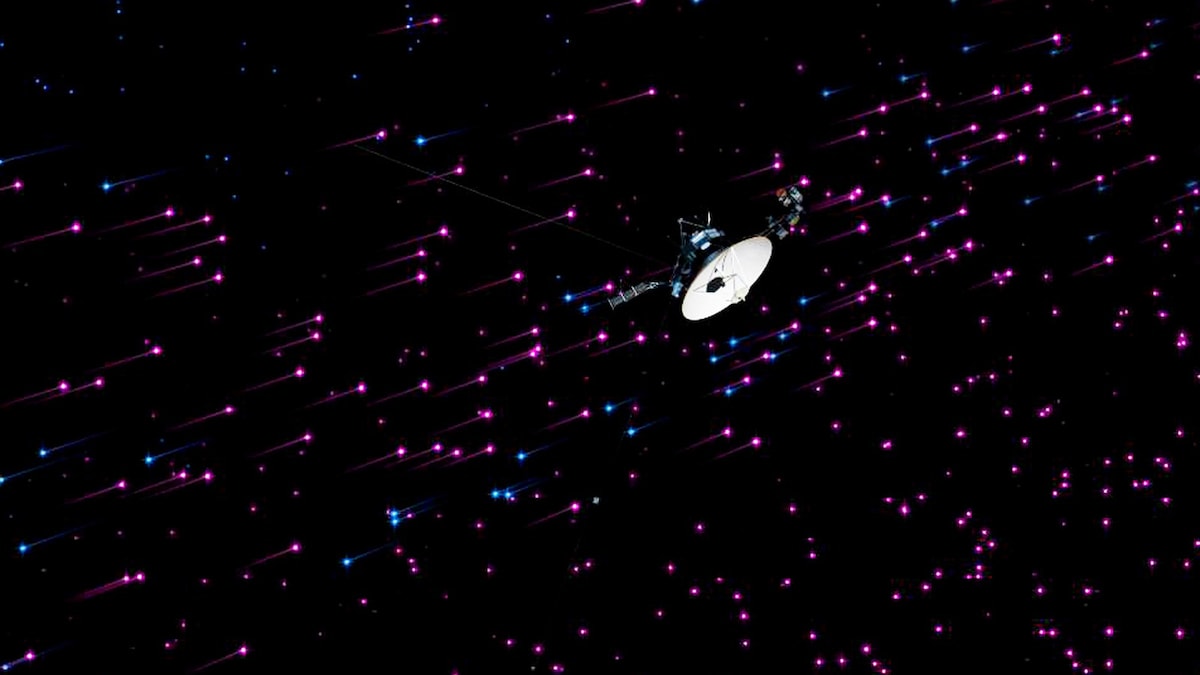
NASA’s Voyager 1 will reach a distance of one light-day from Earth on Wednesday, November 18. Project manager Suzanne Dodd said, "If you want to say 'hello' to Voyager, you send your message and then you go home and you wait two days before you finally get a response."
One light-day: NASA's Voyager 1 is set to become the first human-made object to reach a distance of one light-day from Earth on Wednesday, November 18, 2026. It is expected to be about 16.09 billion miles away at 5:16:07 a.m. EST, or 3:46:07 p.m. IST. The milestone comes nearly 50 years after launch.
Two-day wait: A light-day measures distance, not time: it is how far light travels in 24 hours. Radio signals take roughly a day to reach Voyager 1 and another day to return. Voyager project manager Suzanne Dodd said, "If you want to say 'hello' to Voyager, you send your message and then you go home and you wait two days before you finally get a response."
Mission launch: Voyager 1 lifted off from Cape Canaveral, Florida, on September 5, 1977, aboard a Titan IIIE-Centaur rocket. It was built for close-up studies of Jupiter and Saturn, including their moons and rings. Although Voyager 2 launched first, Voyager 1 followed a faster route, overtook its twin on December 15, 1977, and reached Jupiter ahead of it.
Jupiter finds: Voyager 1 made its closest approach to Jupiter on March 5, 1979. It discovered a faint ring around the planet and two previously unknown moons, Thebe and Metis. It also returned close-up images of Amalthea, Io, Europa, Ganymede and Callisto, giving scientists detailed views of Jupiter's atmosphere and natural satellites.
Saturn discoveries: Voyager 1 passed Saturn on November 12, 1980, and found five previously unknown moons, a ring later named the G-ring, and complex ring structures shaped by smaller 'shepherd moons'. Its images showed Titan had a thick atmosphere made up of about 90% nitrogen, along with methane and other hydrocarbons that could support prebiotic chemical reactions.
Interstellar crossing: Voyager 1's interstellar mission began on January 1, 1990. It crossed the termination shock in December 2004 and entered interstellar space on August 25, 2012. It became the first spacecraft to cross the heliopause, the boundary of the Sun's protective bubble of particles and magnetic fields. Voyager 2 crossed the same boundary in 2018.
Golden message: Voyager 1 also carries a Golden Record, a 12-inch gold-plated copper disc designed as a message to possible extraterrestrial recipients. It contains 115 images, greetings in 55 languages, natural sounds from Earth and around 90 minutes of music. The record also includes messages from then-US President Jimmy Carter and then-UN Secretary-General Kurt Waldheim.
Brief blackout: NASA briefly lost contact with Voyager 1 during scheduled communications checks on October 18 and 19, 2026. The signal returned on October 20, before engineers had sent troubleshooting commands. NASA said one group of thrusters had gone offline and the spacecraft's automatic fault-protection system had switched to backup thrusters. The cause remained under investigation in NASA's October 29 update.
Power-saving steps: Voyager 1 runs on plutonium-powered radioisotope generators, which lose about four watts of output each year. NASA switched off its cosmic-ray subsystem in February 2025 and low-energy charged-particle experiment in April 2026; its magnetometer and plasma-wave instrument remain active. In September 2026, engineers replaced three onboard devices with lower-power alternatives to extend science operations.
Still travelling: Voyager 1 is moving at about 38,000 mph and continues to send data through NASA's Deep Space Network. Reaching one light-day will not alter the spacecraft or its surroundings; it is a milestone defined by distance and communication delay. Voyager 2, travelling on a different route, is expected to reach the same distance in November 2035.