
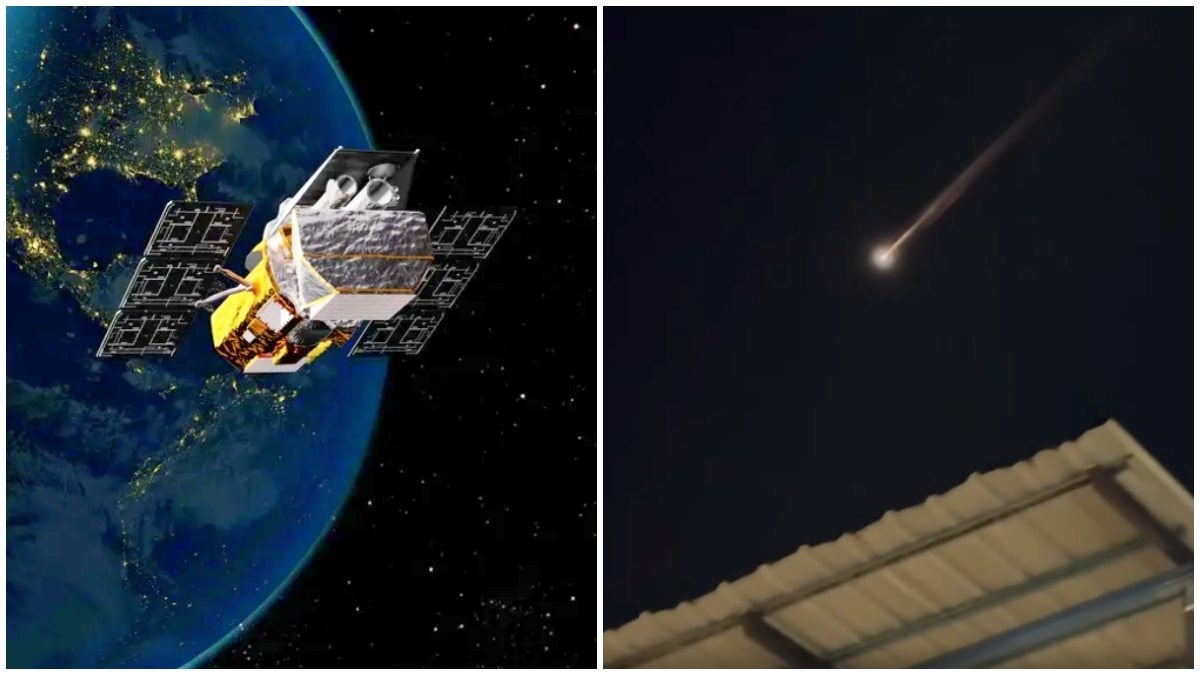
Nasa’s Swift observatory re-entered the atmosphere over Indonesia on Wednesday, November 4, ending a nearly 22-year mission. Residents across Southeast Asia captured videos of debris streaking through the sky as the telescope fell. Nasa confirmed the 1,450-kg spacecraft disintegrated, though some parts may have reached the ground after the descent.
Nasa's Swift observatory re-entered over Indonesia as residents filmed debris streaking across Southeast Asian skies. The descent ended a nearly 22-year mission that transformed observations of gamma-ray bursts.
Nasa's Neil Gehrels Swift Observatory, which spent nearly 22 years studying some of the universe's most powerful explosions, re-entered Earth's atmosphere on Wednesday, November 4, bringing its long-running space mission to an end.
Residents in parts of Southeast Asia captured what appeared to be fragments of the spacecraft streaking across the sky during its descent.
Nasa confirmed that the 1,450-kg space telescope re-entered the atmosphere at approximately 12:39 UTC (6:09 pm IST), over the North Sumatra region of Indonesia. Videos and observations of the falling debris were reported from Mersing and Pulau Tioman in Malaysia, as well as Batam in Indonesia.
The spacecraft is believed to have disintegrated as it plunged through the atmosphere. However, Nasa had cautioned that while most of Swift would burn up during re-entry, some components could survive the intense heat and reach the ground.
The US Space Force had earlier forecast that the telescope would re-enter Earth's atmosphere at around 2 pm IST on November 4.
However, the timing carried an uncertainty of up to 11 hours, reflecting the difficulty of predicting the exact moment when an ageing spacecraft will fall back to Earth.
WHY DID NASA'S SWIFT TELESCOPE CRASH?
Launched in November 2004, Swift was originally designed for a two-year mission to study gamma-ray bursts -- extremely powerful flashes of energy produced by some of the most violent events in the universe.
It went on to operate for almost 22 years, far exceeding its planned lifespan.
During its mission, the observatory studied black holes, exploding stars, comets and other cosmic objects, helping astronomers understand some of the universe's most energetic phenomena.
Swift's return to Earth was driven by atmospheric drag, which gradually slowed the spacecraft and caused it to lose altitude.
Recent solar activity intensified the process by heating Earth's upper atmosphere, causing it to expand and increasing the drag experienced by satellites and spacecraft in low Earth orbit.
The spacecraft's re-entry marks the end of a mission that transformed the study of gamma-ray bursts and delivered nearly two decades of observations of the dynamic universe.