
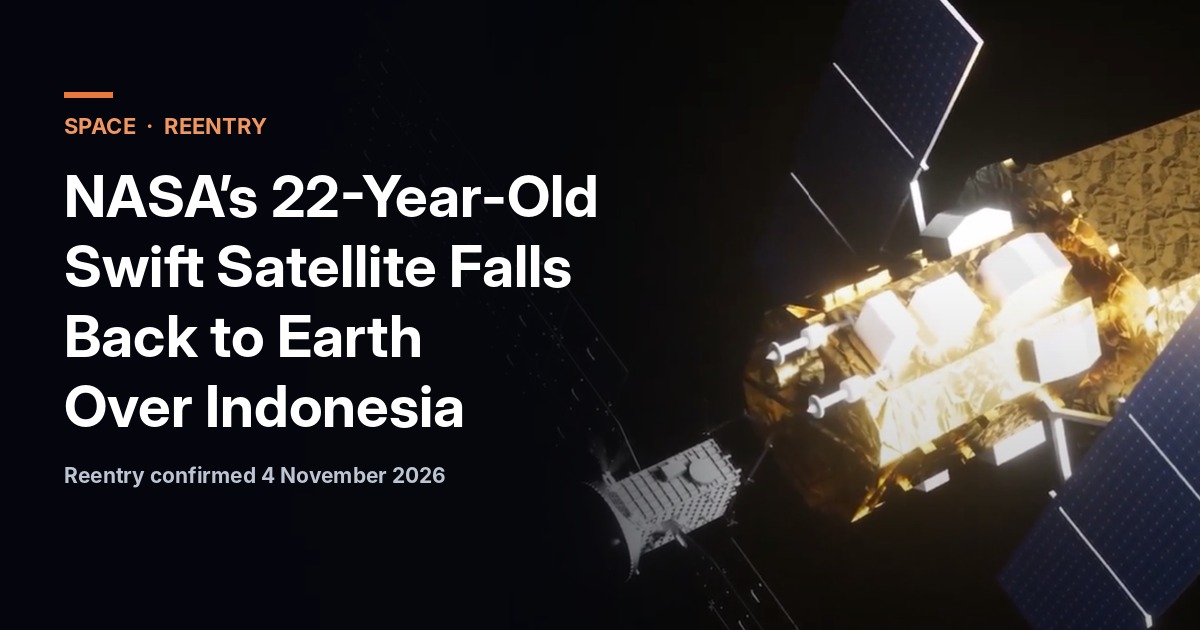
NASA’s rescue mission for the Swift satellite failed after the robot LINK spun out of control. Launched on 3 July 2026, the robot lost power in its wheels and burned too much fuel. NASA and Katalyst said the attempt was a long shot but still worth trying for future missions.
Swift's biggest gift may have been its role as an alarm system. When it saw something flare, it broadcast the position worldwide within seconds, and Hubble, Webb, Chandra and ground observatories followed up. Over time it became a general-purpose observatory for anything that changed fast: comets, flaring stars, novae and active black holes.
NASA's rescue plan was a robot called LINK. It never got close enough to grab Swift, because it started spinning out of control soon after launch.
What LINK was
LINK was a fridge-sized robot spacecraft built by Katalyst Space, a small company in Arizona. NASA paid it US$30 million in September 2025 to build LINK in less than a year. The idea was simple: fly up to Swift, grab it with three robot arms, then use LINK's own engines to push Swift back up to a safe height. No one had ever tried this on a satellite like Swift, which has no handles or hooks to grab.
Launch
LINK was launched on 3 July 2026 by a small rocket dropped from under the wing of an aeroplane.
What went wrong
* To aim itself, LINK used spinning wheels inside it. About a week after launch, one of them lost power.
* Then a small thruster got stuck, and LINK began to tumble, making it hard to talk to from the ground.
* Another wheel lost power. With most of its wheels gone, LINK could not hold itself steady.
* Engineers slowed the tumbling with its engines, but that burned much of its fuel.
* On 19 August, NASA and Katalyst decided LINK no longer had the control or the fuel to grab Swift safely. The rescue was called off.
What happened next
LINK still flew towards Swift to test its equipment. It got within about 12-15 km and photographed the telescope, but never touched it. LINK then fell back to Earth in late September 2026, about six weeks before Swift.
NASA and Katalyst said the attempt was a long shot but still worth trying. Katalyst plans to use what it learned in its next robot.