
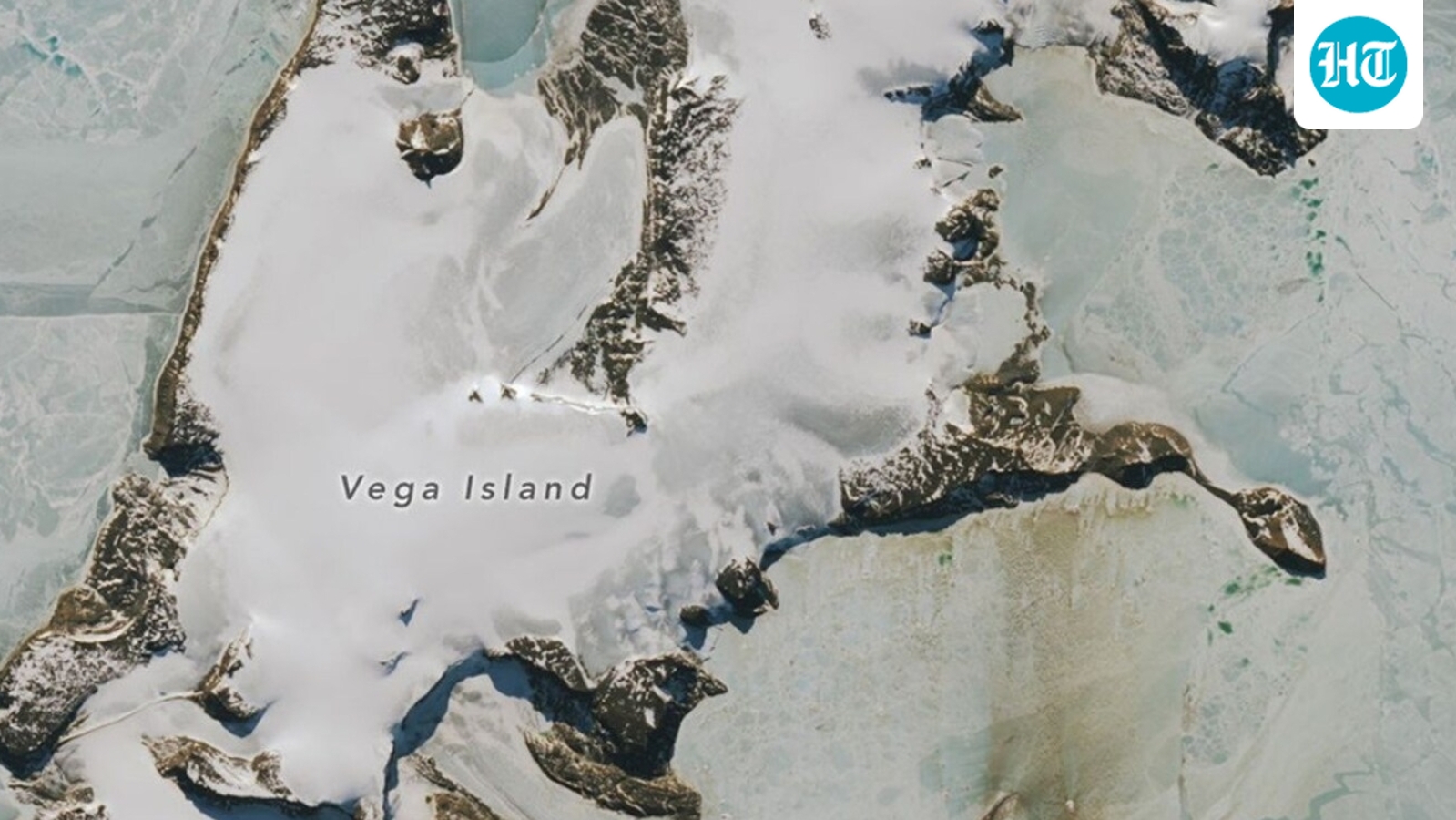
NASA satellite images captured a skull-like formation on Antarctica’s Vega Island. Captured on March 22, 2025, and October 10, 2026, the photos showed exposed glacier ice after a warm winter. Glaciologist Mauri Pelto said, "The winter season was no treat for these glaciers." This melting could change the island's unique appearance.
A remote island in Antarctica has caught the attention of scientists after NASA satellite images revealed an eerie skull-like formation carved into its icy landscape. However, the striking resemblance is not the only unusual feature, as the latest images also show significant areas of exposed glacier ice following an unusually warm winter.
According to a report published by NASA Earth Observatory on October 30, Vega Island, located in the Weddell Sea east of the Antarctic Peninsula, resembles a grinning human skull when viewed from above.
The formation appears to be looking towards nearby Devil Island, with natural geological features creating its distinctive facial appearance.
The images were captured by the Operational Land Imager aboard NASA's Landsat 9 satellite on March 22, 2025, and October 10, 2026.
A rocky peak emerging from the ice resembles an eye socket, while a lateral moraine, a ridge of debris deposited by a glacier, forms the mouth. The Bahía del Diablo Glacier completes the appearance by forming the jawbone.
While the March 2025 image shows the island covered in snow, the October 2026 photograph reveals extensive patches of darker, exposed ice.
Glaciologist Mauri Pelto of Nichols College attributed the exposed ice partly to above-average temperatures during the Antarctic winter, particularly in June 2026.
Limited snowfall, strong winds and sublimation also contributed to the conditions.
"The winter season was no treat for these glaciers," Pelto said.
Scientists warned that darker ice absorbs more solar energy than snow, potentially accelerating melting as temperatures rise during the approaching Antarctic summer.
"Even a thin cover of new snow from a spring storm would be helpful in the short run," Pelto explained.
"When entombed in snow and ice, the skull is preserved. But when exposed to melt, it weathers away, which will lead to a changing jawline and expanding eye socket."
NASA said scientists first comprehensively mapped Vega Island's ice using early Landsat observations, aerial photographs and topographical maps.
A 1982 study identified 29 glaciers across the island, including Devil's Bay Glacier, which researchers have monitored since the 1998-1999 Antarctic summer.
Measurements have documented an overall decline in the glacier's mass, while satellite observations show ice loss and increasingly exposed bedrock elsewhere on the island.
Vega Island also holds historical significance. During the Swedish Antarctic Expedition of 1901-1903, two stranded exploration groups reunited at Cape Well-met before an Argentine expedition rescued the survivors.