
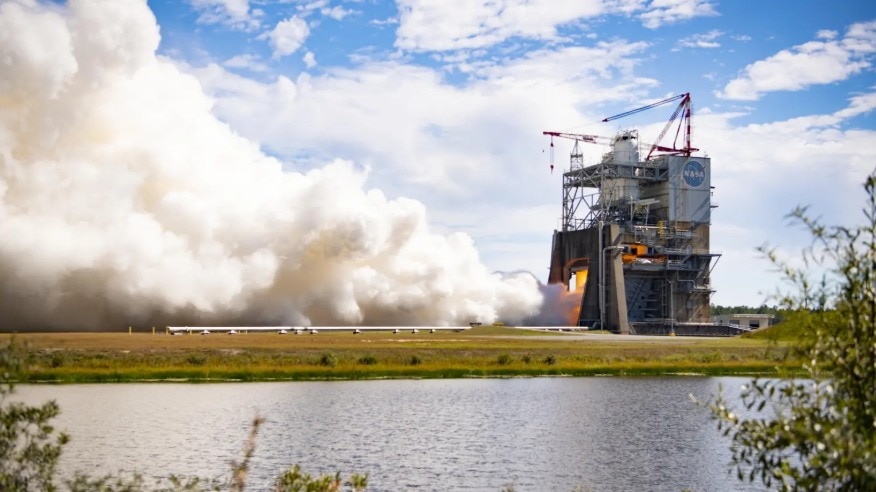
Nasa fired an RS-25 rocket engine at full power on October 21, 2026, at the Stennis Space Center. The engine ran for 500 seconds to test performance for future Artemis missions. Engineers pushed it to 111% power to ensure the rocket can safely carry astronauts toward the Moon one day.
Nasa has fired up one of its powerful RS-25 rocket engines in a major test aimed at preparing future missions to the Moon under its Artemis programme.
The engine was fired for 500 seconds, or about eight-and-a-half minutes, matching the duration it must operate during a launch of the agency’s Space Launch System (SLS) rocket.
The test took place on October 21, 2026, at Nasa’s Stennis Space Center in Mississippi, United States.
Engineers also pushed the developmental engine to 111% of its rated power level, testing the performance required from newly manufactured engines that will help carry astronauts aboard the Orion spacecraft towards the Moon.
According to Nasa, the test was designed to check flight components intended for future Artemis missions and validate a new protective system for the engine nozzle, the part through which hot gases escape to generate thrust.
The developmental engine itself will not fly in space. Instead, the test will provide engineers with data to improve the performance and reliability of engines intended for actual missions.
WHAT IS RS-25 ENGINE AND WHY IS IT IMPORTANT?
The RS-25 is a liquid-fuel rocket engine that burns liquid hydrogen and liquid oxygen to produce the force needed to propel a rocket upwards.
Four such engines are fitted to the core stage of Nasa’s SLS rocket, working together to generate about 9 million newtons of thrust during the rocket’s journey towards orbit.
The engines have a history stretching back to the Space Shuttle programme, but they have been upgraded to meet the demands of the SLS rocket.
The newer engines are designed to operate at higher thrust levels, while changes to their components and manufacturing processes aim to improve performance and reduce production costs.
Every RS-25 engine intended for flight undergoes ground testing at Stennis before it can be cleared for a mission.
PREPARING TO GO TO MOON
Nasa’s Artemis programme aims to return astronauts to the Moon and establish a longer-term human presence there, while building experience for future crewed missions to Mars.
The SLS rocket and Orion spacecraft are central to that effort. SLS provides the power to send the spacecraft beyond Earth, while Orion carries astronauts on their journey.
The latest engine test is part of the work needed to ensure that the rocket’s propulsion system can perform reliably under the extreme conditions of launch.
By testing components and protective systems on the ground before flight, Nasa aims to reduce risks as it prepares for future missions.