
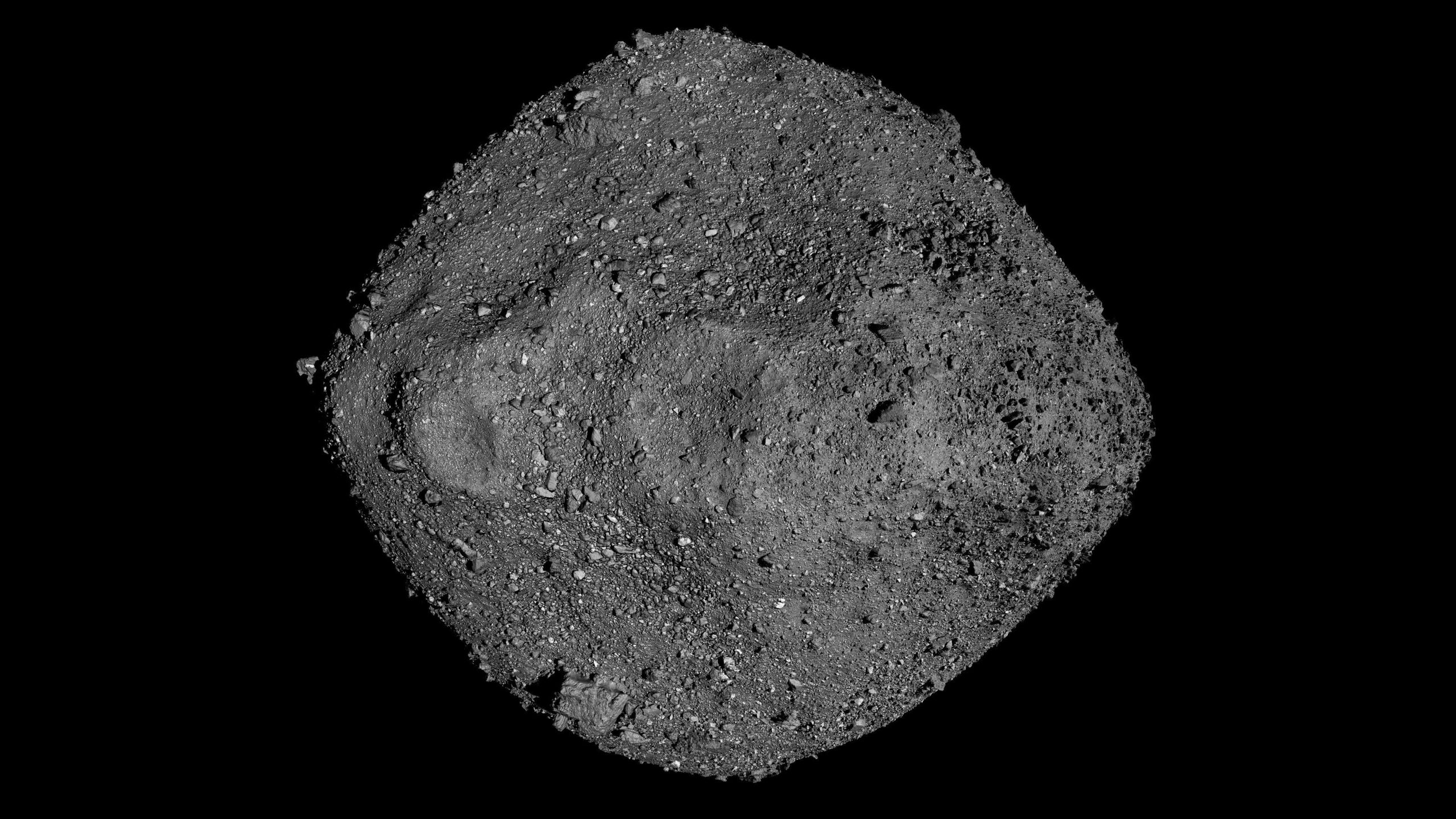
NASA formally concluded the OSIRIS-REx mission on Sept. 30 after successfully delivering asteroid samples to Earth. The spacecraft visited Bennu to collect ancient space rocks. Principal Investigator Dante Lauretta said, "I feel enormous pride in what we accomplished together." This historic project finally ended after a decade of hard work.
On Sept. 30, NASA formally concluded OSIRIS-REx, the historic first U.S. mission to pluck a pristine piece of an asteroid and deliver it safely back to Earth.
The van-sized OSIRIS-REx spacecraft — whose name is short for Origins, Spectral Interpretation, Resource Identification, Security-Regolith Explorer — visited and sampled Bennu, an ancient space rock holding pristine remnants from the dawn of our solar system more than 4.5 billion years ago. Among those cosmic relics are raw organic building blocks, the kind that may have seeded life on Earth.
"I have known this day was coming for a long time, but it is still difficult to see it arrive," OSIRIS-REx Principal Investigator Dante Lauretta, who's based at the University of Arizona, said in a post on LinkedIn. "I feel enormous pride in what we accomplished together, and real sadness that this journey has come to an end."
For the mission team, the farewell capped a decade of high-stakes engineering, on-the-fly troubleshooting and nail-biting close calls that ultimately delivered to Earth the largest asteroid sample ever collected in space, one that held secrets from the early solar system.
Long before launch, the team faced obstacles that nearly thwarted the endeavor — chiefly, two rejections from NASA — before finally securing the green light for the $1 billion project under the New Frontiers Program in 2011.
When OSIRIS-REx launched on Sept. 8, 2016, on a two-year journey across the inner solar system, Bennu was little more than a point of light in telescopes. Scientists expected the asteroid’s surface to be a smooth, sandy sphere where OSIRIS-REx could seamlessly touch down. Much to their surprise, however, when the probe arrived at the asteroid in late 2018, it revealed Bennu to be a treacherous, loosely bound amalgamation of jagged boulders.
"Our expectations about the asteroid's surface were completely wrong," Lauretta said in an Oct. 7 statement from the University of Arizona. "There was no obvious place to collect a sample anywhere."
When OSIRIS-REx touched down on a small crater named Nightingale, Bennu offered so little structural resistance that scientists said its surface reacted more like fluid than a hard, rocky shell. The spacecraft's sampling head sank directly into the asteroid, stopping after burrowing 20 inches (51 centimeters) deep by firing its thrusters at the right time to pull away, with the precious sample in hand.
Then came another nail-biting moment: The sample collector lid got jammed in a partially open position because so much material was scooped up, allowing fragments of the precious cargo to escape. In a race against time to prevent further loss, the mission team quickly stowed the sampler head directly inside the return capsule, securing the cosmic treasure for its journey back to Earth.
Even the final return to Earth, on Sept. 24, 2023, kept the team on edge: A parachute failed to deploy properly during reentry, forcing a tense but ultimately safe landing in the Utah desert.
"Successful exploration missions are not those that avoid surprises; they are those that are deliberately designed to adapt to them," Lauretta said in the statement, quoting a line from the mission's final report to NASA.
"That certainly describes OSIRIS-REx," he said. "Again and again, the mission presented us with circumstances we had not expected, and again and again, this team found a way forward."
The mission's triumphs began long before the samples reached Earth. For example, the probe set a Guinness World Record when it slid into orbit around the 1,610-foot-wide (490 meters) Bennu, which became the smallest object ever circled by a spacecraft.
The scientific payoff that followed included remote-sensing work that confirmed Bennu's surface is coated in carbon-bearing compounds. Those observations also revealed that Bennu was once part of a much larger, water-rich parent asteroid that shattered in a catastrophic collision in the main asteroid belt between Mars and Jupiter.
The returned sample — which weighs 4.29 ounces (121.6 grams) here on Earth, more than twice the mission's requirement — continues to thrill and occupy scientists.
A wave of research papers, now topping 200, continues to piece together the composition and history of the ancient space rock. Among other findings, Bennu's pristine material has revealed amino acids and sugars that, on Earth, are essential for life, alongside a history of exposure to liquid water that could have served as the "broth" for these compounds to interact.
More discoveries are likely to come. Most of the returned Bennu sample is being preserved for future generations of scientists, who will study it "with questions and instruments we cannot yet anticipate," Lauretta said in the statement.