
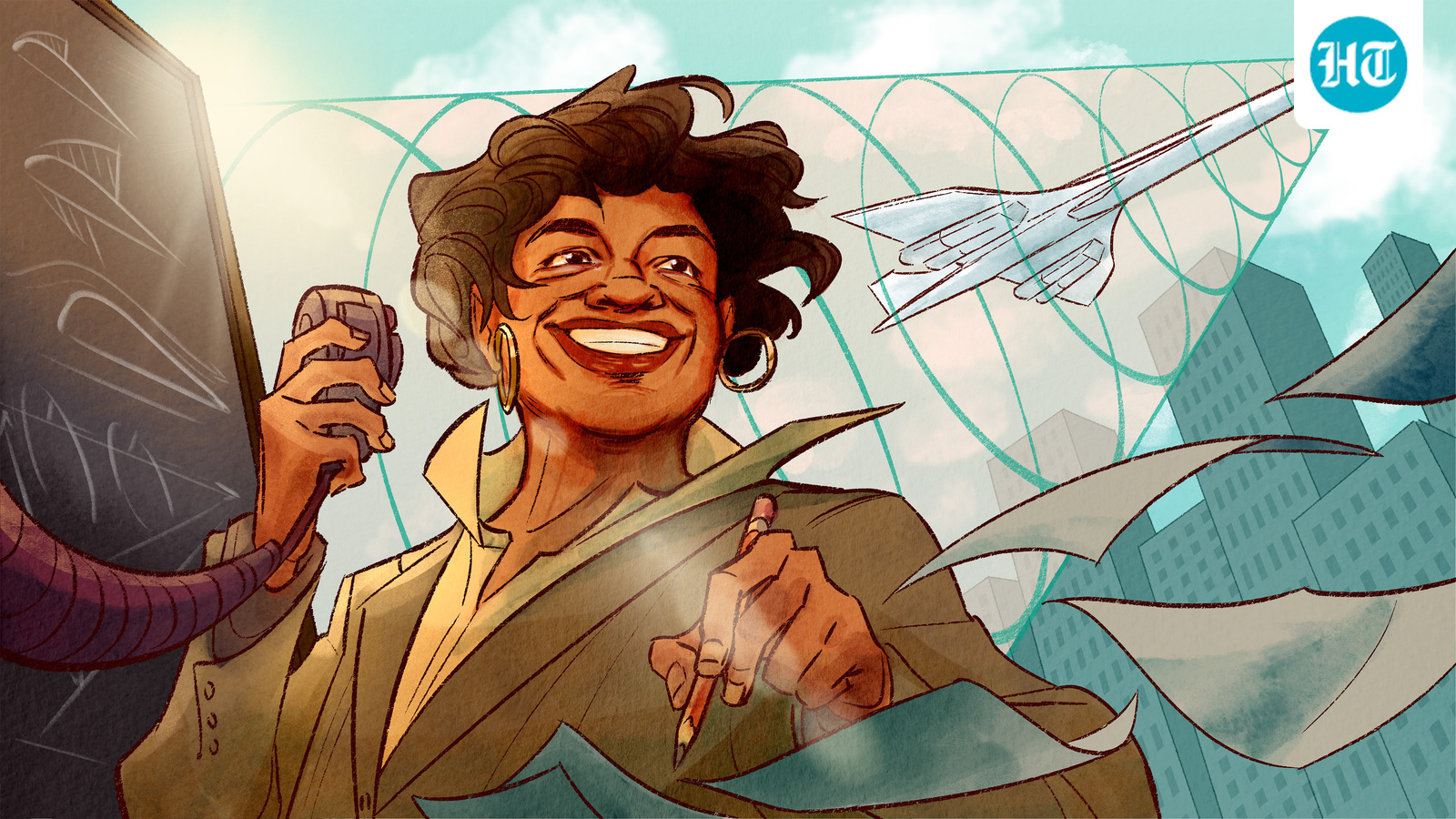
The Matilda Project is highlighting women whose scientific contributions were ignored or credited to men. Started by brothers Shehroze and Shehryar Saharan, the initiative grew from 30 women in 2024 to over 190. They use art to share these stories, showing how bias still affects science careers today for many.
It’s hard, and that isn’t your fault.
As suffragist Matilda Joslyn Gage noted in her essay, Woman as an Inventor (1883), women’s contributions to science and technology have been consistently sidelined, ignored or attributed to a nearby man. (This has happened with art too. Scan the QR code alongside for an overview of stunning “lost” art by women.)
In Gage’s honour, the phenomenon of side-lining women in science came to be called The Matilda Effect. It was Margaret Rossiter, a science historian at Cornell University, who coined the term Matilda Effect, in 1993.
Now, an online initiative called The Matilda Project is bringing lost stories of such women into the spotlight. And these stories are breath-taking for the scale of work they did, and the ways in which they were forced out of the spotlight.
The Matilda Project is run by Canadian brothers Shehroze Saharan, 27, and Shehryar Saharan, 29, and the idea for it dates to a high-school science class.
“We were learning about the discovery of DNA’s double-helix structure and James Watson, Francis Crick, and Maurice Wilkins, when my teacher pointed out that someone was missing from the book: Rosalind Franklin,” says Shehroze Saharan. Her work in X-ray diffraction had been instrumental in understanding DNA’s structure, yet her contribution hadn’t received the same recognition.
“I remember being quite surprised. Until then, I’d taken what was in my science textbooks at face value,” he says.
He went on to study biomedical science at University of Guelph and, in his fourth year, picked women unacknowledged in science as his digital humanities project. His brother joined him soon after, and their original list of 30 women in 2024 has now grown to over 190.
They work with illustrators to bring the stories to life. Where possible, interview their subjects too.
What bothers them most perhaps, Saharan says, is that the biases live on.
A study by researchers at Yale University, published in the Proceedings of the National Academy of Sciences (PNAS) in 2012, for instance, found that when senior science faculty were given identical candidate portfolios, with just the names were changed to suggest either a man or a woman, over and over the man was found to be “better suited” to the role.
This bias affects admissions, funding, appointments and tenure, all of which continue to serve as barriers of entry.
Their website cannot change this, but getting word out is a good start, Saharan says.
Here are some of the incredible stories they’ve documented.