
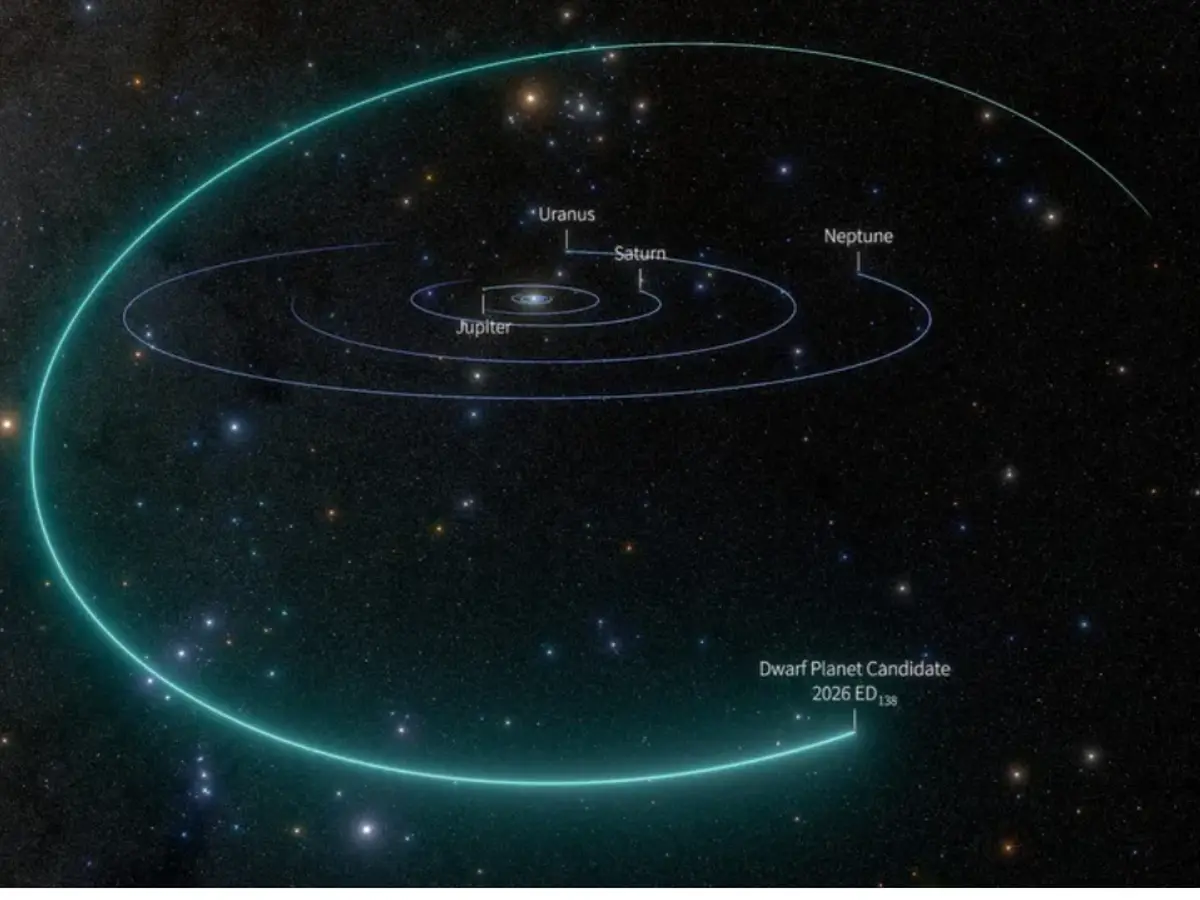
The Vera Rubin Observatory spotted a mysterious object named 2026 ED138 beyond Neptune. Matthew Holman discovered it on October 13. If confirmed, it will be the sixth dwarf planet in our solar system. Holman said, "Objects like this are very rare, so I immediately started checking whether I had done wrong."
A possible dwarf planet likely resides beyond Neptune, according to data from the Vera Rubin Observatory (VRO). Scientists say it lives in the same region as other dwarf planets. Only five confirmed dwarf planets have been identified in the solar system till now.
The Vera Rubin Observatory (VRO) has spotted a mysterious object beyond Neptune, in a region where known dwarf planets reside. This object could be a dwarf planet as well, based on initial observations. Named 2026 ED138, it is between 600 and 1500 kilometres wide. This suggests that it was capable of coming together because of its own gravity.
Till now, only five dwarf planets have been identified - Pluto, Ceres, Eris, Haumea and Makemake. If 2026 ED138 is confirmed as a dwarf planet, that would be a major discovery for astronomers. Matthew Holman, from the Center for Astrophysics | Harvard & Smithsonian (CfA), discovered this object on October 13.
Holman had developed a search code with his CfA colleague Kevin Napier and was running previous data from Rubin through it. This is when he found a strange object beyond Neptune's orbit. This is an icy and dark region in the solar system, but despite this, the object was quite bright. This meant that it was larger than other bodies in the region.
Holman said in a statement on Tuesday, "Objects like this are very rare, so I immediately started checking whether I or the code had done something wrong." To confirm that what he was looking at was real, he went through Vera's entire catalogue, which despite being relatively new, contains quite a lot of data.