
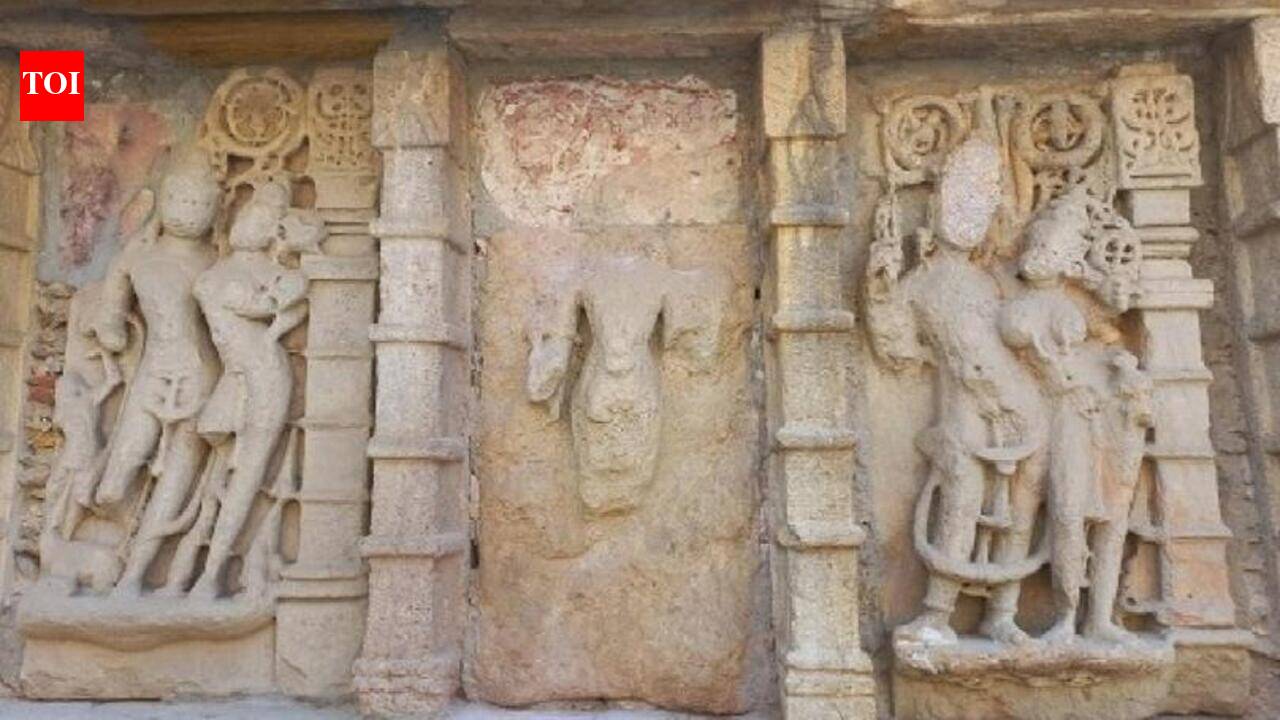
A new study reveals that microbial growth is damaging the sandstone at the 11th-century Rani-ki-Vav stepwell. Researchers found that bacteria form biofilms that trap moisture and dissolve stone minerals. "Our study shows that the deterioration is influenced by complex biochemical interactions," said researcher Rachana Priyadarshi, urging better preservation strategies.
Ahmedabad: Patan's 11th-century stepwell Rani-ki-Vav, celebrated for its densely carved panels of deities, celestial figures and mythic scenes, has endured for nearly a millennium and has been on Unesco's World Heritage list since 2014. Now, a new study flags a quieter risk to the monument's sandstone -- microbial growth and the chemical processes that accompany it -- that may progress without obvious visual cues.The paper, 'Bacterial degradation of sandstone at the Unesco World Heritage Site Rani-ki-Vav, India: A multi-analytical diagnostic study,' by Rachana Priyadarshi, Gautam Priyadarshi, Rajat Patel, Subhash Bhandari, Shubha Majumdar, Snehal Bagthariya and Ashish Patel, has been published in Elsevier's Journal of Cultural Heritage.Researchers combined microbiology with mineral and chemical analysis to identify bacterial communities and compounds potentially involved in stone deterioration. Samples were collected from 12 locations linked to erosion on surfaces and sculptures, including microbial colonies, biofilms and moist sediments. The team used X-ray-based methods along with chromatography and spectroscopy to detect metabolites associated with microbial activity.
The dominant bacterial groups reported were firmicutes (61.5%), Bacteroidetes (18.5%), proteobacteria (18%) and actinobacteria (1.4%), among others. The study notes that some bacteria are associated with sticky biological matrices that enable microorganisms to adhere to stone and form biofilms. "These biofilms help retain moisture and trap chemical compounds close to surface, creating small environments. Chemical profiling also identified acids that can contribute to mineral weathering by dissolving calcite. Metabolites - a byproduct of the metabolism process - increase porosity of the sandstone, whereas some compounds may alter the way how water is seeped in the structures," said a researcher.The work was conducted as part of Rachana Priyadarshi's master's dissertation at the Department of Archaeology, Krantiguru Shyamji Krishna Verma Kachchh University, Bhuj. Other participating institutions included the Department of Life Sciences, Hemchandracharya North Gujarat University, Patan; Gujarat Biotechnology Research Centre (GBRC), Gandhinagar; and the Archaeological Survey of India (ASI), Vadodara Circle.Priyadarshi described the research as a baseline for assessing the monument's condition and argued for expanding conservation toolkits beyond surface-level inspection. "Our study shows that the deterioration of Rani-ki-Vav is influenced not only by environmental factors but also by complex biochemical interactions occurring on the stone surface. The findings can help conservation agencies develop more informed monitoring and preservation strategies for this globally important heritage monument," she said.Experts cited in the study's forward-looking recommendations emphasize long-term monitoring across seasons, particularly before and after the monsoon, to track fungal, algal and other microbial communities. The findings also point toward conservation approaches aimed at limiting moisture retention, mineral dissolution and salt redistribution linked to microbial activity, framing stone decay as more than a function of age, weathering or physical damage.
The paper situates its results within a growing body of bio-deterioration research in India. A recent study at the 7th-century Parsurameswara stone monument in Odisha used metagenomic analysis to investigate microbes and reported compounds associated with bio-corrosion. Similar work at sites in Bhubaneshwar and at the Sun Temple, Konark, has documented cyanobacterial biofilms and microbial adaptation to harsh weather, echoing global findings on chemistry-driven mineral erosion. Researchers underline the need for India-specific evidence on how microorganisms respond to local climate, surface temperature, water retention and mineral composition, and how those factors interact with conservation interventions.