
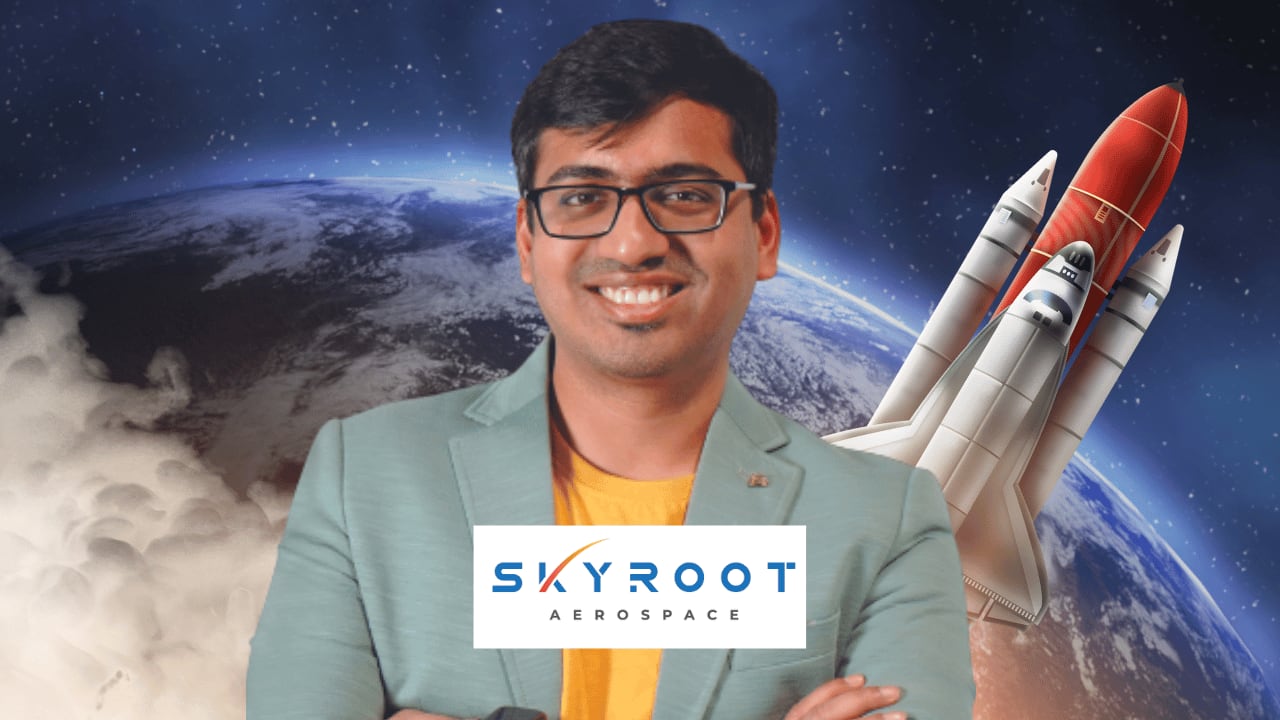
Pawan Kumar Chandana quit his job at ISRO to build the space startup Skyroot Aerospace. After leaving in 2018, he helped the company reach a major milestone on July 18, 2026. Skyroot successfully placed satellites into orbit, showing that private Indian firms can lead in the global space industry today.
Meet Pawan Kumar Chandana, the former ISRO rocket engineer who left a secure career in India's premier space agency to pursue a seemingly audacious dream: building rockets through a private Indian company. Today, that decision has helped put India's private space industry on the global map. Chandana, the co-founder and CEO of Hyderabad-based Skyroot Aerospace, has been recognised in TIME's inaugural TIME100 Next India list, which celebrates 100 emerging leaders shaping the country's future. At 35, Chandana's journey is particularly inspiring for young professionals and engineers who dream of building something beyond the conventional boundaries of their careers.
From ISRO engineer to startup founder Chandana spent six years at the Indian Space Research Organisation (ISRO), working as a rocket engineer between 2012 and 2018. During this period, he contributed to the development of India's GSLV Mk-III launch vehicle and the Small Satellite Launch Vehicle. His experience gave him an understanding of the complexities involved in rocket engineering and India's space programme. However, he wanted to take that experience in a different direction. In 2018, Chandana decided to leave ISRO and co-founded Skyroot Aerospace with his former colleague Naga Bharath Daka.
The decision came at a time when India's private space industry was still in its early stages. Building rockets was largely associated with government institutions, and the idea of an Indian startup developing its own launch vehicles was an ambitious proposition. But Chandana and his co-founder believed that private companies could play a much bigger role in India's space ambitions. Building a rocket company from the ground up Skyroot's journey was not about simply creating another technology startup. It was about developing the capabilities to design, manufacture and launch rockets. The company's first major milestone came in November 2022, when its Vikram-S rocket completed a suborbital flight under Mission Prarambh.
It made Skyroot the first private Indian company to launch a rocket into space. The bigger breakthrough came on July 18, 2026. Skyroot's Vikram-1 rocket successfully placed satellites into low-Earth orbit, marking the first time an Indian private company had launched a payload into orbit using its own privately developed and owned rocket. The 72-foot-tall rocket carried several small satellites, completing a mission that marked a significant milestone for India's commercial space sector. For Chandana, it was the culmination of years of engineering, experimentation and determination. From a startup to a $1.1 billion company Skyroot's progress has also attracted significant investor interest.
The company reached a valuation of approximately $1.1 billion in 2026, becoming India's first space-tech startup to achieve unicorn status. It now employs around 1,000 people. Its Vikram-1 rocket is designed to carry small satellites into low-Earth orbit, offering customers dedicated launch services rather than having to share space on larger rockets. The company is also looking beyond its first orbital launch. Skyroot plans to develop more powerful rockets, including Vikram-2, which is expected to have around two-and-a-half times the payload capacity of Vikram-1. Its longer-term ambitions include developing reusable launch vehicles, expanding satellite launch capabilities and potentially supporting human spaceflight.
His vision goes beyond building rockets For Chandana, the ambition is not limited to making Skyroot a successful company. He sees private space companies as important contributors to India's long-term technological capabilities. India's private space ecosystem has expanded significantly in recent years. According to TIME, the country had more than 440 space startups by the first half of 2026, compared with just one registered space startup in 2014. Skyroot is among the companies helping drive this transformation. Chandana also believes that the future of space exploration could extend to areas such as satellite constellations, orbital data centres and eventually human spaceflight.
One of his personal ambitions is to travel to space aboard a rocket built by his own company.