
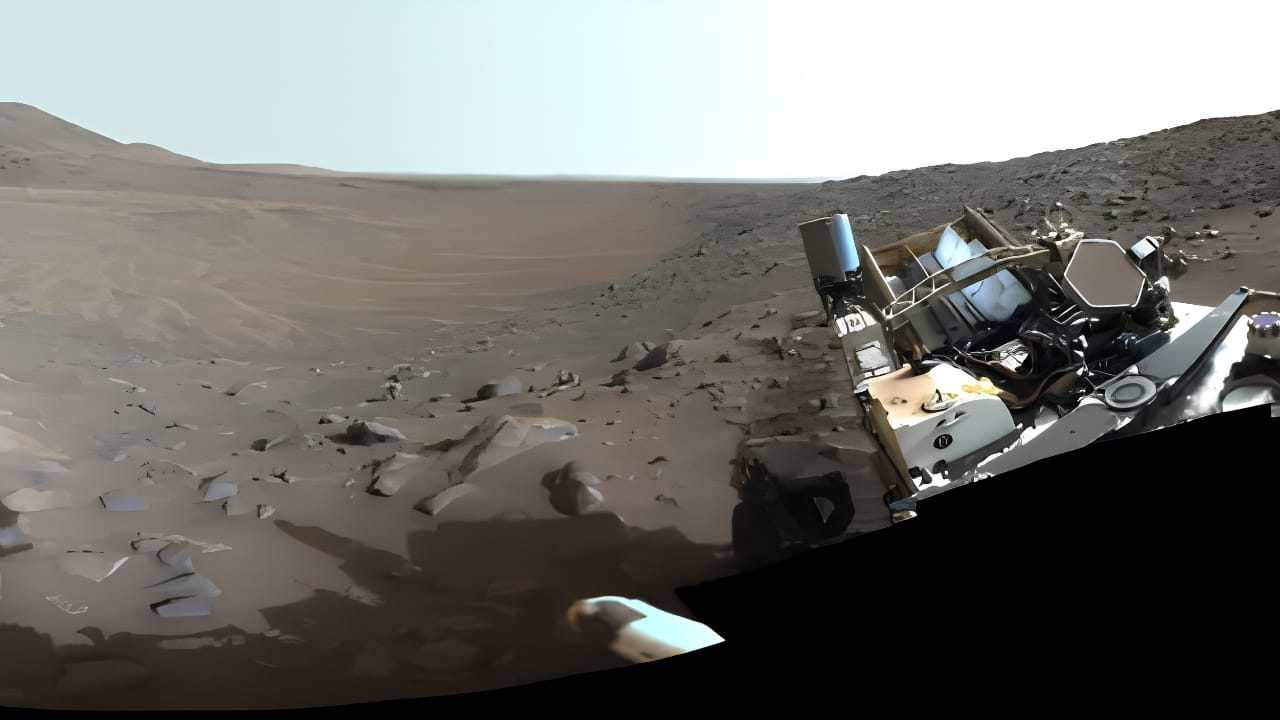
NASA’s Perseverance rover detected ultrafine dust particles on Mars that could threaten future astronauts. Over 1,645 Martian days, the rover found particles 700 times thinner than human hair. These tiny specks might enter lungs or travel to the brain. NASA now plans to use these findings to improve spacesuit materials.
NASA's Jet Propulsion Laboratory (JPL) has reported a new finding from the Perseverance rover that could affect plans for future human missions to Mars. The rover detected ultrafine dust particles measuring around 100 nanometres, raising concerns about how Martian dust could affect astronauts' health. Some particles are small enough to penetrate deep into the lungs, while research on Earth suggests that ultrafine particles can travel from the nasal cavity towards the brain. What did NASA's Perseverance Rover discover on Mars? NASA's Perseverance measured fine and ultrafine Martian dust particles that accumulated on samples of spacesuit materials carried aboard the rover. The observations covered 1,645 Martian days. Earlier measurements could resolve dust particles down to approximately 3 micrometres. The latest analysis detected particles smaller than 2.5 micrometres, along with ultrafine particles around 100 nanometres. A human hair is approximately 70 micrometres wide. The smallest particles detected are therefore about 700 times thinner than a human hair. NASA JPL measured the Martian Dust! Scientists used the rover's PIXL instrument, which analyses the chemical composition of materials using X-rays. Researchers examined dust accumulated on calibration targets containing Teflon and basaltic glass. They also studied Teflon and Vectran samples used in spacesuit materials. The findings showed that different surfaces attracted different particle sizes, with static electricity appearing to influence how dust adhered to them. Result: Martian dust could be dangerous for Astronauts! Fine particles on Earth are associated with health risks because they can penetrate deep into the lungs and enter the bloodstream. Studies have also shown that ultrafine particles can travel from the nasal cavity towards the brain along the olfactory nerve. Martian dust contains silicate minerals and chemically reactive compounds. These include perchlorates, which can disrupt thyroid function, and reactive iron compounds that can damage cells. However, the study did not establish that Martian dust causes brain damage in humans. The actual health risks will depend on exposure levels and duration. "Proceed with caution": NASA's future Motto The measurements could help engineers select spacesuit materials and protective coatings that collect less dust. NASA is also considering suitports and dual-chamber airlocks to prevent contaminated suits from bringing dust into habitats. The findings could eventually inform astronaut health standards and procedures for removing dust during surface operations. Does this finding change everything we know about Mars? The research provides direct measurements of fine and ultrafine dust under Martian surface conditions. It gives scientists valuable information to prepare for the challenges of human exploration. As NASA plans future crewed missions, understanding how Martian dust behaves could prove essential for protecting astronauts during extended stays on the Red Planet.