
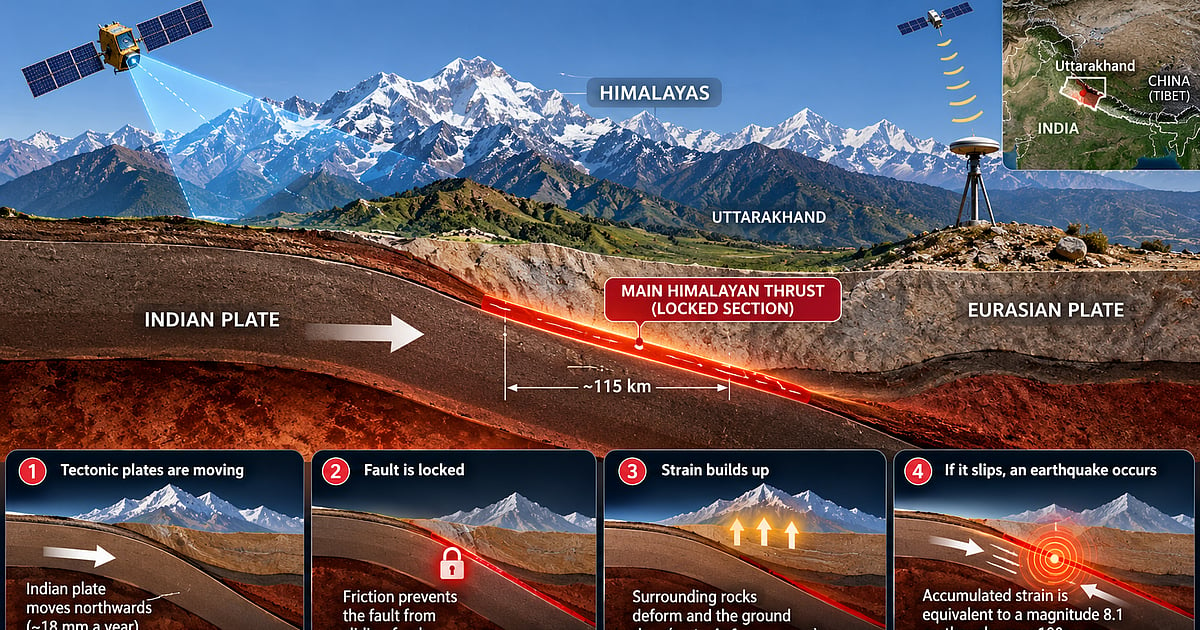
A 115-km-wide section of the Main Himalayan Thrust remains locked beneath Uttarakhand, raising major earthquake risks. A study presented at the 2026 EGU General Assembly showed the fault accumulates strain at 18 mm yearly. Researchers said, "The Indian plate's continuing movement is not being accommodated through steady sliding across this portion."
Satellite and ground-positioning data indicate that a 115-km-wide section of the Main Himalayan Thrust remains locked, raising concerns about long-term earthquake hazards in the central Himalayas
A section of the tectonic plate named Main Himalayan Thrust beneath Uttarakhand is accumulating tectonic strain at a rate that researchers estimate could produce energy equivalent to a magnitude 8.1 earthquake over a century, according to a study presented at the European Geosciences Union (EGU) General Assembly 2026.
Titled Evidence of strong plate coupling in the Uttarakhand Himalayas: Constraints from GNSS and ALOS-2 InSAR observations , the study was conducted by Dibyashakti Panda, Mridul Yadav, Eric O. Lindsey and G Srinivasa Rao. The researchers used ground-based satellite positioning measurements and radar imagery to investigate how the fault behaves as the Indian plate continues to move beneath the Himalayas.
The findings are significant because scientists have differed over how firmly the Main Himalayan Thrust (MHT) is locked beneath Uttarakhand. The degree of locking helps determine how much tectonic movement is being stored as strain in the Earth's crust rather than being released gradually through movement along the fault.
The researchers found that the fault remains locked across a width of approximately 115 km. Their measurements indicate a slip deficit of around 18 millimetres a year, while satellite radar observations show peak ground uplift of 4-6 mm annually.
The findings point to a strongly coupled section of the fault, suggesting that the Indian plate's continuing movement is not being accommodated through steady sliding across this portion of the megathrust. Instead, the surrounding rocks are deforming as tectonic pressure accumulates.
What are the study's major findings?
1. A 115-km-wide locked section of the fault
The researchers found that the Main Himalayan Thrust beneath Uttarakhand is strongly locked across a width of about 115 km. A locked fault section is one where friction prevents the opposing sides from sliding freely, even as tectonic forces continue to push them against each other. The resulting deformation can store elastic strain that may be released during an earthquake.
2. A slip deficit of 18 mm a year
The study estimates a slip deficit of approximately 18 mm annually. In simple terms, this is the movement that would be expected from the continuing convergence of the tectonic plates but is not being accommodated through sliding along the locked section of the fault.
.Nepal disaster shows why Himalayas need multi-hazard risk assessment: GSI expert. This does not mean the ground is visibly moving by 18 mm every year at every location. Rather, it is an estimate of the difference between the expected tectonic movement and the movement accommodated along the fault. Over time, that difference contributes to strain accumulation.
3. The ground is rising by up to 4-6 mm annually
Radar observations from Japan's ALOS-2 satellite detected peak vertical ground movement of 4-6 mm a year in the study area. Such changes are small at the surface but provide scientists with evidence of deformation occurring across a much larger geological structure.
The researchers combined these observations with data from the Global Navigation Satellite System (GNSS), which measures ground movement using satellite positioning. The two datasets provide complementary information about horizontal and vertical deformation.
4. The estimated strain is equivalent to a magnitude 8.1 earthquake
Based on their measurements and modelling, the researchers estimate that the accumulated strain energy along the studied section of the megathrust is equivalent to that released by a magnitude 8.1 earthquake over a 100-year period.
This is an estimate of the rate of strain accumulation, not a prediction that an earthquake of that magnitude will occur every 100 years. Nor does it establish a deadline for the next major earthquake. The timing, location and extent of a future rupture cannot be inferred from this estimate alone.
How does a locked Himalayan fault accumulate strain?
The Indian plate continues to move northwards beneath the Eurasian plate, driving the formation and uplift of the Himalayas. Along the Main Himalayan Thrust, friction can keep sections of the fault stuck while the plates continue to converge.
As movement continues, rocks surrounding the locked section bend and deform. This process stores elastic strain. If the fault eventually slips suddenly, some of the accumulated strain is released as seismic energy, generating an earthquake.
.Water security at risk as Himalayas face 'snow drought' . Not all accumulated strain necessarily produces one earthquake of a particular magnitude. The eventual outcome depends on how much of the fault ruptures, how the rupture propagates and how the fault's different sections interact.
The researchers used an Elastic Subducting Plate Model (ESPM) to interpret the observed deformation. They said this approach could explain both horizontal and vertical ground movements while avoiding artefacts associated with some conventional fault-dislocation models.
Why does this matter for Uttarakhand and northern India?
Uttarakhand lies within the Central Himalayan Seismic Gap, a region of the Himalayan arc that has long been scrutinised because parts of the megathrust have not ruptured in major earthquakes for more than 200 years.
The study adds evidence that the fault beneath Uttarakhand is strongly coupled and continues to accumulate strain. This has implications for seismic hazard assessments across the Himalayan region and the adjoining Indo-Gangetic plains, which contain large population centres and extensive infrastructure.
However, the findings do not establish that an earthquake is imminent. The absence of a major rupture over a long period does not, by itself, determine when the next one will occur. Earthquake risk also depends on local ground conditions, building vulnerability, population exposure and preparedness.
The study therefore provides a clearer picture of how strain is accumulating along a major Himalayan fault, while leaving the timing and scale of any future rupture uncertain.