
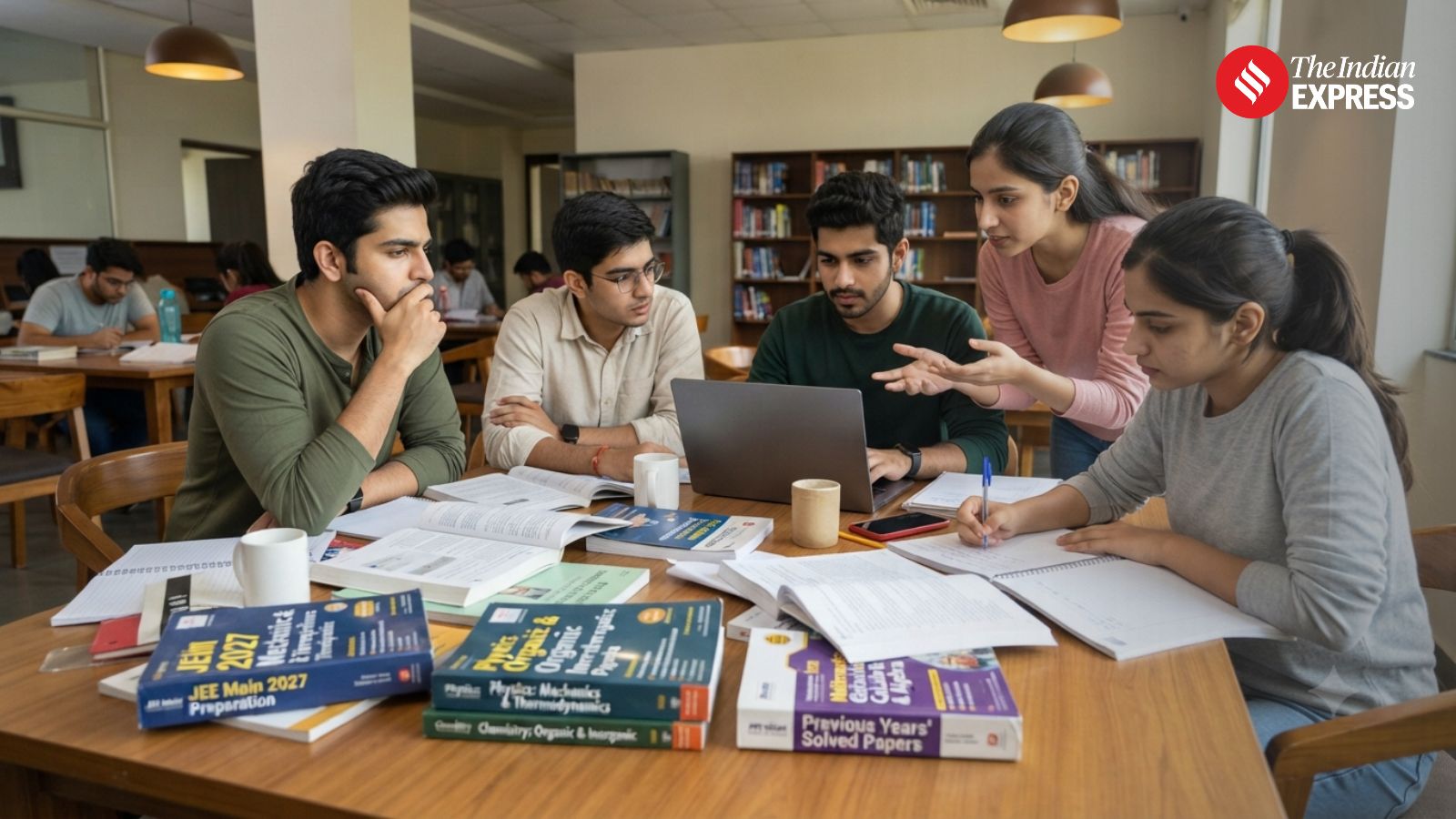
JEE Main 2027 preparation requires a structured strategy to master Physics, Chemistry, and Mathematics. Students should focus on building strong conceptual foundations through regular practice and timely revision. By dividing the syllabus into manageable sections, candidates can effectively track their progress, improve problem-solving skills, and answer questions accurately during exams.
A structured preparation strategy for JEE Main 2027 involves building strong conceptual foundations in Physics, Chemistry and Mathematics. Students should focus on subject-wise preparation, regular practice, timely revision and effective time management to strengthen their problem-solving skills.
Preparing for JEE Main 2027 requires more than completing the syllabus or putting in long hours of study. Students need a structured preparation strategy that helps them understand concepts, improve problem-solving skills and answer questions accurately within the stipulated time. Since Physics, Chemistry and Mathematics each demand a different approach, following a subject-wise study plan can make preparation more effective. Regular practice, revision and mock tests can also help students identify their strengths, work on weaker areas and track their progress.
A good starting point is to understand the JEE Main syllabus and identify the topics that need greater attention. Students can divide the syllabus into manageable sections and classify chapters according to their difficulty level and familiarity with the concepts. Rather than concentrating only on topics they find comfortable, they should maintain a balance between strengthening weaker areas and revising chapters they have already covered.
Physics: focus on conceptual understanding and application
Physics is a subject that entails application of thought. It involves knowledge of concepts along with mathematics and skills of solving problems. Students must first know the basics of all the chapters, and they should not be rote learners of the formulas without realising how to use them. There are domains such as Mechanics, Electrodynamics, Modern Physics, Optics, Thermodynamics that require continuous practice as the questions often require students to apply their knowledge of several concepts at one go while solving problems.
NCERT textbooks are beneficial in building the basic understanding of the important topics but going through standard reference materials and last years' JEE Main questions help in understanding various types of questions asked in exams. Students should maintain a separate notebook for formulas and revise them periodically. More importantly, they should know the conditions under which a particular formula can be used. Solving numerical problems with the time constraint helps develop speed and accuracy in calculations. It is also significant to analyse wrong answers, as it helps determine whether the errors happened due to lapses in conceptual understanding, calculation mistakes or misinterpretation of the question.
Chemistry: combine conceptual learning with frequent revision
Chemistry is widely regarded as a high-scoring subject.However, it has three components, namely Physical Chemistry, Organic Chemistry and Inorganic Chemistry, which need different treatment. Thus, Physical Chemistry deals with numerical problems and requires understanding formulas, making relevant calculations, and focusing on interconnections between various concepts. To be successful at topics such as Chemical Equilibrium, Electrochemistry, Chemical Kinetics, and Thermodynamics, it is important to practice them regularly.
Organic Chemistry emphasises an understanding of the mechanism of reactions rather than memorising separate reactions. Students must have a good grasp of General Organic Chemistry, reaction intermediates and the effect of different substances before moving forward.
Inorganic chemistry demands consistent practice as well as understanding and remembering facts and trends in chemical properties. NCERT should form the basis of preparation for this part of the syllabus. In order to speed up the revision process, students can make short notes, tables and comparison charts of the information that is necessary for them to remember. Since the subject of chemistry involves memorisation and application, constant revision is essential for the students not to forget their knowledge.
Mathematics: emphasise regular practice and work on solving speed
In Mathematics, one must practice extensively, as understanding the concept does not mean the student can solve the problems easily. Students must first make sure they understand the core topics of the subject, like algebra, calculus, coordinate geometry, trigonometry and vectors. Instead of trying to solve complicated problems, they can start solving easy problems first and then move on to solving more difficult ones involving various topics.
Calculus and Algebra generally require a good amount of practice as students are faced with problems requiring long calculations and many steps. It is important for students to work out a smart approach to their problems, rather than work out solutions that take too long. Practicing past years exams can help students to understand their pattern and recognise main concepts that are repeated in exams. Keeping an error notebook containing incorrectly solved exercises, missed formulas and errors during calculations will make their revision process more successful.
A well-formed plan for studying cannot be effective without a proper daily timetable. It is necessary to organise hours of studying according to the student's personal level of student's knowledge rather than dividing the total amount of hours for study equally. One should include conceptual learning, practice questions and revision in the study plan throughout the week. Regular testing will help students learn about their own weaknesses and control their emotions during the examination.
Students should spend some time after each test analysing their own results. They should focus on the topics they could not master and on the questions that took too long to answer. Comparing personal progress with that of other students is not a good idea either.
The preparation for JEE Main 2027 should be focused on consistency, rather than last-minute intensity. It takes time to develop robust concepts in physics and employ a comprehensive review strategy for chemistry as well as consistent practice of problem-solving for mathematics. It is also important to set achievable goals, prepare in an organised way, and continuously monitor your performance.