
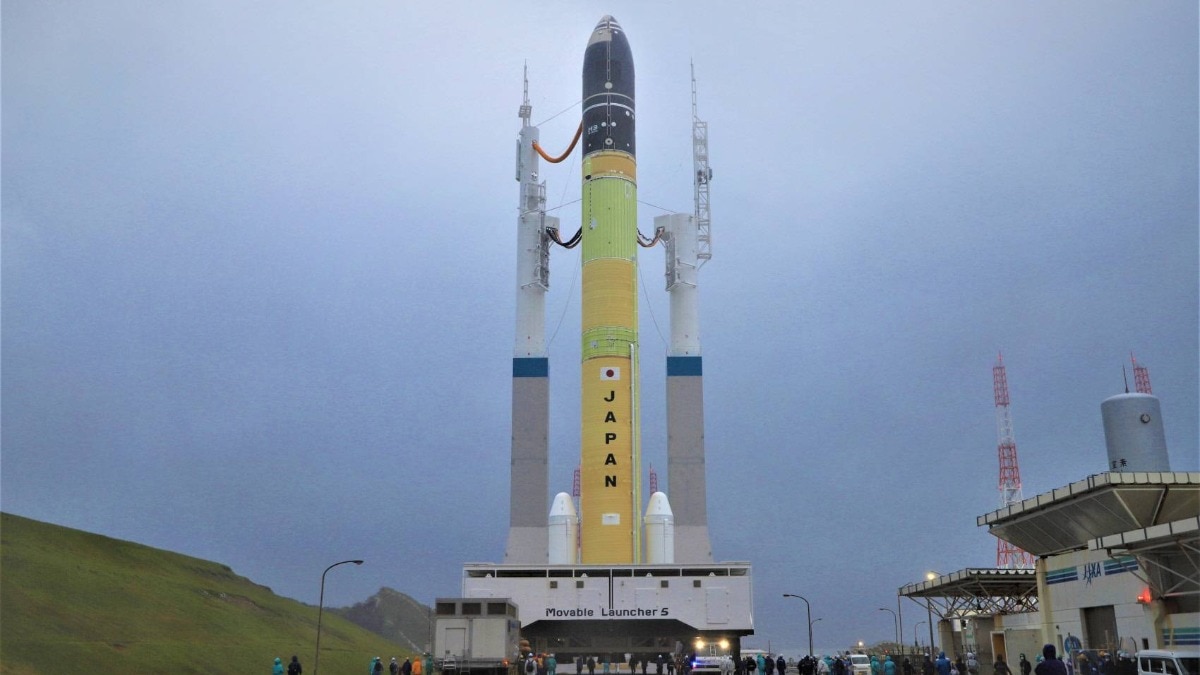
Japan will launch its Martian Moons eXploration mission on October 20 using the H3 rocket. The spacecraft will travel to Mars to study Phobos and Deimos, aiming to bring samples back to Earth in 2031. This flight is a big test for the H3 rocket after its earlier development setbacks.
Japan is preparing to send a spacecraft on a five-year journey to Mars' mysterious moons, and the rocket carrying it will be making a crucial flight of its own.
The Japan Aerospace Exploration Agency (Jaxa) is scheduled to launch its Martian Moons eXploration (MMX) mission aboard the H3 rocket on October 20, with liftoff planned for 1:11 am IST from the Tanegashima Space Centre in Japan.
The mission, which has contributions from Nasa and other international partners, aims to study Phobos and Deimos, Mars' two small moons, and bring samples from Phobos back to Earth in 2031.
WHAT IS JAPAN'S H3 ROCKET?
The H3 is Japan's next-generation flagship rocket, developed jointly by Jaxa and Mitsubishi Heavy Industries.
It is designed to replace the country's older H-IIA rocket and make satellite launches more affordable and flexible.
Standing up to 63 metres tall, depending on its configuration, the H3 can be fitted with different numbers of engines and solid rocket boosters to suit different missions.
Jaxa has set a target launch price of over USD 30 million for a lighter version without solid rocket boosters. This is a target for that particular configuration, not the confirmed price of the MMX launch.
The rocket's development budget rose from an initial USD 1.2 billion to over USD 1.5 billion, according to JAXA.
The investment is intended to give Japan a dependable domestic launch system and help it compete for commercial satellite-launch contracts.
WHY IS THE JAPANESE ROCKET IMPORTANT FOR MARS MISSION?
The H3's job is to carry the MMX spacecraft away from Earth and set it on the journey towards Mars. Once the spacecraft is on its way, the rocket's role will be over.
After travelling for roughly a year, MMX is expected to reach the Martian system in 2027, where it will study both moons, collect at least 10 grams of material from Phobos and return the samples to Earth in 2031.
The H3 programme has faced setbacks, including the failure of its first flight in March 2023.
Subsequent launches demonstrated improvements, although the rocket's eighth flight also failed, prompting a formal investigation. Its performance on the MMX mission will therefore be important for Japan's ambitions in space.
Beyond this mission, the H3 is intended to launch scientific spacecraft and commercial satellites, helping Japan maintain independent access to space while competing in the global launch market.