
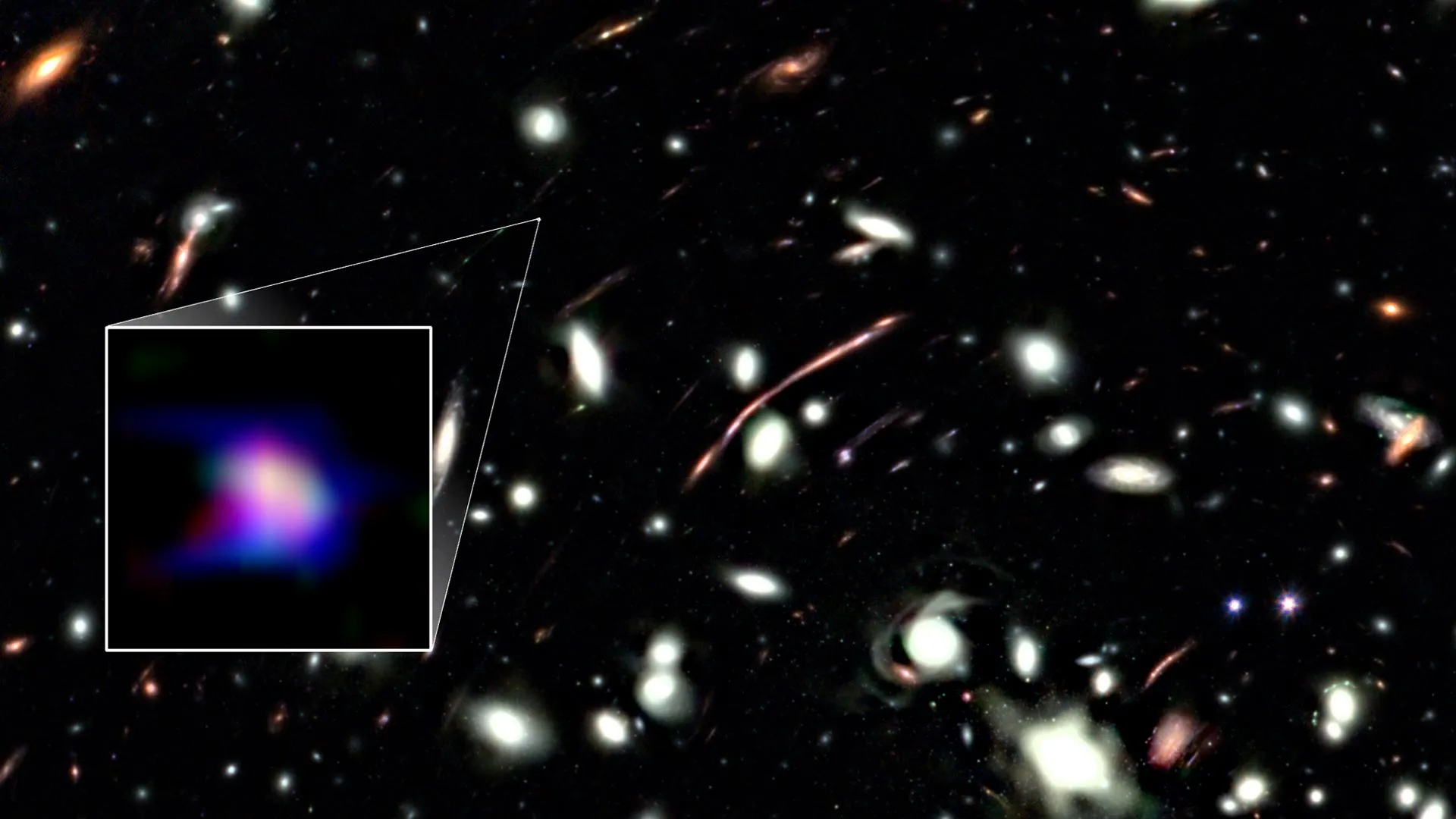
An international team led by Kimihiko Nakajima used the James Webb telescope to find LAP1-B, a galaxy from 800 million years after the Big Bang. This tiny, faint galaxy has very little oxygen. It shows how the first stars started the chemical changes that eventually led to life on Earth.
An international research team led by Associate Professor Kimihiko Nakajima of Kanazawa University used Webb and a natural magnifying effect known as gravitational lensing to examine LAP1-B, a tiny, ultra-faint galaxy that existed just 800 million years after the Big Bang.
Building on earlier observations, the researchers determined that the galaxy has an oxygen abundance of approximately 1/240th that of the Sun, making it the most chemically primitive star-forming galaxy discovered to date.