
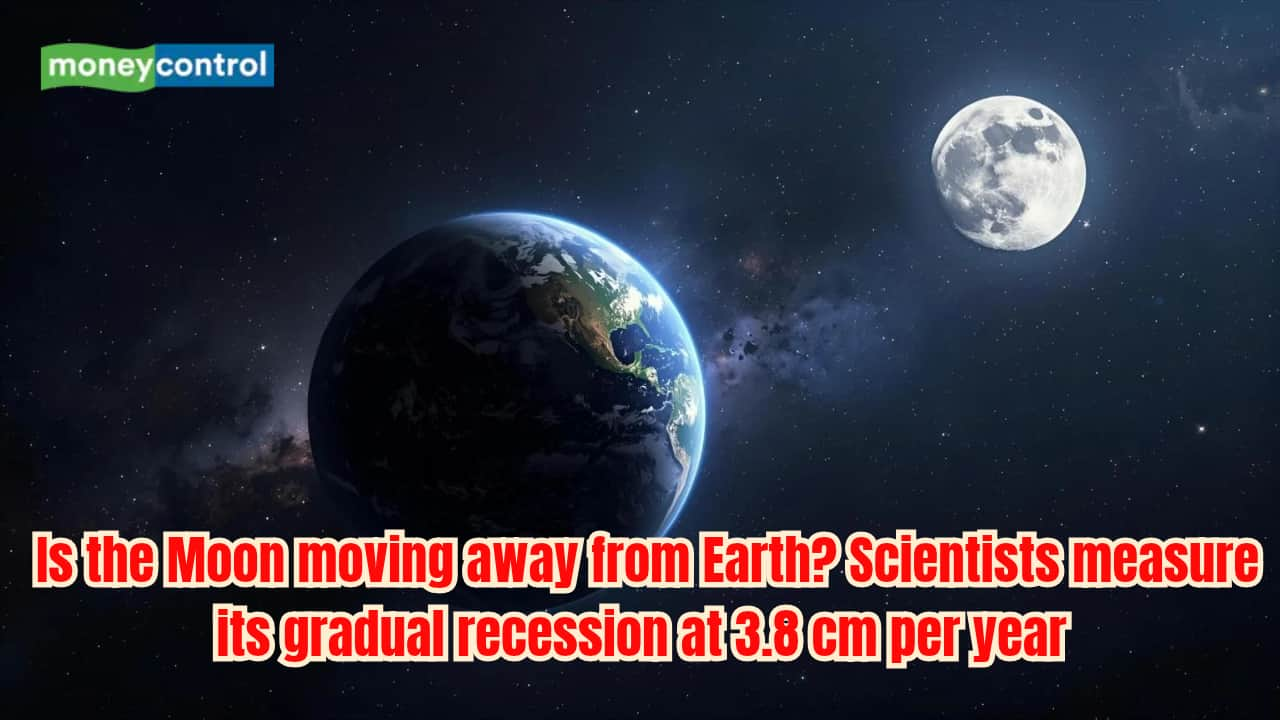
The Moon is gradually moving away from Earth at a rate of 3.8 centimetres every year. Scientists confirmed this phenomenon, known as lunar recession, using laser pulses. While this process slows down our planet's rotation and lengthens our days, experts said it poses no immediate threat to life on Earth.
The Moon has been Earth's natural satellite for billions of years, influencing ocean tides, stabilising the planet's rotation and lighting up the night sky. However, it is gradually moving farther away from our planet. Scientists have measured that the Moon is receding from Earth at approximately 3.8 centimetres every year, or around 1.5 inches. The phenomenon, known as lunar recession, is a natural consequence of gravitational interactions between Earth and its only natural satellite. Is the Moon really moving away from Earth? Yes. The Moon is gradually moving into a higher orbit around Earth.
It currently maintains an average distance of approximately 384,400 kilometres from planet Earth. Measurements using lunar laser ranging have confirmed that this distance increases by about 3.8 centimetres annually. Although the change is too small to notice during a human lifetime, it has significant implications over geological timescales. What is Lunar Recession? The gradual increase in the Moon's orbital distance is called lunar recession. As the Moon moves farther away, its orbital period increases. At the same time, Earth gradually loses some of its rotational momentum, causing its rotation to slow down.
This process also contributes to the gradual lengthening of Earth's day. How do scientists measure the Moon's distance? Scientists use a technique called Lunar Laser Ranging. Reflectors placed on the lunar surface during Apollo missions and Soviet robotic missions allow researchers to send laser pulses towards the Moon and measure how long they take to return. NASA reports that these measurements can determine the Earth-Moon distance with millimetre-level precision. So, Moon will eventually drift away from Earth! The Moon is not about to escape Earth's gravitational influence. Its gradual recession is a natural process that has continued for billions of years.
Scientists also point out that the current recession rate cannot simply be projected unchanged across billions of years because tidal interactions evolve over time. Over long periods, the Moon's increasing distance and Earth's slowing rotation will influence the planet's tides and the length of its days. However, these changes occur extremely slowly and pose no immediate threat to life on Earth. For now, the Moon is not breaking up with Earth. It is simply following the laws of gravity.