
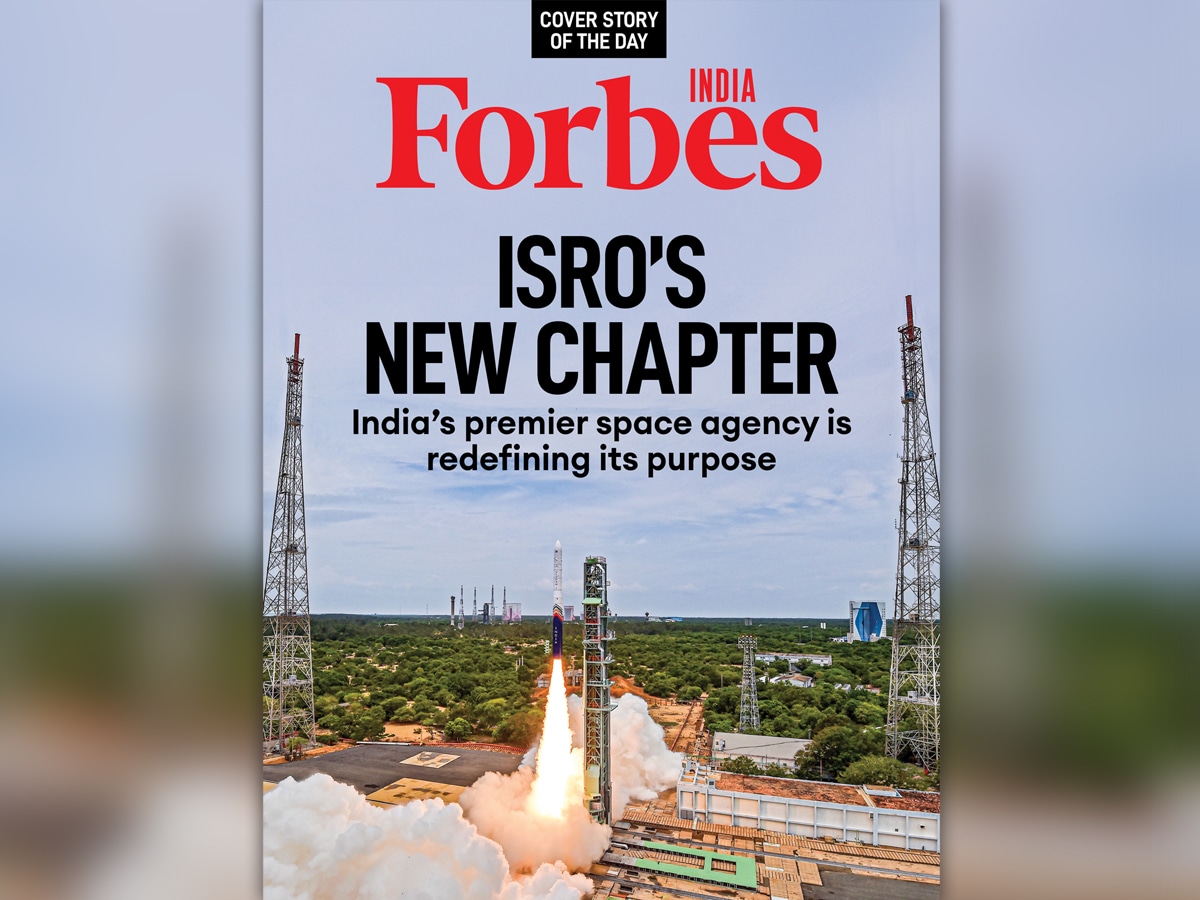
ISRO Chairman V Narayanan said the agency won't be privatised, but employee associations seek clarity on its future role. On September 4, nine associations wrote to him after IN-SPACe Chairman Pawan Goenka suggested private firms might handle launch vehicles. Experts say this shift allows ISRO to focus on advanced research.
Chairman of India's space organisation V Narayanan says the agency won't be privatised, but employee associations still seek clarity as commercial work moves to industry
Awais Ahmed, co-founder and CEO of space tech startup Pixxel, says that Isro's current transition cannot be compared to the handover of Air India to the private sector. In space, he says, what changed is that private firms are now allowed to do what only Isro could do before. "A space research organisation should not face revenue targets or sell satellite capacity, which is why commercial work moved first to Antrix and then to NSIL (the commercial arms of Isro)," he says.
Pawan Kumar Chandana, CEO of Skyroot Aerospace, too, says it is different from the private sector taking over Isro. "It is an expansion of India's space ecosystem," he says, adding that Isro can concentrate on frontier technologies, human spaceflight, planetary exploration, science missions and high-risk programmes, while industry takes on commercial and repeatable work. Skyroot's Vikram-1, the first privately developed Indian rocket to reach orbit, benefited from infrastructure and regulation created by Isro, Indian National Space Promotion and Authorisation Centre (IN-SPACe, a single-window autonomous agency under the Department of Space) and the government, he points out.
Isro Chairman V Narayanan. Photo by R. Satish Babu / AFP
Keyur Gandhi, the director of space regulatory and commercialisation for Dhruva Space, goes a step further. Asked whether Isro needs to adapt, he says, "The answer is no. I think the ecosystem needs to adapt." Private capacity, he argues, lets Isro move work on operational requirements to other players and use its decades of expertise on next-generation systems, and strategic, scientific and space exploration requirements.
An organisation in transition
Inside the space agency, the picture appears less settled, according to media reports. The Indian Space Policy 2023 states that Isro will focus primarily on R&D. "Hereafter, mature systems shall be transferred to industries for commercial exploitation. Isro shall focus on R&D in advanced technology, proving newer systems and realisation of space objects for meeting national prerogatives," the policy states.
However, on September 4, nine employee associations wrote to Isro Chairman V Narayanan, seeking clarification after IN-SPACe Chairman Pawan Goenka said Isro would eventually stop making launch vehicles, with manufacturing handled by private companies or PSUs. The associations described launch-vehicle work as core competence. They also said that they were not opposed to privatisation as such but wanted clarity on the future relevance of existing staff and centres.
On September 7, Narayanan told reporters at the Bengaluru Space Expo that Isro remains a government organisation and is not getting privatised. He noted that it has about 20,000 employees, including more than 8,000 scientists.
In a follow-up letter dated October 7, a Joint Action Council representing the nine employee associations acknowledged the chairman's responses, but stated in a letter that "the core questions regarding the future mandated role of Isro, the policy on privatisation and transfer of manufacturing and operational functions, technology transfer, staffing and recruitment, and employee safeguards remain substantially unanswered".
Compounding the fears of uncertainty, media reports estimate that between 100 and 120 scientists from key space programmes quit over a few months earlier this year. Isro has not published official figures on departures but the Department of Space issued a memorandum dated July 14 tightening rules on voluntary retirement and resignations by scientists.
However, some point out that attrition at Isro predates the current debate and is an ongoing concern. According to media reports, in 2023, then Isro chairman S Somanath said about 60 percent of IIT graduates left an Isro recruitment presentation after seeing the salary structure.
Gurpeet Singh spent almost eight years in the navigation group at the UR Rao Satellite Centre in Bengaluru, the lead centre for the design, development, and realisation of all satellites within Isro and where most of India's satellites are built. But he left in July 2025 to join Newton School of Technology as an associate director of academics, and also advises Vyomic, a space startup working on low-Earth-orbit navigation.
He believes people often quit Isro because they feel "that mundane, repetitive work is happening at Isro and don't want to associate with that," he says. People expect "specialised R&D inside Isro, which is the usual assumption", he says, adding that, as Isro transfers repetitive tasks, such as end-to-end satellite fabrication, to private companies, that should give its scientists room for deeper research and riskier missions.
The second reason, he says, is opportunity in the private sector, which has grown. The third reason is that a number of scientists leave to pursue higher education. "[But] that was always there. That is not a new phenomenon," he says.
Despite the exits, however, he adds that Isro's size gives it resilience. "It's such a large organisation, there is huge inertia," he says. "If one or two people leave, overall momentum is not much affected." Hiring is still open and young engineers still want to join, he says, and the gap is "manageable".
The support ISRO provides
It is not just engineers who want continued association with Isro. Founders, too, describe continuing reliance on Isro's infrastructure and supply chain. Suyash Singh, CEO of GalaxEye, says Isro's decades of in-house building has left India with a downstream supply chain that is able to make space components.
Ahmed adds that Pixxel started with about 45 percent indigenous content because Isro had qualified local vendors for chips, radios, antennas and GPS receivers.
Testing facilities are another area of cooperation. Bellatrix uses Isro's facilities to fill propellant and validate its data, and Ganapathy says access that once took anywhere from two days to seven months now follows a streamlined process through IN-SPACe. Singh adds that technology transfer lets a startup avoid 5-8 years of R&D on components already proven in space.
Capacity, however, is a limit. Ahmed says Isro's laboratories offer slots when they are free of its own satellite tests, and Pixxel is building its own facility to reduce that dependence. "They had to come up with a framework where we would pay a certain rent per day, and so, the taxpayer money is not being utilised for free by the private sector," he adds.
Pixxel was among the first private companies to use Isro's laboratories, testing satellite hardware at the UR Rao Satellite Centre in early 2022. Ahmed says there was no established process at the time. "It had never been done before." Now, he says, IN-SPACe has become the single window for booking Isro's test facilities, and access has become far easier.
What's next
Several founders see the division of labour between startups and Isro in terms of capital and risk. Srinath Ravichandran, CEO of Chennai-based Agnikul, says private companies cannot undertake high-end technological projects, like building a space station or developing a human space flight mission, because there is "no business model for that today" and because projects such as these are of "extreme national security importance". He adds that industry can take over once a technology can become a business. "Isro will open the gates, and then the private sector can come in and make it commercial."
Singh of GalaxEye, too, feels privatisation is a faster route for India's space sector, while Isro continues long-term research that will become important in 20 or 50 years. "Isro should be at the centre of the ecosystem, becoming an engine to give tech to companies like us", rather than building what private firms already build, he says.
Contractual deals between Isro and the private sector are undertaken through Technology Transfer Agreements (TTAs) and Non-Disclosure Agreements (NDAs) and involve a transfer of technology fee and some licensing cost. So far, IN-SPACe has facilitated 118 technology transfer agreements.
Even as access has become smoother for startups, the expanding private role has unsettled some among Isro's internal ranks. Even as the startups describe Isro as the source of technology, testing and supply-chain capability they depend on, the space agency's employees are waiting to see what its new role will be.
"India's Space Policy 2023 lays out a clear roadmap for how each stakeholder's role in the ecosystem will evolve. We will have to wait and watch as the policy is implemented and realises its full potential," says IN-SPACe chairman Goenka.