
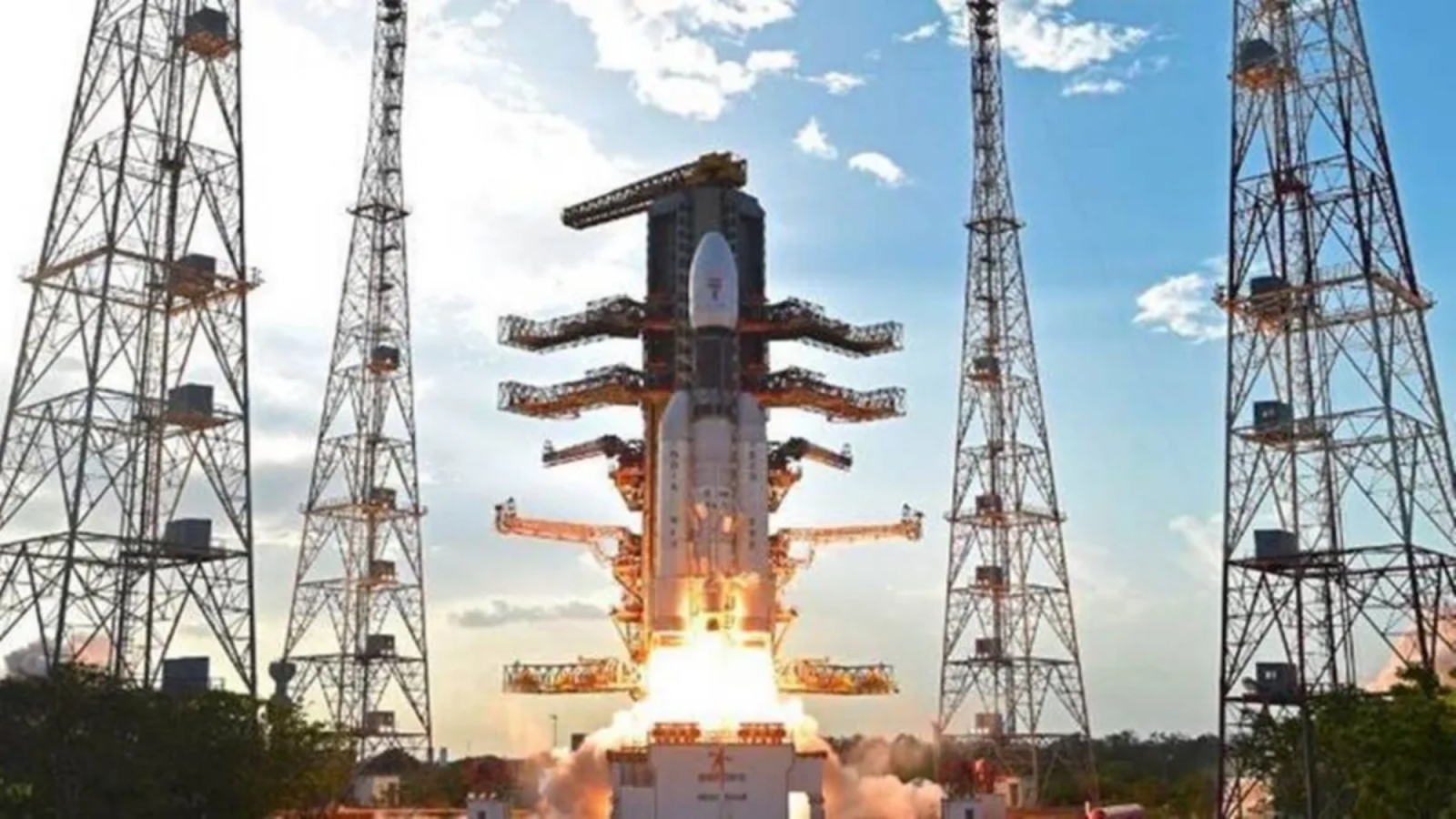
Isro will launch the NVS-03 navigation satellite on October 30 from the Satish Dhawan Space Centre. The agency uses the GSLV Mk II rocket for this mission after a successful flight in September. This launch aims to fix the navigation system, which got weak after many atomic clocks failed earlier.
Thank you for your feedback.
Your feedback has been reported succesfully.
Following mixed fortunes with its two missions in 2026, the Indian Space Research Organisation (Isro) is set to return to the launch pad on October 30 to launch a navigation satellite, NVS-03, on board the GSLV Mk II, which delivered this year's only successful mission in September.
Isro Chairman Dr V Narayanan indicated on Thursday that the NVS-03 launch, which had been slotted tentatively between October 15 and 20, was cleared for a launch attempt on October 30 from Satish Dhawan Space Centre at Sriharikota.
Since the second successive failure of Isro's workhorse PSLV rocket on January 4, 2026, the space agency has adopted a cautious approach to launches -- to understand and rectify the anomalies that caused the PSLV launch failures on May 18, 2025 and January 12, 2026.
The cautious approach on all launches irrespective of the launch vehicle has also meant delays in the timelines for the realisation of Gaganyaan , the ambitious human space flight programme, with the schedule for the proposed first test launch of the unmanned crew module spilling over into a probable late 2026 or early 2027 date, as against a previously targeted schedule of mid 2026.
Incidentally, the NVS-03 satellite was moved to Sriharikota nearly three months ago in anticipation of a launch clearance on board the GSLV Mk II.
The successful launch of the EOS-05 satellite on September 4, 2026, on board the GSLV Mk II has now cleared the path for the launch of the NVS-03 satellite at the end of October, Isro sources said.
The EOS-05 satellite for earth observation -- described as an "eye in the sky" by Isro officials -- has begun transmitting images since settling into a geosynchronous perch, rather than an optimal geostationary location, on September 8, an official said.
EOS-05, India's first geosynchronous earth observation satellite, had a near-perfect launch on the GSLV Mk II. The GSLV Mk II, which is equipped with an indigenous cryogenic engine, has had six successive, successful flights since 2021.
The same rocket system is now set to launch the much-delayed NVS-03 satellite, which is required to bolster India's indigenous navigation satellite system. The system now operates at a sub-optimal level following the failure of atomic clocks on the first generation of Navigation with Indian Constellation (NavIC) satellites.
NVS-03 to bolster Indian navigation satellite system
NavIC, India's indigenous navigation satellite system, suffered a major setback in March when one of the four remaining operational satellites (IRNSS 1F) in the navigation constellation reported failure "at the end of 10 years since its launch".
A minimum of four indigenous navigation satellites must be fully functional for the NavIC system to be useful for navigation in India by the public and government agencies like the railways and the military.
"On 13th March 2026, the procured on-board Atomic clock stopped functioning. However, the satellite will continue to function in-orbit for various societal applications to provide one way broadcast messaging services," Isro said in an official statement on March 14.
Although Isro has launched 11 navigation satellites since July 2013 for the nearly Rs 2,250-crore NavIC system, six satellites have failed primarily because of defective imported atomic clocks and, on a few recent occasions, due to orbital issues.
The faulty atomic clocks were imported for the first generation of navigation satellites.
Last year, prior to the failure of the IRNSS 1F, the government reported in a reply in Parliament that only four of the 11 satellites launched for the NavIC system were operational for positioning, navigation, and timing (PNT) services, with others working at below-par levels.
The failure of the IRNSS 1F meant that the functional NavIC satellites for PNT services are only the IRNSS 1B, IRNSS 1L, and IRNSS 1J (NVS-01).
The launch of NVS-03 has been in the pipeline since late 2025 but has been delayed by multiple factors, including the cautious approach taken by Isro after the recent PSLV setbacks.
Union Minister of Science and Technology Jitendra Singh stated in Parliament in mid 2025 that "NVS-03 is planned to be launched by the end of 2025" and "subsequently, with a gap of six months, NVS-04 and NVS-05 are planned to be launched".
The new satellites are intended "to augment the NavIC base layer constellation with enhanced features for ensuring continuity of services", he said.
Why NavIC is important for India
The NavIC system is an indigenous GPS service provided by Isro's IRNSS and NVS satellites. The space agency incidentally started work on NavIC in 1999 after the Kargil war, where Indian defence forces could not use the US-owned GPS system to provide locational aid to its soldiers in conflict zones.
Accurate time-keeping lies at the heart of navigation systems, as determining a person's position on Earth depends on the accurate calculation of signal transmission delays from satellite to Earth.
The IRNSS 1J satellite, which is operational, and the IRNSS 1K, which reported an engine failure last year, are also called NVS-01 and NVS-02 satellites because they are second-generation Isro navigation satellites equipped with a mix of indigenous and foreign atomic clocks.
Though a seven-satellite constellation is considered ideal for the NavIC system, four fully operational satellites are also considered sufficient to provide navigation services.
"To provide a solution for position navigation and timing, only four satellites are needed. For timing, only one satellite is sufficient, and for position navigation, four satellites are sufficient," an Isro official said.
A full-fledged NavIC system can help achieve the government's goal of real-time tracking of around 12,000 trains, with around 8,700 trains already equipped with the system.
Space science at ESTIC 2027 conclave
On Wednesday, Dr Narayanan unveiled the space science and technologies theme for the Emerging Science Technology and Innovation Conclave (ESTIC) to be held in New Delhi from October 27.
"We have to enable the country to have the capability of telecommunication, satellite navigation, to have the full capability of health observation and one of our goals is also to ensure safety and security of everyone," Dr Narayanan said regarding Isro's vision document for the conclave.
"Without proper monitoring from space, we cannot have proper safety and security of the citizens of the country," he said.
The Isro vision document for ESTIC will also refer to the flagship Gaganyaan, a proposed Indian space station, and an ambitious human lunar landing goal by 2040.
"We compiled mainly our human space exploration and space science initiatives in that document," said ISRO's satellite centre director D K Singh, who is the chair for the space science theme at ESTIC.
At the ESTIC conclave, Isro will display models of the proposed Indian space station, Bharath Antariksh Station, and a heavy-lift New Generation Launch Vehicle, officials said.