
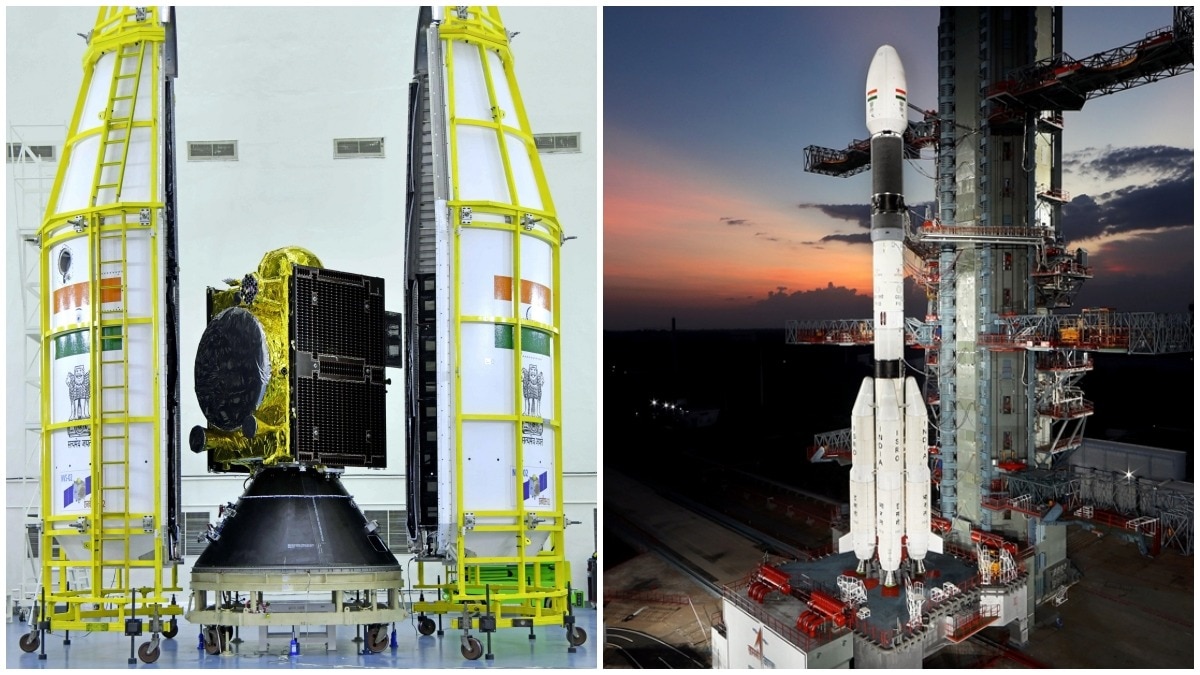
Isro will launch the NVS-03 satellite aboard the GSLV-F18 rocket on October 30. To prevent the propulsion failure that stranded NVS-02 in January 2025, Isro decided to fly with pyro valves already open. This change aims to fix the electrical signal issue that stopped the previous satellite from reaching its orbit.
Isro will launch NVS-03 aboard GSLV-F18 on October 30 with its pyro valves already open. The unprecedented configuration aims to prevent the propulsion failure that stranded NVS-02.
The Indian Space Research Organisation (Isro) is preparing to launch its navigation satellite NVS-03 aboard the GSLV-F18 rocket on October 30, but the mission carries an unusual engineering decision that has drawn attention across the space sector.
For the first time in its 51-year history of satellite launches, Isro is preparing to fly a satellite with its pyrotechnic valves, or pyro valves, already open, according to senior officials part of the mission.
The move follows the failure of NVS-02, which became stranded in geosynchronous transfer orbit in January 2025 after a propulsion-system malfunction prevented it from reaching its designated orbit.
The decision is aimed at eliminating a specific failure mechanism that affected its predecessor. However, experts have raised questions about the risks associated with changing a configuration traditionally used to isolate spacecraft propellant during launch.
LESSONS FROM THE NVS-02 FAILURE
Launched aboard GSLV-F15 on January 29, 2025, NVS-02 was successfully placed in geosynchronous transfer orbit. However, it could not perform the crucial orbit-raising manoeuvres required to reach geostationary orbit.
Isro's investigation found that oxidiser could not flow to the liquid apogee motor because the electrical drive signal failed to reach the pyro valve.
An Apex Committee concluded that the most likely cause involved the disengagement of at least one contact in each of the main and redundant paths of a connector.
Without oxidiser reaching the propulsion system, the satellite could not fire its engine as required to complete its journey to the designated orbit.
A pyro valve is a single-use mechanism that opens a sealed passage through a pyrotechnic action. Once activated, it remains open and cannot be closed again. Satellites use these valves to keep fuel and oxidiser isolated until the appropriate stage of a mission.
For NVS-03, Isro appears to have chosen to open the valves before launch, removing the need for the critical post-launch activation that failed on NVS-02.
WHY LAUNCHING WITH OPEN VALVES IS UNUSUAL
The altered configuration does not eliminate all risks. Instead, it shifts attention towards the downstream isolation and latch-valve arrangement, which must safely control the flow of propellant during spacecraft operations.
Experts have raised concerns about possible leakage, pressure conditions and the effects of intense vibration and acceleration during the rocket's ascent. If the downstream valve fails to operate in orbit, the satellite could still lose its ability to manoeuvre.
The key question is whether the configuration has undergone sufficient qualification and testing to ensure that the propulsion system can safely withstand launch with its pyro valves already open.
Isro's publicly available information does not establish whether comparable operational satellites have previously flown in this configuration.
WHY NVS-03 MATTERS FOR INDIA'S NAVIC
NVS-03 is the third second-generation satellite planned for India's Navigation with Indian Constellation (NavIC), the country's independent satellite navigation system.
It follows NVS-01, launched successfully in May 2023, and NVS-02, whose orbit-raising manoeuvre failed.
The next-generation satellites are intended to replenish the ageing navigation constellation and introduce additional capabilities, including the L1 navigation signal alongside the existing L5 and S signals. NVS-03 also carries indigenous atomic-clock technology.
Isro's GSLV-F18 is expected to place the approximately 2,250-kg satellite into geosynchronous transfer orbit. Its liquid apogee motor must then raise it into geostationary orbit, around 37,000 km above Earth.
The October 30 launch is therefore more than a routine satellite deployment. Its success will depend not only on the rocket reaching the intended transfer orbit but also on NVS-03 completing the crucial propulsion manoeuvres that its predecessor could not.
The mission will test whether Isro's revised approach can avoid a repeat of the NVS-02 failure while safely delivering a vital addition to India's independent navigation infrastructure.