
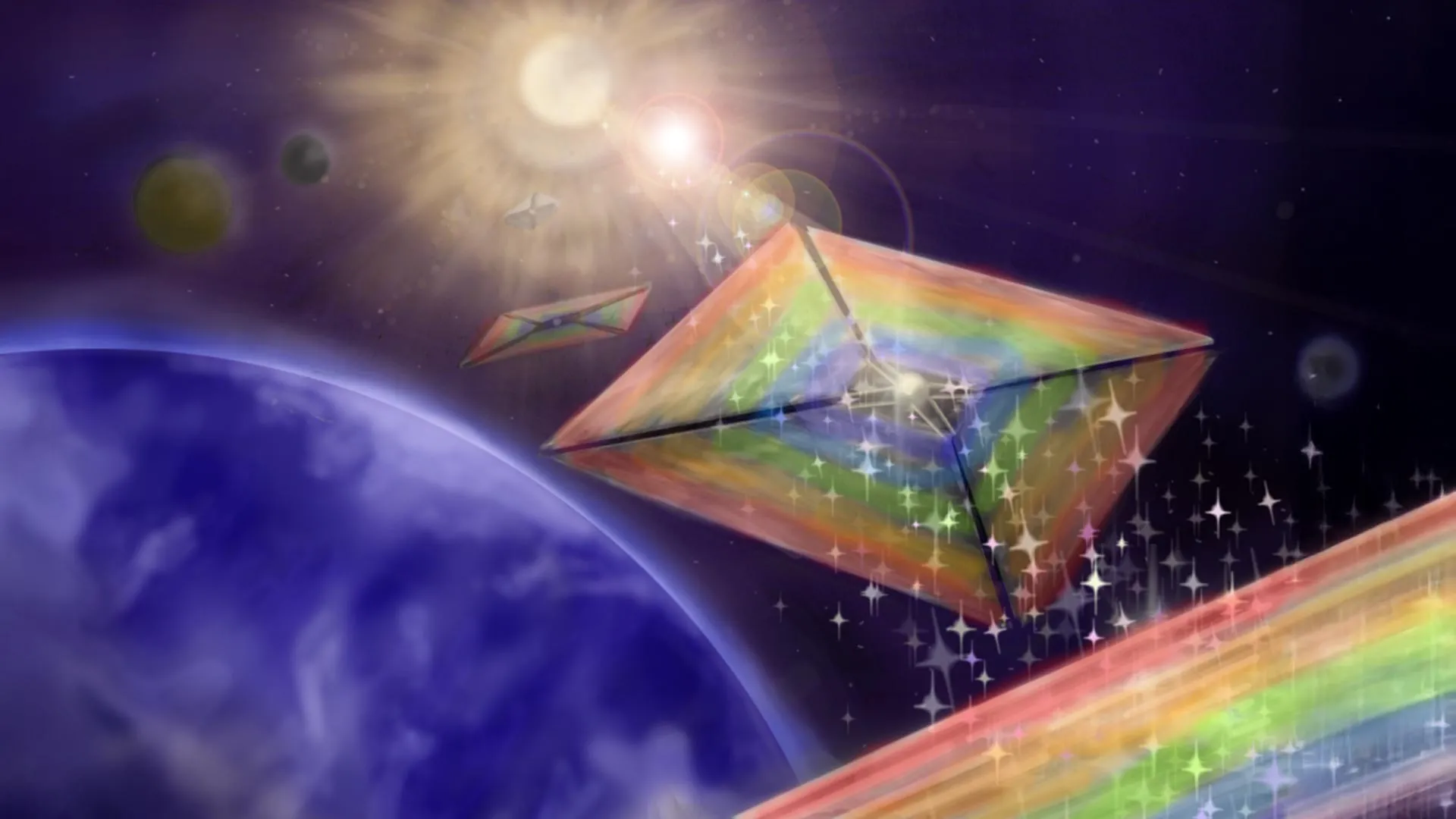
New research shows interstellar solar sails face a strange problem at 75% of light speed. Chao Shen and Jiaze Li found that light can act against a spacecraft moving at extreme speeds. As the sail accelerates, the Doppler effect creates resistance, making it harder for lasers to push the craft.
Some proposed interstellar missions would take this concept even further by using powerful lasers to push sails to extraordinary speeds, potentially reaching a substantial fraction of the speed of light. However, new research suggests that this approach comes with an unexpected complication. At extreme speeds, some of the very light driving the spacecraft forward could begin acting against it.
In a recent paper available on arXiv, Chao Shen and Jiaze Li of the Harbin Institute of Technology investigate how light interacts with a rapidly accelerating solar sail. Their findings reveal a surprising source of resistance that emerges as the spacecraft approaches 75% of the speed of light.
How Light Can Push a Spacecraft Through Space
Although light has no mass, it carries momentum and can transfer that momentum to objects it strikes. This creates a tiny pushing force known as radiation pressure. Under ordinary conditions, the effect is extremely weak, but in the vacuum of space, a large reflective sail can gradually build up speed as light continues to strike its surface.
For spacecraft traveling between stars, powerful lasers could provide a much more concentrated source of light than the Sun. By directing an intense beam at a sail, engineers hope to accelerate extremely small probes to speeds that conventional propulsion systems cannot approach.
The researchers examined three ways that photons, the individual packets of energy that make up light, transfer momentum to a sail. These interactions are incident light (that raw momentum of the photons hitting the sail), specular reflection (momentum imparted when photons bounce perfectly off the sail), and diffuse scattering (momentum from photons that are absorbed by the sail then reemitted in random directions).
According to the study, these three contributions affect the sail's motion with different levels of efficiency. Incident light provides the strongest contribution in the researchers' breakdown, followed by specular reflection and then diffuse scattering.
A Strange Problem Emerges Near the Speed of Light
The situation becomes considerably more complicated once a solar sail reaches relativistic speeds, meaning speeds high enough that the effects predicted by Einstein's theory of relativity become important.
As the sail accelerates away from its laser source, it experiences an increasingly strong Doppler effect. This is the same basic phenomenon that changes the apparent pitch of a passing ambulance siren, except that light experiences a change in frequency rather than sound.
For the accelerating sail, the incoming laser light becomes progressively redshifted, meaning its frequency decreases from the sail's perspective. As a result, the light transfers momentum less effectively, reducing the thrust generated by all three contributions examined in the study.
In other words, the faster the spacecraft travels, the less effective its laser propulsion becomes. Even with a powerful beam continuously striking the sail, gaining additional speed becomes increasingly difficult.
Various concepts for interstellar exploration have been proposed over the years, including Breakthrough Starshot, which envisioned using powerful lasers to accelerate tiny spacecraft toward nearby stars. The new findings highlight another challenge that such ambitious missions would need to consider.
At 75% of Light Speed, Light Starts Working Against the Sail
The researchers identified an especially unusual effect once the sail reaches approximately 75% of the speed of light.
At this point, a phenomenon known as relativistic light aberration changes how the scattered light is distributed. Relativistic aberration describes how the apparent directions in which light travels are altered by motion at speeds approaching the speed of light.
From the viewpoint of an observer at rest on Earth, the diffusely scattered light becomes increasingly concentrated in the spacecraft's forward direction. Because emitting light carries momentum, the sail experiences a corresponding recoil in the opposite direction.
This means that diffuse scattering (admittedly the weakest of the three forces) begins producing drag rather than helping propel the spacecraft forward.
The result is a striking paradox: some of the light intended to accelerate an interstellar spacecraft actually begins resisting its motion.
Importantly, this does not mean the spacecraft suddenly stops accelerating or that its entire propulsion system begins pushing backward. The laser still generates a positive overall force, allowing the sail to continue gaining speed. However, the additional resistance reduces the efficiency of the system, making further acceleration more challenging.
The study focuses specifically on the forces produced by light and does not attempt to model every obstacle a spacecraft would encounter during an interstellar journey.
For example, the researchers do not include resistance from interstellar gas and dust, which could become important at extreme velocities. They also leave out the thermal challenges associated with directing extremely powerful lasers at a thin sail. If the material absorbs too much energy, intense heating could damage or even melt it.
Another important simplification is that the calculations treat the sail as an idealized mirror. Real spacecraft would need materials capable of reflecting laser light efficiently while remaining lightweight, durable, and stable under extreme conditions.
Engineers are already exploring advanced metamaterials and photonic crystals that could help address these demands. These specially engineered materials can be designed to interact with particular wavelengths of light in ways that ordinary reflective surfaces cannot.
Intriguingly, such materials might even turn some of the relativistic effects identified in the research into an advantage. By carefully controlling how light scatters from the sail, future designs could potentially generate forces that automatically correct its orientation and position, helping it remain aligned with the laser beam throughout acceleration.
The Long Road to Interstellar Travel
Despite the promise of laser propulsion, humanity remains far from building and testing a complete solar sail system capable of reaching another star.
The physics becomes increasingly complicated over such enormous distances and at such extraordinary speeds. Additional effects, including the curvature of spacetime, would also need to be considered in a more complete description of an interstellar journey. These effects were simplified out of the new analysis.
Nevertheless, understanding how light behaves when it interacts with a spacecraft traveling at a significant fraction of light speed is an important part of making interstellar exploration possible.
If humanity eventually sends robotic probes to another star, success will depend on solving countless engineering and physics challenges. Knowing that light itself can become an unexpected source of resistance gives researchers one more piece of the puzzle, and potentially a better understanding of how to design spacecraft capable of making the journey.