
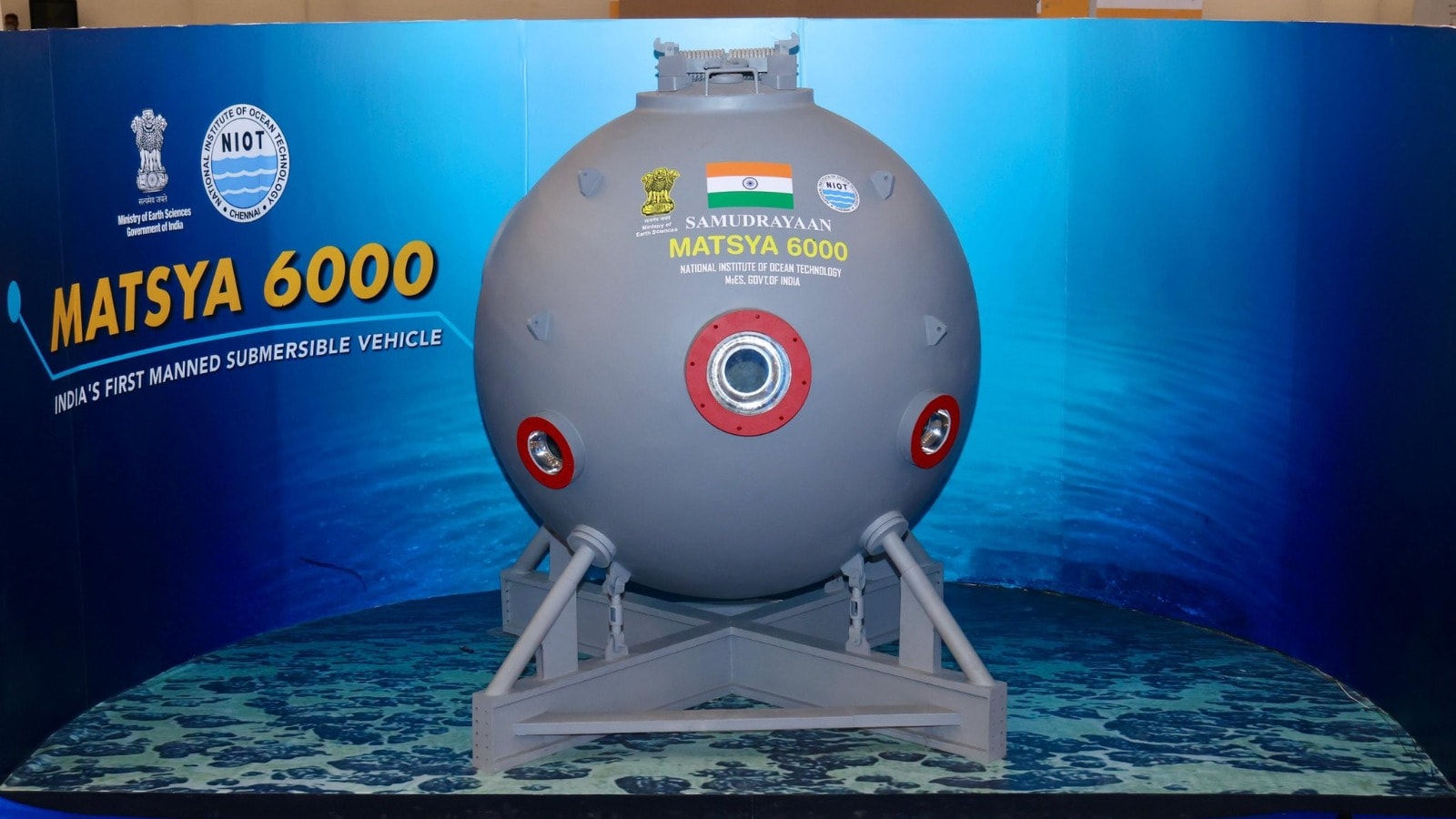
India is preparing for its first human deep-sea mission by 2028 using the MATSYA-6000 submersible. On Friday, the craft completed unmanned trials in Kattupalli, Tamil Nadu. This project aims to explore the ocean floor at 6,000 metres, where many strange creatures live and valuable mineral deposits wait to be found.
MATSYA-6000 is expected to be launched in 2028.
We have sent humans to the Moon, explored Mars and built telescopes capable of looking billions of years into the past. Yet, one of Earth's greatest mysteries lies much closer to home - beneath its oceans. Thousands of metres below the surface, an alien-like world exists in complete darkness, under crushing pressure, with strange creatures and potentially valuable mineral deposits. India now wants to venture into this largely unexplored frontier with the help of a specially designed submersible called MATSYA-6000.
It sounds like Hollow Earth, an imaginary world depicted in Godzilla franchise that lies within our planet and ancient domain to giant creatures like Titans.
The submersible is part of India's ambitious Samudrayaan project and can carry three people to a depth of 6,000 metres inside a compact 2.1-metre diametre spherical hull. MATSYA-6000 aims to explore the ocean floor, study marine biodiversity and develop technologies to access deep-sea resources.
On Friday, the submersible completed its unmanned trials in Kattupalli, Tamil Nadu.
The target is ambitious. India is working towards its first human deep-sea mission by 2028. If successful, it will join a small group of countries with the capability to send people to such extreme depths.
But what exactly lies beneath the ocean? And why is India investing in a mission that takes humans into one of the least explored environments on Earth?
A World Where Sunlight Never Reaches
The ocean may cover more than 70 per cent of Earth's surface, but much of its depths remain poorly explored. Scientists have mapped large parts of the ocean floor, but mapping the seabed is very different from visiting it, observing it and collecting samples.
At 6,000 metres, MATSYA-6000 will enter the deep-sea zone known as the abyssal region. Temperatures are close to freezing, sunlight cannot penetrate and the pressure is roughly 600 times that at sea level.
To put that into perspective, the pressure at this depth is comparable to having several hundred kilograms pressing on every square centimetre of the submersible's surface.
Yet life survives here.
Deep-sea researchers have discovered organisms that live without sunlight, animals that produce their own light and microbes that survive around hydrothermal vents, where hot, mineral-rich water emerges from the ocean floor.
Some of these ecosystems rely on chemosynthesis rather than photosynthesis. In simple terms, organisms use chemical energy instead of sunlight to survive.
For scientists, this is an extraordinary natural laboratory. Studying such life could help us understand how organisms adapt to extreme environments and how life might exist in the oceans beneath the icy surfaces of moons such as Europa.
Meet MATSYA-6000: India's Underwater Vehicle
The centrepiece of India's mission is MATSYA-6000, developed by the National Institute of Ocean Technology (NIOT), Chennai, under the Ministry of Earth Sciences.
The name refers to Matsya, the fish incarnation of Lord Vishnu. The vehicle is designed to take three aquanauts - people trained to work underwater - to depths of up to 6,000 metres.
Unlike an ordinary submarine, which can be relatively large, MATSYA-6000 has a compact, specially engineered passenger sphere. ISRO has been involved in developing this crucial component.
The sphere is approximately 2.26 metres in diametre and is made from a special titanium alloy. Its walls are 80 mm thick and it is designed to withstand external pressure of up to 600 bar.
The structure is important because at such depths, even a small weakness could be catastrophic. The passenger sphere must protect its occupants from the enormous pressure outside while maintaining a safe environment inside.
The submersible will also have life-support systems, underwater communication, navigation equipment, batteries and emergency escape mechanisms.
It is designed for an operational period of around 12 hours, with emergency life-support provisions for up to 96 hours.
What Is India Looking For At The Bottom Of The Ocean?
The mission is not simply about sending people underwater and breaking a depth record. There is a much bigger economic and scientific objective.
One of the key attractions is the presence of polymetallic nodules, the potato-shaped mineral deposits scattered across the ocean floor.
These nodules contain metals such as manganese, nickel, cobalt and copper and are important for several industries, including battery manufacturing, electronics, steel production and clean-energy technologies.
As countries look to diversify their supplies of critical minerals, the deep ocean has attracted growing interest.
India has been exploring the Central Indian Ocean Basin, where polymetallic nodules have been identified.
The government has also developed an integrated seabed mining system designed to collect and crush these nodules. Its mobility and power systems were tested at a depth of 5,270 metres in 2021.
But apart from minerals, countries are also exploring the seabed for scientific knowledge. Researchers say that these deep-sea missions can help them understand underwater geological formations, ocean currents and marine ecosystems.
The government is also exploring hydrothermal sulphide deposits along underwater ridges. These deposits form when hot, mineral-rich fluids emerge from cracks in the seabed and interact with cold seawater.
Such environments can support unusual ecosystems and offer clues about the geological processes that shape the ocean floor.
Which Countries Have Reached These Depths?
India is not the first country to explore the deep ocean with human-occupied submersibles. The United States, China, Russia, France and Japan have all developed deep-sea exploration capabilities.
The United States has operated submersibles such as Alvin, while China has developed the Fendouzhe, which has reached depths greater than 10,000 metres. France also has Nautile, a deep-sea submersible capable of reaching 6,000 metres.
In August 2025, Indian scientists gained operational experience in deep-sea exploration by participating in dives aboard France's Nautile in the Atlantic Ocean. They reached depths of up to 5,000 metres.
Got a follow‑up question on this article? Go on
How may i help you today
Show full article
Track Latest News Live on NDTV.com and get news updates from India and around the world