
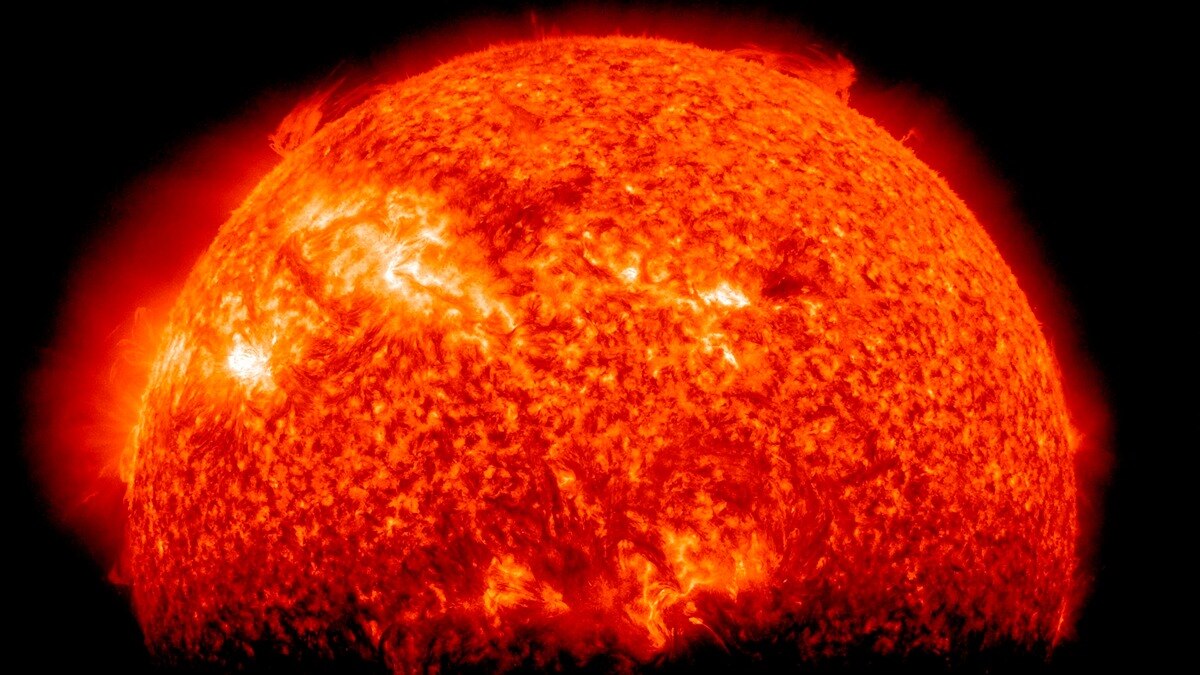
India’s Aditya-L1 mission joined Europe’s Proba-3 spacecraft to study solar eruptions. Scientists used data from both missions to track coronal mass ejections that hit on September 14 and September 16, 2025. This joint effort helps experts understand how the Sun affects satellites and communication systems here on our Earth.
India's Aditya-L1 solar mission has joined forces with Europe's Proba-3 spacecraft to uncover how powerful eruptions from the Sun evolve in their earliest stages, offering fresh insights into phenomena that can disrupt satellites, communications and Earth's space environment.
In a first, scientists have jointly analysed observations of the same solar eruptions captured by the two missions, combining data from India's Visible Emission Line Coronagraph (VELC) and Europe's ASPIICS instrument to measure the mass, density and energy of coronal mass ejections (CMEs) close to the Sun.
The study, led by researchers at the Indian Institute of Astrophysics (IIA), Bengaluru, alongside European and American solar physicists, has been published in the journal Astronomy & Astrophysics.
WHY STUDYING SOLAR ERUPTIONS MATTERS
CMEs are enormous bursts of magnetised plasma expelled from the Sun into space. When directed towards Earth, they can trigger geomagnetic storms, disrupt satellite operations and interfere with navigation and communication systems.
Understanding how these eruptions develop close to the Sun is crucial to predicting their evolution and potential impact. However, observing CMEs in the inner corona has been challenging, particularly during their early stages, leaving scientists with limited information about how their energy is divided between motion, heat and magnetic fields.
By combining observations from two complementary instruments, researchers have now obtained independent estimates of CME properties, helping address these gaps.
TWO MISSIONS, ONE VIEW OF THE SUN
Launched on September 2, 2023, Aditya-L1 is India's first dedicated solar mission. It entered a halo orbit around the Sun-Earth L1 point on January 6, 2024, providing a continuous view of the Sun.
Its VELC instrument, developed by IIA in collaboration with ISRO, studies the solar corona between 1.05 and 1.5 solar radii using spectroscopic observations of the green coronal emission line.
Proba-3, launched by the European Space Agency on December 5, 2024, is the world's first precision formation-flying mission. Its two spacecraft fly about 150 metres apart, creating an artificial solar eclipse that allows the ASPIICS coronagraph to observe the corona between 1.1 and 3 solar radii.
While ASPIICS captures images that reveal a CME's shape, movement and mass, VELC's spectroscopic measurements provide information about the temperature and density of the erupting plasma.
TWO ERUPTIONS REVEAL DIFFERENT ENERGY PATTERNS
The team identified two CMEs observed simultaneously by both instruments, on September 14 and September 16, 2025.
The first travelled at around 645 km per second, while the second moved much more slowly at approximately 145 km per second. The slower CME also showed a steeper decline in density with height, suggesting stronger early expansion.
The energy distribution differed significantly. In the September 14 event, thermal energy accounted for only about 1% of the total. In the September 16 eruption, thermal energy increased until it became comparable to kinetic energy. In both cases, the estimated magnetic energy was comparable to or greater than the kinetic energy.
Importantly, mass and thermal-energy estimates from the two instruments agreed well despite their different measurement techniques.
The findings demonstrate how coordinated observations can reveal the physics of solar eruptions more comprehensively than either spacecraft alone, potentially improving scientists' understanding of how CMEs evolve and influence the space environment around Earth.