
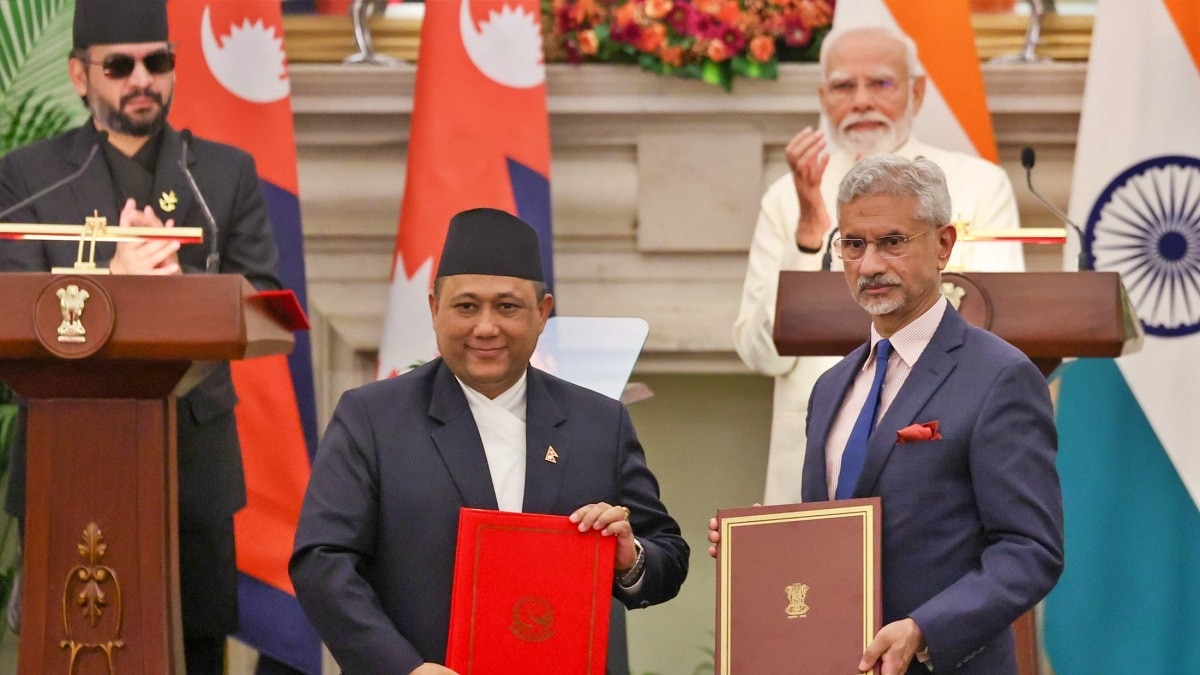
India and Nepal signed an agreement on November 23 to build a satellite communication network. Using India’s South Asia Satellite, the project will set up a central hub and 300 user terminals. This network will help Nepal improve public services like telemedicine and disaster management in its remote mountain areas.
India and Nepal signed an agreement to establish a communication network using the South Asia Satellite. The project will support remote connectivity, public services and emergency coordination across Nepal.
India and Nepal have signed an agreement to establish a satellite communication network that will expand connectivity across Nepal, using India's South Asia Satellite.
The Memorandum of Understanding (MoU) was signed between the Indian Space Research Organisation (ISRO) and Nepal's Ministry of Information and Communication during Nepal Prime Minister Balendra Shah's meeting with Prime Minister Narendra Modi in New Delhi on November 23.
Under the agreement, India will assist Nepal in setting up a Ground Station, also described as a Central Hub Station, along with 300 user terminals. The arrangement will also enable Nepal to access 36 MHz of satellite bandwidth provided free of charge through India's South Asia Satellite.
The network is expected to support a range of public services, including telemedicine, tele-education, disaster management and Very Small Aperture Terminal (VSAT) services.
HOW WILL THE SATELLITE NETWORK HELP NEPAL?
Nepal's mountainous geography and scattered settlements make it difficult to provide reliable communication infrastructure in several remote areas.
Satellite connectivity can help bridge these gaps by enabling communication in locations where conventional terrestrial networks, including fibre-optic cables and mobile infrastructure, are difficult or expensive to establish.
Telemedicine services could allow healthcare professionals in cities to connect with patients and medical facilities in remote mountain communities. Similarly, satellite-enabled tele-education could help schools and learning centres access digital resources and connect with teachers beyond their immediate locations.
The network could also play an important role during natural disasters. Nepal is vulnerable to earthquakes, floods and landslides, which can damage roads, power lines and communication infrastructure.
Satellite links can provide an alternative channel for emergency communication and coordination when terrestrial networks are disrupted.
The 300 user terminals will provide access points for using the satellite communication services, while the central hub station will serve as a key part of the network's ground infrastructure.
WHAT IS THE SOUTH ASIA SATELLITE?
The South Asia Satellite, also known as GSAT-9, is an Indian communication satellite developed to provide regional connectivity and communication services to neighbouring countries. India had offered its use to South Asian neighbours as part of its regional cooperation initiative.
The new agreement gives Nepal a more structured framework to utilise the satellite's capacity for essential services.
It also adds space and communication technology to the growing India-Nepal partnership, with both countries seeking to deepen cooperation across infrastructure, healthcare, education and development.