
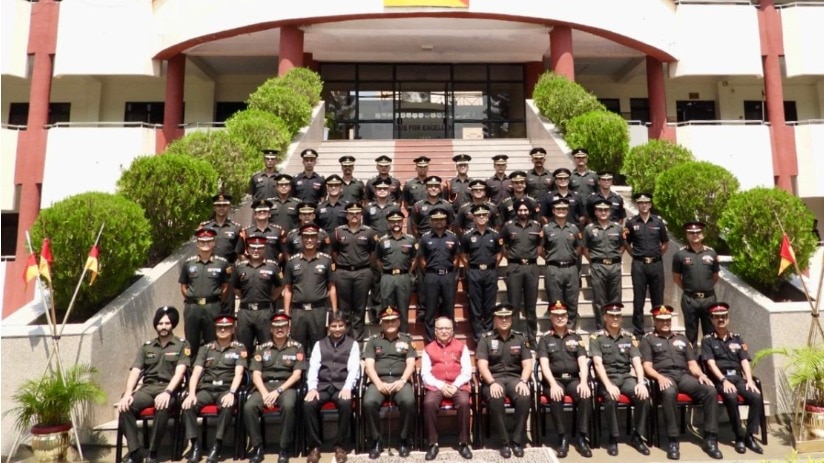
On October 9, 2026, IIT Ropar awarded its first MTech degrees in Defence Technology to 59 officers in Ahilyanagar. Professor Rajeev Ahuja said, “Today, classroom knowledge meets the battlefield. These officers will help India build its own defence technologies.” This joint programme brings advanced engineering education directly to military personnel.
On October 9, 2026, Professor Rajeev Ahuja, Director of the Indian Institute of Technology (IIT) Ropar, who has more than three decades of teaching experience in Europe, conferred the institute’s first M Tech degrees in Defence Technology upon 59 officers of the Armoured Corps Centre and School (ACC&S) in Ahilyanagar, Maharashtra. The first-of-its-kind programme has been developed jointly by IIT Ropar and the Army establishment, pigeonholing a noteworthy effort that can bring advanced engineering education closer to the operational requirements of the armed forces.
The gumption has been shaped by the work of Lieutenant General Surinder Singh Mahal (Retd), a former General Officer Commanding-in-Chief of the Army Training Command, who now serves as Professor of Practice and Managing Director of IIT Ropar’s Defence Research and Innovation Foundation (DRIF).
In an exclusive conversation with India Today, IIT Ropar Director Professor Rajeev Ahuja described the purpose of the programme in a sentence that captures its ambition: “Today, classroom knowledge meets the battlefield. These officers will help India build its own defence technologies.”
Ahuja also underlined the importance of the officers’ research work, observing that their theses and expertise could serve as a bridge between the operational requirements of the armed forces and the institute’s research capabilities.
FROM OPERATIONAL EXPERIENCE TO APPLIED RESEARCH
The distinguishing detail of the programme lies not merely in the degree awarded, but in where and how the teaching takes place.
IIT Ropar faculty travel to the military establishment to teach the officers; the academic programme is thus brought to the officers, rather than requiring serving personnel to leave their institutional setting for conventional campus-based education.
The 24-month-plus programme adopted a rigorous approach, involving several hours of classroom activity. Familiarisation with emerging technologies and advancing terminology was another aspect of the programme, hinting at the evolving requirements of modern warfare.
The programme also included illustrations of machinery and real-world scenarios similar to those encountered during warfare.
This arrangement allows military experience to inform academic inquiry. Officers who have encountered equipment limitations, maintenance difficulties or operational challenges can examine such problems.
Gen SS Mahal, associated with DRIF, emphasised the potential value of the officers’ dissertations. Operational problems, he explained in the campus discussion, could help researchers identify questions that require a thorough look at them.
Where a thesis establishes a viable solution, the work might also provide a starting point for subsequent institutional research and development.
Consider, by way of illustration, a manually operated weapon system whose range settings require repeated human adjustment.
BATTLEFIELD QUESTIONS TURNING INTO RESEARCH PROBLEM
A study examining the automation of those calculations could investigate a defined engineering problem, rather than attempt an entire weapons-system redesign. The example illustrates the kind of problem-solving approach described in the discussion; it is not a claim about a completed thesis.
Not every such study, however, can be published openly. Where military authorities determine that a project contains sensitive information, its examination and dissemination must follow the applicable security requirements.
A classified thesis may be reviewed under restricted arrangements and here institutes like IIT Ropar could play a major role. The confidentiality obligations imposed upon authorised reviewers.
Such restrictions can limit public scrutiny, but they may also be necessary to protect operational capabilities.
Professor Pushpendra Singh, who is closely associated with Anam AI and serves as a project director at IIT Ropar, stressed that the programme responds to the changing technical demands of military service.
Singh opines on how an MTech thesis can serve as a bridge between a complex PhD-level problem and a smaller, practical engineering challenge.
Citing an example, he said "An officer could study the automation of a grenade gun, where range and firing angle are currently determined manually, turning an operational requirement into a defined engineering problem."
“The changing needs and technological advancements are at its centre,” Singh further added, describing the shift from conventional battlefield considerations towards the technical dimensions of drone and missile engagement.
His point is consequential: an operational problem, once identified by an officer, need not end with a report.
Subject to military approval and technical feasibility, it may become the basis of a research question, a prototype or a further development project.
"If a thesis is classified, and the defence personnel or their command decides that its contents should not be made public, it may be treated as a classified thesis and reviewed internally or by a committee under a non-disclosure agreement (NDA). In such a case, the authorised reviewers may be required to sign an NDA, undertaking not to share the information with anyone, in the interest of the country’s safety and security," adds Singh.
THE BATTLEFIELD THAT LIES AHEAD
The need for such an approach became more apparent during Operation Sindoor in May 2025.
The official Indian briefing described drone activity along the western frontier, while subsequent reporting documented the importance of air-defence systems, radar installations and precision strikes during the confrontation.
The episode that was held on display a few months back showed the growing prominence of unmanned systems and integrated air defence in modern military operations.
The future battlefield will demand more than proficiency in individual platforms.
It will require an understanding of sensor fusion, electronic warfare, autonomous systems, resilient communications and command-and-control networks.
Operations in GPS-denied environments, for instance, present problems of navigation, positioning and coordination when familiar signals become unavailable or unreliable.
IIT Ropar's MTech degree programme caters to that requirement to protect the borders.
The US Army’s Advanced Civil Schooling programme enables selected officers to pursue postgraduate studies in science, technology, engineering and mathematics.
The US Defence Advanced Research Projects Agency, meanwhile, supports work on autonomous systems, battlefield sensing and operations in contested electromagnetic environments.
These are not identical to IIT Ropar’s model; they nevertheless reflect a shared concern with translating technical knowledge into operational advantage.
For India, the opportunity lies in making that connection more direct. From research activity at the institute to a new thought-through thesis is proved as an X factor in the programme and time to come will reflect the actual outcomes.
Whether a thesis ultimately produces a deployable technology will depend upon testing, funding, security clearance and the requirements of the armed forces. A degree, by itself, cannot guarantee a battlefield advantage.
In the wars to come, the advantage may belong not only to the force possessing the more advanced machine.