
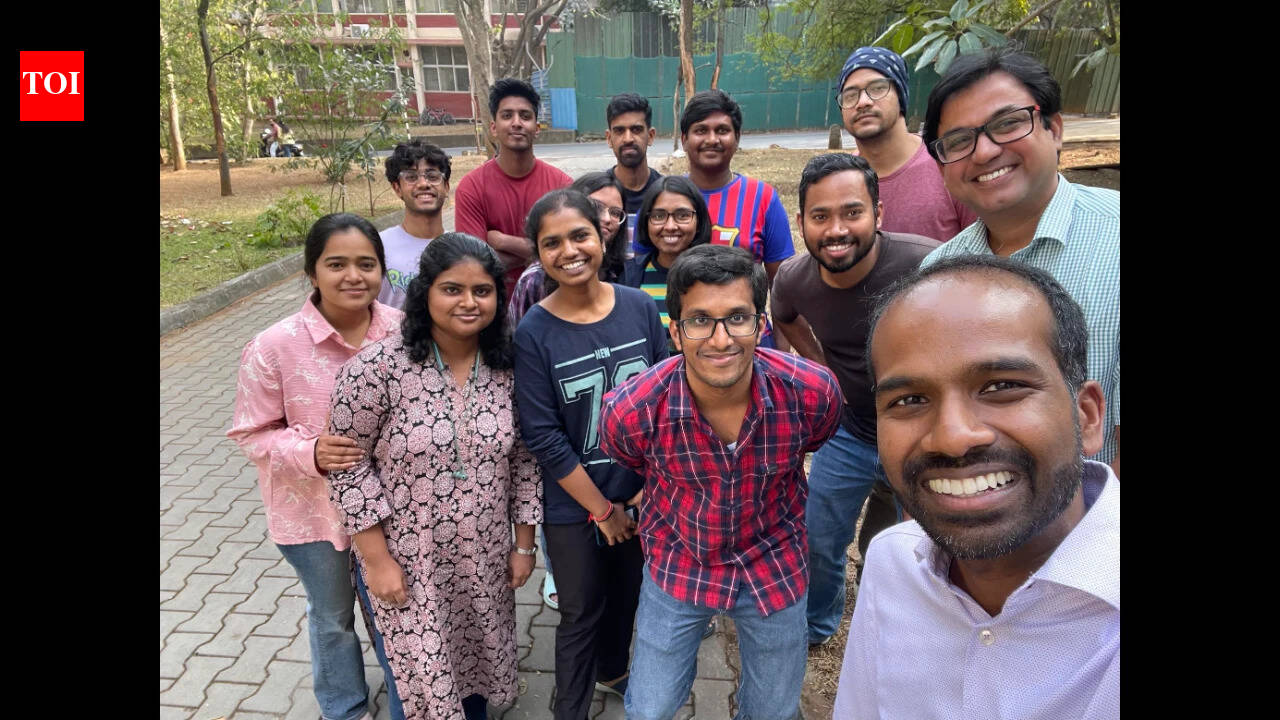
Caltech professor Karthish Manthiram spent a month at IISc in Bengaluru to study protein research. He said, "I have rarely visited a place that shares the ethos of Caltech." Manthiram praised the institute for its deep focus on fundamental science, noting that such patience often leads to major future technologies.
For Karthish Manthiram, a month at the Indian Institute of Science (
IISc) in Bengaluru was less a visit to a leading Indian research institution than a chance to become a student again.The California Institute of Technology professor and winner of the Infosys Prize 2025 in physical sciences spent his sabbatical at IISc's molecular biophysics unit, working with professor Anand Srivastava's group on a field quite different from his own. He chose the group after following its research on proteins and their ability to change shape.But what struck him most was not just the science. It was the culture around it. Manthiram says IISc has something increasingly rare in an era when universities are pushed to produce research that can be commercialised quickly: a willingness to spend years pursuing fundamental questions whose practical applications may not yet be clear."I have rarely visited a place that shares the ethos of Caltech, where I am now," he says. "Caltech has this love of science, this belief that fundamental inquiry is important."
He says the same culture is alive at IISc..
That patience, he says, is not an indulgence. Major technologies often rest on decades of science that initially appears too uncertain, too difficult or too far from commercial use.
Different way of looking at proteins
His own research has largely focused on abiotic chemical transformations, using catalysts and materials to make useful chemicals without biological processes. But he had become increasingly interested in how nature itself performs chemical transformations. He had been following Srivastava's work and, when he got the opportunity to spend a month in India, knew almost immediately whom he wanted to work with.
The research concerned fold-switching proteins. The conventional assumption is that the amino-acid sequence of a protein determines a particular three-dimensional structure. Srivastava's group has shown computationally that some proteins can adopt multiple structures instead.The group has developed Morpheus, a computational method for predicting multiple folds, and a newer version called Morpheus 3D. Manthiram says the work is at the forefront globally. If proteins can shift between different structural states, those states could help explain how biological systems behave and could ultimately open new possibilities for drug development. Manthiram points to proteins linked to circadian rhythms. "If you understand how that works, you then start to have the opportunity to think about what to do about sleep apnea, about narcolepsy," he says.
Excellent researchers & infra
During his sabbatical, he worked in a computational group with access to state-of-the-art CPUs and GPUs. Modern computational biology increasingly depends on access to large amounts of computing power.
He is equally excited about researchers in India. Those trained in Indian institutions who later join his group in Caltech, he says, are "exceptional". They come with strong fundamentals and experience working on frontier problems. IISc, he says, is a "crown jewel" in global scientific recognition.Where he does want students to improve is in how they present their work. Scientists often become so immersed in technical language that they forget what it sounds like to someone outside their immediate field. Manthiram runs workshops at Caltech to teach researchers how to articulate their research vision in a short, clear form, and he held a similar workshop at IISc.
He also teaches young researchers to build a professional presence online. His recent postdocs, he says, told him they had discovered his group through LinkedIn posts about research philosophy, papers or advice on graduate school. That means, to be noticed, researchers have to package their expertise so people can find and understand it.
Communication also makes science move faster. When researchers clearly explain what they are doing, Manthiram says, colleagues can ask better questions, spot problems and suggest new directions.
I had read Anand Srivastava's work. He's a faculty member in IISc's molecular biophysics unit. And when I heard about the Infosys prize, it was apparent to me in a heartbeat as to who I wanted to work with and where I wanted to go. I would learn a lot in this setting, because it was very different from what I had done historically. But that's the magic of a sabbatical. You get to make yourself feel uncomfortable. My only request to Anand was one phrase, five words: 'Treat me like a student.'Karthish Manthiram, Professor, California Institute of Technology