
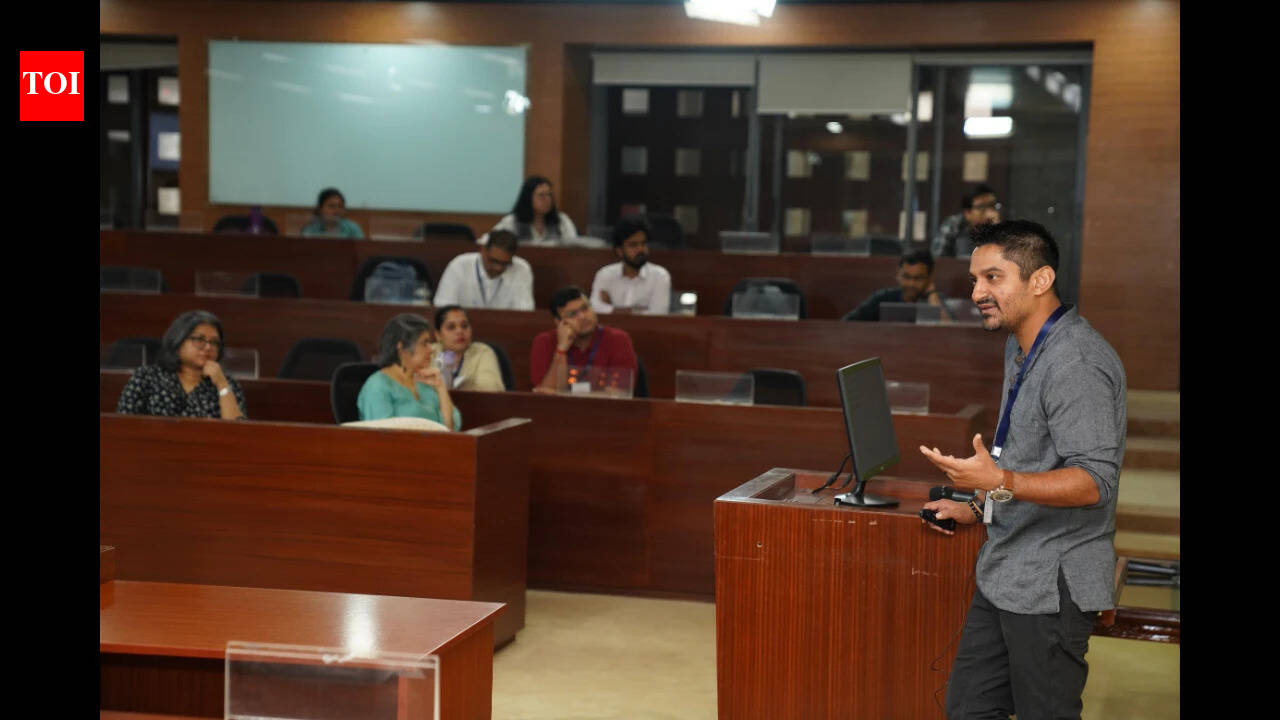
Stanford professor Arun Chandrasekhar said IIM Bangalore faculty are extremely good. He noticed many talented students felt shy about applying to top global universities. He told them, "You miss 100% of the shots you don't take." He believes better information about scholarships and opportunities could help these students succeed.
Arun Chandrasekhar describes IIM Bangalore's faculty as "extremely good". He was particularly struck by the number of research assistants, including undergraduates already doing serious research and preparing for graduate study.
But he noticed something that concerned him. Some of the students he spoke to had interesting research ideas and strong backgrounds, yet were cautious about applying to top global universities and research programmes. He told them: apply anyway.Chandrasekhar is a Stanford professor, an economist who has spent much of his career studying poverty and development in India. He was born and raised in the US, but his family is from Bengaluru. He won the Infosys Prize 2024 in economics, and used his sabbatical to deepen links between IIMB and the research lab he runs in Bengaluru."I was talking to some of the students about where they had applied for postdoc or graduate school, and they are from smart backgrounds, have interesting research ideas, but they're like, shy about the scope of their applications than I would have imagined," he says, and notes the iconic phrase coined by Wayne Gretzky, the Canadian former professional ice hockey player: "You miss 100% of the shots you don't take."
He told them they should apply to a number of places they're not considering. "Because everything is low chance for everybody, but you have really interesting stuff here, and if you get in, the returns are very steep, and if you don't, that's okay," he says.The problem, he says, may be lack of information - about what opportunities exist, what scholarships are available or how institutions assess applicants.One student particularly impressed him. The student had independently learned Lean, a programming language used to formally verify mathematical proofs, to pursue an interest in game theory. Chandrasekhar says he had never encountered someone who was not yet in graduate school but had independently gone that far in learning a specialised research tool. "It's a real achievement and you should take this and run with it," was his message to the student.
Building connections helps everyone
Chandrasekhar was particularly impressed by IIMB's behavioural economics lab, which allows researchers to conduct controlled experiments in simulated markets and games using specialised software, computers and physical infrastructure.
He sees an opportunity to build more links between this and his own work, including his Bengaluru lab. Chandrasekhar is part of the Abdul Latif Jameel Poverty Action Lab, or J-PAL, a global research centre founded in 2003 at Massachusetts Institute of Technology (MIT) by Nobel laureates Abhijit Banerjee and Esther Duflo with the objective of reducing global poverty by ensuring that policy decisions are rooted in rigorous scientific evidence. It's today a global network that helps researchers build field laboratories, recruit research staff, work with local partners and conduct development research.For development economics, that local context matters. Chandrasekhar is conscious of being an outsider even though he has worked on the country for years. IIMB, he says, can gain access to international research networks and infrastructure, while researchers outside India can gain from local knowledge, students and faculty.
His lab has already begun exploring collaborative work in areas including skilling, technology and AI.
Chandrasekhar says universities need not work in isolation from policy organisations, research networks and institutions that have built expertise in conducting field research. Connecting those pieces, he suggests, can give students more exposure, researchers more resources, and policymakers better evidence.
One of the things we do a lot (in Stanford), especially the younger faculty, is spend a lot of time not just socialising, but really picking at each other's research from different fields. You and I as friends, we might go and play basketball together or have a drink together, but at the same time, you, as a macroeconomist, may have modeled individual behaviour in a certain way, which is really strange to me as a person who works on psychology, and we discuss it, and then may eventually even decide to work together on it. But I think the economics faculty there (IIM-B) was more siloed. I was like, you guys should do more of this (interdisciplinary discussions). Because there's so much complementarity.Arun Chandrasekhar, Professor of Economics, Stanford University