
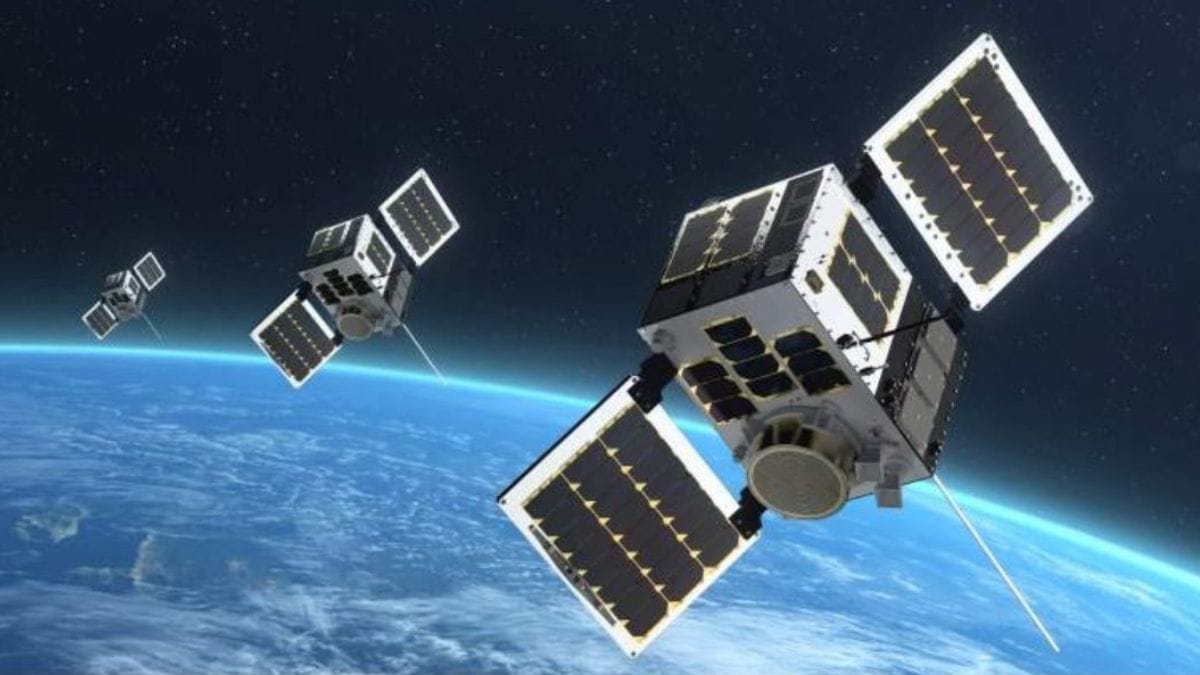
The IAF will get its first dedicated communications satellite, GSAT-7C, by 2030. The Defence Acquisition Council approved the project in November 2021 for Rs 2,236 crore. A source said, "the idea is to help establish a secure channel of communication between aircraft or between an aircraft and ground stations."
GSAT-7C will form part of a military communications network linking satellite infrastructure, ground hubs and software-defined radios (SDRs).
Enabling secure communications beyond line of sight
Unlike conventional radios, which rely largely on hardware designed for specific communication functions, SDRs use software to configure how signals are transmitted, received and processed. This allows their communication capabilities to be modified without replacing the entire radio.
"We cannot give the specifications now, but the idea is to help establish a secure channel of communication between aircraft or between an aircraft and ground stations, especially when conventional radio links cannot reliably connect military platforms," a source in the defence and security establishment said.
Direct radio communications between aircraft, or between aircraft and ground stations, are limited by the curvature of the Earth, terrain and equipment range. Known as line-of-sight (LoS) communication, this method cannot reliably connect platforms separated by long distances or physical obstacles.
Satellite communications help overcome these constraints by relaying signals between users who cannot establish a direct radio link, enabling military platforms to exchange information over much greater distances.
GSAT-7C and its associated ground hubs are expected to strengthen the IAF's ability to maintain secure communications beyond line of sight, particularly when conventional radio links are unavailable or unreliable.
Sources have indicated that the satellite could be launched within the next two years, although ISRO has not announced an official launch date or confirmed the schedule.
The Defence Acquisition Council (DAC), the Defence Ministry's apex procurement decision-making body, granted in-principle approval for GSAT-7C and its associated ground hubs in November 2021. The project was initially approved at a cost of Rs 2,236 crore under the government's Make in India initiative.
India's expanding military space capabilities
India's military space capabilities span four broad areas: communications, surveillance and imaging, electronic intelligence, and navigation.
The country's first dedicated military communications satellite, GSAT-7, also known as Rukmini, entered service with the Indian Navy in 2013. It enables communications between warships, submarines, aircraft and shore-based command centres, supporting naval operations across the Indian Ocean Region.
Its successor, GSAT-7R, also designated CMS-03, was launched in November 2025. Designed to provide higher-capacity communications, it supports secure links between ships, submarines, aircraft and maritime operations centres.
The IAF's GSAT-7A, launched in December 2018, provides communications support to airbases, radars and airborne platforms, while also meeting some Army requirements.
GSAT-7C will add a dedicated satellite communications capability for the IAF, with a focus on secure beyond-line-of-sight connectivity for software-defined radios.
The contract forms part of India's broader effort to strengthen its indigenous military space infrastructure and improve the ability of its armed forces to communicate securely across dispersed operational areas.