
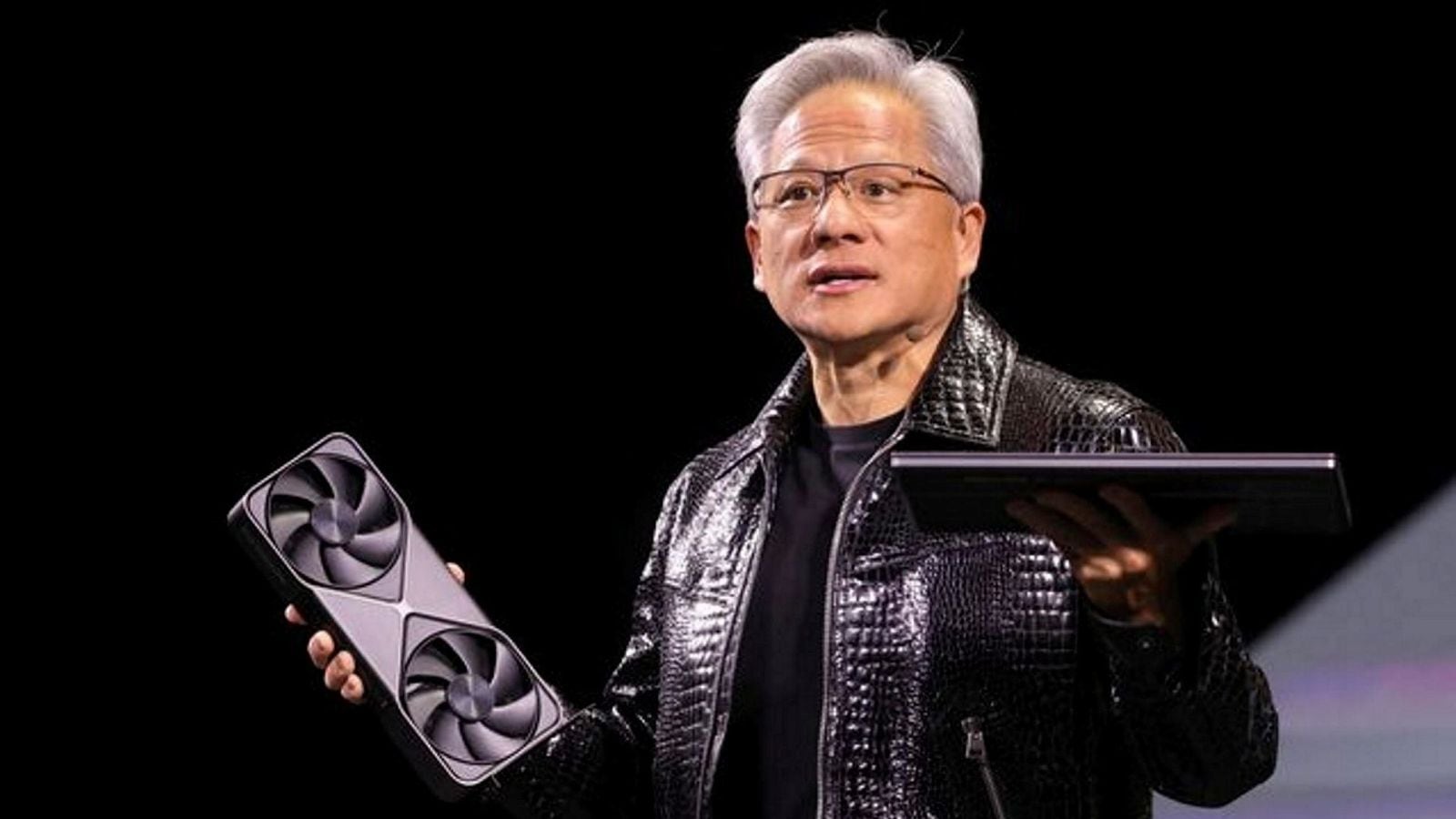
A report published on Thursday, November 12, suggests Chinese AI models like DeepSeek V4 and Moonshot Kimi K3 used export-restricted Nvidia Blackwell chips. Researchers found technical fingerprints within the models’ weights. This news adds pressure on US officials to tighten chip restrictions amid a scandal involving former CEO Jensen Huang.
The report’s findings published on Thursday, November 12, are based on an analysis of the weights of large language models (LLMs) released openly by DeepSeek, Moonshot AI, MiniMax, and Ant Group.
A model’s weights are the billions of adjustable numbers that determine how it processes information and produces answers. They can also reflect the configurations of the chips used to train them, the report said. It claims to provide compelling evidence that closely watched Chinese AI models such as Moonshot’s Kimi K3 and DeepSeek’s V4, bear fingerprints from training on export-restricted Blackwell chips.
The findings come at a time when a spy scandal surrounding Nvidia and its former CEO Jensen Huang has renewed calls by US lawmakers for tougher restrictions limiting China’s access to advanced US chips.
Huang stepped down last week after news reports of a romantic relationship with Alice Huang, a former executive of Singapore-based cloud company Megaspeed, whom US authorities suspect of spying for Beijing. In addition to the extramarital affair he has acknowledged, Huang was also reported to have had at least two other past intimate relationships with Nvidia employees. Beyond these alleged relationships, Nvidia’s potential liability for export control violations may have also influenced its decision to part ways with Huang.
US officials and news reports have previously claimed that DeepSeek and Moonshot AI were using export-restricted Blackwell chips. Unemployment Labs’ report looks to provide technical evidence, extracted from the models’ own published weights, to support these claims.
To be sure, the findings do not show that these models were trained entirely on Nvidia chips or that US-imposed export control laws were necessarily violated. For instance, some Chinese firms are known to remotely access computing resources at offshore data centres in countries such as Malaysia, where Nvidia is permitted to export Blackwell chips.
Still, the report could raise questions about the effectiveness of US export controls and challenge the perception of China catching up with the US in the AI race, if the former’s leading developers still depend on access to cutting-edge Nvidia chips.
What are the key findings of the report?
As part of its investigation, the report said that it recovered traces of the models’ initial values before training adjusts these numbers. These initial values are generated at random by an algorithm called Philox. The researchers then searched for the hardware configurations and initial configurations that reproduce these initial values. For models such as DeepSeek-V4-Flash and Kimi K3, the researchers also confirmed the match on physical Blackwell chips.
In particular, the report found the following:
-Blackwell fingerprints: DeepSeek-V4-Flash and MiniMax-M3 models matched Nvidia’s Blackwell (B200 or B300) chips, which have 148 processor cores called streaming multiprocessors (SMs). DeepSeek-V4-Pro, Kimi K3, Kimi K3.1-Pro, and Ling-3.1-flash models were trained on Blackwell GB200 or GB300 chips which have 152 processor cores.
-Method validation: To verify the accuracy of the method used, researchers analysed 24 AI models whose developers had publicly revealed what hardware they had used to train them. “In every case, our method agrees with the public announcement,” the report said.
-Recent upgrades: The Chinese models trained using Blackwell GPUs are recent ones launched in 2026. For instance, DeepSeek-V3 was released in 2024 and trained on Hopper chips, allowed for export to China, whereas DeepSeek V4 (released in April 2026) read as Blackwell-trained.
-Mixed-generation training: Most of the open-weight models were trained using a mix of Hopper and Blackwell generation of chips. For instance, Moonshot AI’s Kimi K2.7-Code is built on the Hopper-era weights but contains a small part that matches the B200 or B300. The Hopper readings do not identify a specific chip such as H800s, H100 SXMs, and H200s because they share the same fingerprint.
-Large scale training runs: Based on the size of each model and the amount of training data required, the researchers estimated that Kimi K3 and DeepSeek-V4-Pro each needed thousands of Blackwell GPUs running for two to three months.
-Estimated costs: Based on a previous Wall Street Journal report that said 36,000 Blackwell chips installed in Malaysia for ByteDance’s use would cost more than $2.5 billion, the report calculated the cost for some of these clusters to be roughly $200 million to $300 million at roughly $70,000 per GPU. “These figures cover only the final training runs; the labs’ total spending on export-controlled GPUs is likely in the billions of dollars,” it added.
-Notable exceptions: Not every Chinese AI lab relies on Blackwell chips. Models from Alibaba, Zhipu, Tencent, Xiaomi, and StepFun all read as Hopper-trained, as per the report. Meituan, another Chinese developer, trained its LongCat-2.0 model entirely on ‘AI ASIC superpods.’
Why has US imposed chip export restrictions?
Nvidia’s advanced GPUs are widely used to develop cutting-edge AI models, making the company key to the US race against China to build superior AI systems. For years, the US government has sought to limit China’s access to Nvidia’s chips because it does not want the Chinese military to benefit from them.
The Biden administration had introduced broader, tiered restrictions on exporting advanced chips and chipmaking equipment to countries outside the US, including China and India.
However, after returning to the White House for a second term, US President Donald Trump rescinded Biden’s ‘AI Diffusion Rule’, which had imposed new restrictions on chip exports. However, his administration also added more than 80 companies, most of them Chinese, to the US Entity List in 2025, barring them from acquiring US technology on national security grounds.
Despite these curbs, gaps remain. US export controls largely focus on the destination to which chips are shipped, rather than where they are installed or who ultimately uses them. This reportedly allows companies to keep GPUs in data centres in Malaysia and Singapore while allowing customers in China to access the computing power remotely.
Over 2,75,000 Nvidia AI chips were imported to Malaysia in 2024 and 2025, according to nonprofit research organisation Epoch AI.
The export controls have also led to mass smuggling of Nvidia GPUs to China. Analysts estimate that more than 1.5 gigawatts (GW) worth of restricted Nvidia hardware, which could be equivalent to up to 1.5 million GPUs, has reached China, according to a newsletter by semiconductor research firm SemiAnalysis.
Epoch AI estimates that about two million advanced chips entered China in 2024 and 2025 through schemes designed to hide their final destination.
Why has Jensen Huang opposed export curbs?
Former Nvidia CEO Jensen Huang has argued that keeping global markets, including China, open to its chips would help the US maintain its technological lead. He has also lobbied the US government to allow Nvidia chip sales to China, warning that export restrictions are fuelling the rise of competitive homegrown alternatives. Chipmaker Huawei has emerged as China’s top Nvidia competitor, and is reportedly working with DeepSeek to develop its next-generation of AI chips that is expected to be ready in the first quarter of 2027.
In response to reports that its chips were being illegally smuggled into China, Nvidia has previously denied the claims and said that it seems ‘far-fetched’, according to The Information.
Meanwhile, the US Commerce Department, led by Secretary Howard Lutnick, has faced questions over its handling of investigations into suspected chip smuggling. Reports say investigators failed to identify suspicious buyers, and Nvidia officials reportedly intervened in the department’s probe into Singapore-based Megaspeed.