
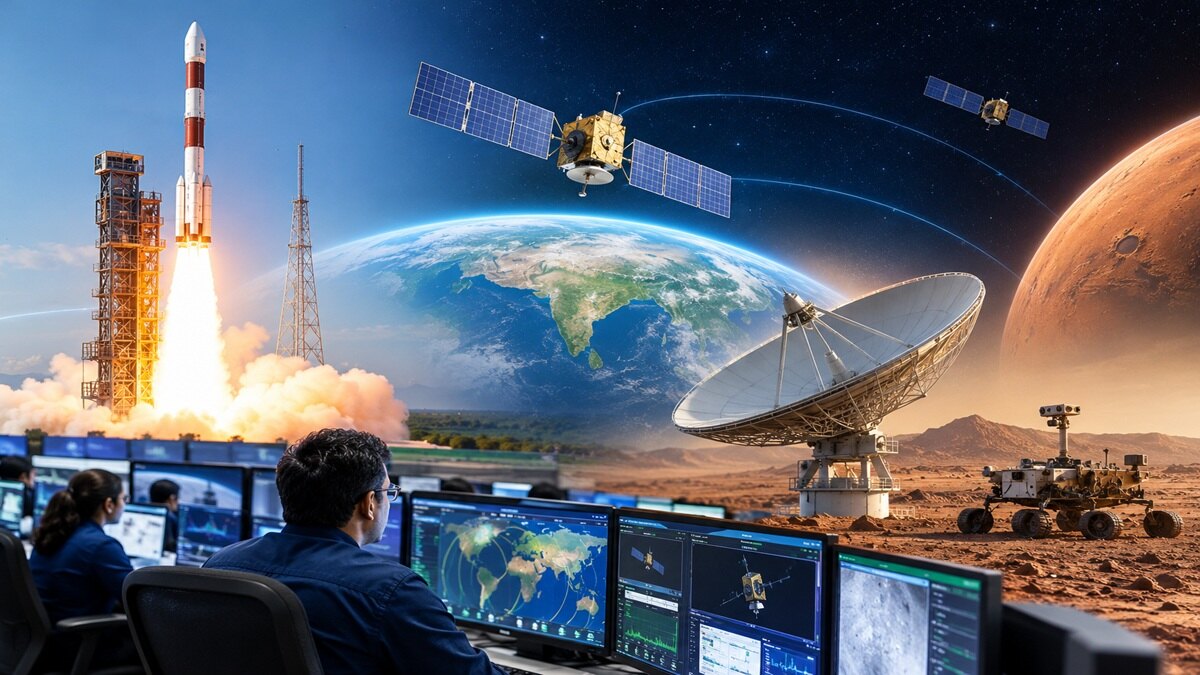
India’s space sector is shifting from government-led missions to building planetary infrastructure. Private firms now design satellites and offer continuous data services instead of just supplying parts. Bengaluru-based Pixxel has six operational satellites in space. Founder Awais Ahmed said, "Planetary infrastructure is about creating the technological foundation to" support global customers.
India's space programme was largely government-led, with private firms mainly supplying components and engineering support for ISRO missions.
This shift is best understood as the move from a mission economy to an infrastructure economy. A single satellite proves that a technology works. Planetary infrastructure, by contrast, requires repeatable manufacturing, dependable operations, continuous data delivery, scalable customer service and recurring revenue.
The change is visible across the sector. Companies are investing in satellite constellations, Earth-observation analytics, launch vehicles and orbital-return systems. Instead of selling hardware once, they are attempting to sell continuous intelligence, connectivity, logistics and services from space.
From government missions to private platforms
India's space programme was historically government-led. Private companies largely supplied components, subsystems and engineering support for missions designed and operated by the Indian Space Research Organisation (ISRO).
That model is changing. Indian firms now design complete satellites, develop launch vehicles, operate constellations and build software platforms that turn satellite data into commercial services. The supply chain is moving from an ISRO-centric model to one where private original equipment manufacturers and startups can own full systems.
The difference is structural. A mission demonstrates capability. Infrastructure requires the ability to manufacture the same system repeatedly, operate it reliably, deliver data continuously and serve customers with different needs.
The earlier model was based on custom, one-off satellites, government as the primary customer, project-based revenue, technology demonstration and an ISRO-led supply chain. The emerging model is instead built around standardised, repeatable satellite platforms, a customer base spanning government, enterprises and global buyers, data-as-a-service and subscription revenue, operational infrastructure and services, and private OEMs and startups owning full systems.
Pixxel: From satellite maker to data business
Bengaluru-based Pixxel designs, manufactures and operates its own hyperspectral satellites, while also building software platforms that make the resulting data usable on the ground.
It has launched nine satellites so far, of which six are operational, said Pixxel founder and CEO Awais Ahmed to The Financial Express Digital. The six operational Firefly satellites deliver five-metre hyperspectral data, and the company says it serves customers including NASA, the US National Reconnaissance Office and other government and commercial buyers globally.
Hyperspectral imaging captures information across many narrow bands of light. Unlike ordinary optical imagery, it can help identify material and chemical signatures -- useful for crop health, soil conditions, water quality, mineral exploration, pollution monitoring and infrastructure inspection.
"Planetary infrastructure is about creating the technological foundation to meet that need, bringing together different observation capabilities and intelligence systems to support decisions at scale," Ahmed said.
He added that Pixxel is expanding into multiple sensing technologies and sovereign space systems for agriculture, natural resources, environmental monitoring and national security.
Pixxel's model shows how founders are thinking beyond individual products. The company is not merely selling a satellite; it is building a vertically integrated business spanning satellite manufacturing, constellation operations, data processing and commercial analytics.
Rs 1,200-crore national constellation
The clearest example of the infrastructure model is the Pixxel-led consortium selected under IN-SPACe's public-private partnership initiative to develop India's national Earth observation constellation.
The consortium includes Pixxel, Dhruva Space, PierSight and SatSure. It will design, build, own and operate a 12-satellite system over five years, with an estimated investment of more than Rs 1,200 crore.
The constellation will combine very-high-resolution optical, multispectral, hyperspectral and synthetic aperture radar (SAR) capabilities, supported by ground infrastructure and value-added analytics.
Each technology serves a different purpose:
* Optical and multispectral imaging can support land, crop and infrastructure monitoring.
* Hyperspectral imaging can detect material, chemical and environmental signatures.
* SAR can observe through cloud cover and at night, making it useful for disaster response, flood mapping and all-weather surveillance.
The value lies in the combined system rather than any single spacecraft. A constellation can provide frequent, layered and more reliable observation than an individual satellite, creating a national Earth-intelligence capability for government departments and commercial users.
Why the economics are changing?
Constellations are changing the unit economics of space. Building standardised satellites in batches can reduce the cost per satellite, while operating a fleet creates recurring revenue through imagery, analytics and data subscriptions.
The commercial opportunity is no longer limited to selling a satellite. Companies that own satellites, ground systems and analytics software can sell continuous intelligence from orbit -- information about crops, water, infrastructure, disasters, mines, forests and security-related activity.
The customer base is also widening. Beyond ISRO and defence, demand is emerging from agriculture, insurance, climate services, infrastructure, energy and logistics companies that need timely information about land, assets and environmental change.
Capital is following that logic. Investors are increasingly backing companies that can scale production and operations rather than those pursuing one-off demonstrations. Pixxel's $100 million Series C round, reported as India's largest spacetech funding round, reflects this preference for companies building satellite fleets and commercial data businesses.
Beyond observation: The need for return infrastructure
Earth observation is only one part of the emerging orbital economy. Another is the ability to send payloads into space, conduct experiments or manufacturing in microgravity, and bring them back safely to Earth.
Dr Aravind IB, co-founder of Inbound Aerospace, argues that India's space programme has reached an inflection point: the country is moving beyond proving it can reach orbit towards building systems for sustained orbital operations.
"India's space programme is at an inflection point, moving beyond proving we can reach orbit and building the necessary infrastructure for sustained orbital operations," he said to The Financial Express Digital.
He pointed to ISRO's Gaganyaan human spaceflight programme, the proposed Bharatiya Antariksh Station and Chandrayaan-4 as steps towards capabilities such as human spaceflight, rendezvous and docking, in-orbit refuelling, microgravity research, in-space manufacturing and safe return from space.
The Bharatiya Antariksh Station's first module, BAS-01, is targeted for launch in 2028, with a five-module station planned by 2035. ISRO has identified microgravity research, in-orbit refuelling, rendezvous and docking, and in-space manufacturing as priorities for sustained orbital operations.
"Affordable launch is transforming one half of the equation; the next frontier is making return from space just as routine, reliable and affordable," Dr Aravind said.
Inbound Aerospace and orbital logistics
Inbound Aerospace is developing orbital return infrastructure for repeatable microgravity missions, in-space manufacturing and payload recovery. Unlike conventional satellites that remain in orbit, its proposed spacecraft would operate independently after launch, supporting scientific experiments, pharmaceutical research, advanced materials development and in-space manufacturing.
The company's stated differentiator is re-entry and precision landing capability, intended to enable payload recovery at locations across Earth.
The commercial logic is straightforward: launch capacity alone does not create a complete orbital economy. Companies also need ways to recover high-value products, biological samples, manufactured materials and experimental hardware from space.
This becomes more important as the International Space Station approaches decommissioning around 2030 and NASA shifts towards commercial low-Earth-orbit destinations. Microgravity access is expected to move from a single government-operated laboratory to a more distributed, commercially viable ecosystem.
"Building the orbital return infrastructure is as important to this emerging economy as building the infrastructure to reach it," Dr Aravind said.
What are the challenges behind the shift
Building planetary infrastructure is capital-intensive and technically risky. Space companies need sustained funding for satellite manufacturing, launches, ground stations, insurance and operations before recurring revenue becomes meaningful. Industry leaders identify funding, specialised talent, testing infrastructure and access to space-grade components as key bottlenecks.
Technology risk is equally significant. A constellation business depends on reliable satellite operations, consistent data quality and timely deployment; a failed launch or malfunction can delay revenue. For return-vehicle companies such as Inbound Aerospace, safe re-entry, precision landing and repeatable payload recovery remain unproven execution challenges.
Regulatory clarity has improved through IN-SPACe's authorisation framework, but India still lacks a fully codified space law. Indian firms also face global competitors with larger balance sheets, mature constellations and established customer bases.
India's market opportunity
India's space economy was valued at about $8.4 billion in 2022, or roughly 2% of the global market. IN-SPACe's decadal vision projects it to reach $44 billion by 2033, or about 8% of the global space economy, including $11 billion in exports.
Inbound Aerospace raised $1 million in 2026, an early-stage amount compared with the capital needed to commercialise reusable re-entry vehicles. India's funding is also concentrated: Skyroot, Pixxel and Agnikul have together raised more than half of the sector's private capital, while most other startups operate with under $10 million.
Achieving that growth will require more than successful launches. India will need larger domestic manufacturing capacity, wider access to launch and testing infrastructure, reliable ground segments and sustained demand for commercial space services.
Indian companies will also need to compete internationally. The next stage of growth will depend on whether firms can move from technology demonstrations to operating space systems at scale, winning global customers and generating recurring revenue.
Also, the next phase of India's space economy will be decided less by who launches a satellite and more by who can operate infrastructure reliably and convert orbital data into usable products. Companies that combine manufacturing scale, constellation operations, ground infrastructure and data analytics are likely to capture more value than pure hardware suppliers. The winners will be those that turn satellites into services, data into decisions and orbital capability into dependable infrastructure.
As Pixxel CEO Ahmed put it, the industry's progress will be measured "by both the capabilities we put into orbit and by how effectively we translate them into intelligence and outcomes on the ground."