
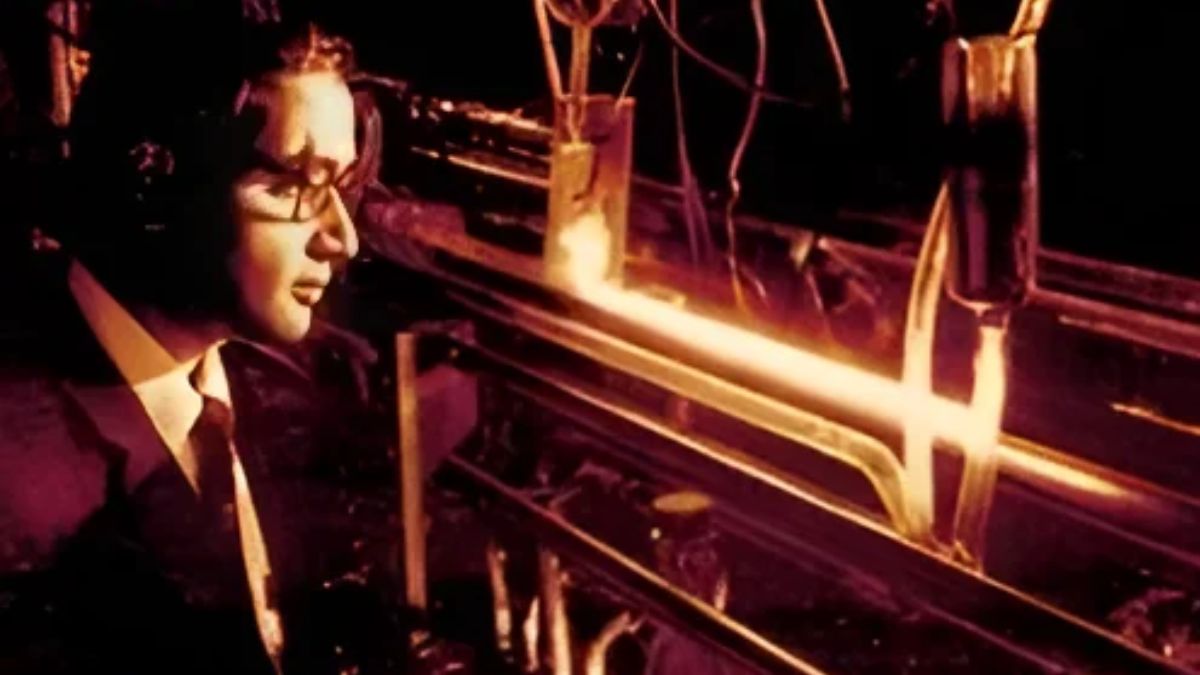
C. Kumar N. Patel invented the carbon dioxide laser at Bell Labs in the 1960s. While many researchers lost interest in gas lasers, Patel succeeded by using molecules. Today, his invention is used to cut steel and helps surgeons treat cancers. He said it was the most exciting moment.
Late one night at Bell Labs in New Jersey, a young Indian engineer switched on an experiment and watched a laser exceed 10 watts. C. Kumar N. Patel later described it as the most exciting moment of his career.
By the standards of the early 1960s, that was a startling number. By mid-1964, by his own account, he had built a laser that produced 100 watts continuously. In his 1995 oral history for the IEEE, he said it was the first laser of any kind to reach that level.
The device was the carbon dioxide (CO2) laser. Six decades on, the National Inventors Hall of Fame (NIHF) says it has more practical applications than any other laser. Today, Patel's invention is used far beyond scientific laboratories. The CO2 laser he developed is used by industries to cut, weld and drill materials such as steel, ceramics and plastic. In medicine, it helps surgeons perform highly precise procedures and treat certain cancers, including small cancers of the mouth and throat. The technology has also found applications in military systems, including range finding.
This is the story of the man behind it, who is now 88 and whose career runs from a small Maharashtra town to Stanford, Bell Labs, UCLA and his own company.
The laser breakthrough that others had given up on
By 1963, researchers around the world were struggling to develop powerful gas lasers.
Most gas lasers could produce only around 10 to 50 milliwatts of power. According to Patel, many researchers had already lost interest in the technology and considered it little more than a scientific curiosity.
But Patel decided to continue working on it.While most researchers were concentrating on solid-state lasers, he chose to focus on gas lasers.
He believed that atomic systems wasted much of the energy supplied to them. He therefore turned his attention to molecules, whose energy levels were closer to the ground state.
He selected carbon dioxide because it was a simple and stable molecule made up of three atoms. His calculations showed that it could work particularly well at a wavelength of 10.6 microns. When he tested the idea, it worked.
Patel then added nitrogen to the mixture. Nitrogen could store energy and transfer it efficiently to carbon dioxide molecules. This helped the laser's output cross one watt almost immediately.
The Lemelson-MIT Program says that the combination produced the first gas laser capable of continuously emitting high power in 1964.
In simple terms, 1963 marked the discovery of laser action in CO2, while 1964 marked the development of the high-power laser.
Why he walked away from the race to build a more powerful laser
Patel's invention soon attracted attention from the US government.
The Defence Department became interested in the technology because of its potential military applications. At the time, newspapers often portrayed powerful lasers as futuristic weapons or "death rays". A 100-watt laser was described as looking like a "brick glowing white."
But Patel was not interested in joining a race to build increasingly powerful lasers.
He decided to step away from that work. He believed that increasing the laser's power was mainly an engineering challenge. He preferred research where the main question was discovering something new rather than finding ways to make an existing invention more powerful.
Others continued developing the technology, and the CO2 laser eventually found applications across several industries.
From cutting steel to treating cancer
The CO2 laser went on to become one of the most widely used lasers in the world.
According to the National Inventors Hall of Fame, industries use it to cut, weld, engrave and drill materials such as metal, ceramics and plastic. Military organisations also use it for range finding.
It has also become important in medicine.
CO2 lasers allow surgeons to make precise cuts and are used in several types of medical procedures. Laser scalpels help doctors operate on delicate areas with greater accuracy. A 2012 review published in a peer-reviewed oral-surgery journal noted that CO2 laser resection had become the preferred treatment for small cancers of the mouth and oropharynx.
Patel's contribution to medical technology also brought him recognition from professional medical organisations. He became an honorary member of the Gynecologic Laser Surgery Society in 1980 and the American Society for Laser Medicine and Surgery in 1985.
The invention is protected by US Patent No. 3,596,202, according to the National Inventors Hall of Fame. Patel holds 36 US patents related to lasers and their applications.
A childhood of tutors and a car jack
Chandra Kumar Naranbhai Patel was born on July 2, 1938, in Baramati, then-Bombay Presidency of British India.
According to his 1995 IEEE oral history, his father worked as a civil engineer in government service, while his mother was a homemaker. His elder brother became a doctor, and his younger sister went on to become a high school science teacher.
The family moved several times during Patel's childhood, and he was taught at home by tutors. When he finally entered a formal school at the age of 11, his test results placed him in Grade 10, according to the National Inventors Hall of Fame.
His interest in understanding how things worked began much earlier. At just four years old, Patel discovered that a car jack could lift his father's desk off the floor. He spent time trying to understand how the device worked.
That curiosity stayed with him throughout his life. "If you see something and you don't know how it works, figure it out," he later told the National Inventors Hall of Fame.
Patel never initially planned to become a scientist. He chose engineering because he was good at science and maths and wanted to get into a highly competitive college that selected just 100 students from around 100,000 applicants. He wanted to join the Indian Foreign Service, but was four years too young to take the entrance exam. His father suggested using the time to pursue a PhD, a decision that eventually changed his career.
A one-year bet that brought him to America
In 1958, at the age of 19, Patel left India for the United States to pursue higher studies. He had completed his bachelor's degree in telecommunications from Poona University.
He did not leave India with plans to settle abroad. His intention was to complete his PhD, return home, appear for the foreign-service examination and build a career as a diplomat. His father agreed to finance his education, but there was one condition. He would support Patel for just one year. After that, Patel would have to manage on his own. If he could not make it, he could return to India and find a job.
Even though Patel had been among the best students in India, adjusting to the American education system was not easy.
He later explained that language was not the problem. The bigger challenge was the pace of studies. American universities conducted courses and examinations every three months, while India's British-style education system followed a pattern of one major examination every year.
It took him an entire quarter to understand how different the system was.After completing his first year, Patel secured a research fellowship. This helped him manage his expenses and meant he no longer had to depend on the financial support promised by his father.
As time passed, his plans to return to India began to change. He realised that he enjoyed doing science more than anything else he could imagine.
According to the Engineering and Technology History Wiki, he completed his master's degree in 1959 and earned his PhD in 1961.
Patel later became a naturalised US citizen in 1970, By then, he had already developed the CO2 laser at Bell Labs.
His achievements also brought him recognition in both countries.
In the US, he was elected to the National Academy of Sciences in 1974 and the National Academy of Engineering in 1978. He went on to become president of the American Physical Society in 1995.
India also recognised his contributions. The Association of Indians in America gave him its Honour Award, dated 1975 in his Optica biography. The Indian National Science Academy and the Institution of Electronics and Telecommunications Engineers also named him a Foreign Fellow.
At Stanford, Patel's professor, Dean Watkins, gave him almost complete freedom to work independently. When Patel offered to include him as a co-author, Watkins refused, saying he had not contributed to the research. Patel later said the experience taught him to choose the right research problems and maintain honesty in science.
He chose Bell Labs despite its lower salary
After completing his PhD, Patel began looking for a job in April 1961. He interviewed with three major companies: IBM, Raytheon and Bell Labs. Bell Labs offered him the lowest salary among the three.
Yet he chose to join Bell Labs.
The reason was simple. The company gave researchers the freedom to decide which problems they wanted to work on. That mattered more to Patel than the money.
During his interview, when he was asked what he wanted to work on, he proposed laser spectroscopy. He admitted that he knew very little about lasers beyond the basic idea of what they were.
His future boss, P.K. Tien, gave him a month to study the subject and report back.
Patel joined Bell Labs in a particularly important year for American science. He recalled that Arno Penzias, who later won the Nobel Prize, also joined the laboratory in 1961.
Patel described it as possibly the best year for new recruits at Bell Labs. He linked the growing interest in scientific research to America's increased investment in science and technology after the Soviet Union launched Sputnik.
A young engineer from Baramati was among those who benefited from that push.
The CO2 laser was not his only invention
Although the CO2 laser remains his best-known contribution, Patel continued working on other scientific problems.
In 1969, he invented the spin-flip Raman laser, which was the first tunable infrared laser. A year later, in 1970, he developed a laser-based technique that could detect extremely small amounts of pollutant gases.
He put this technology to use in 1973 when his system recorded how levels of nitric oxide in the stratosphere changed over time. The findings helped scientists understand how human-made emissions were affecting the ozone layer.
From scientist to research leader
By the early 1980s, Patel had taken on a leadership role at Bell Labs.
He became director of AT&T Bell Labs' Electronics Research Laboratory. According to the Lemelson-MIT Program, he developed a reputation for actively supporting the research work of others.
He later became executive director of the Research, Materials Science, Engineering and Academic Affairs Division.
Patel left Bell Labs in 1993. He then joined UCLA as Vice Chancellor for Research, a position he held from 1993 to 1999.
He had co-chaired the society's study of the Strategic Defense Initiative, popularly known as the "Star Wars" missile-defence programme. He also argued that public policy was one of the biggest challenges facing scientists. He believed researchers needed to build stronger connections with a public that had become increasingly disillusioned with science, as he told The Scientist.
The awards and recognition
Patel's work earned him some of the highest honours in American science. He received the IEEE Medal of Honor in 1989.
In 1996, then US President Bill Clinton presented him with the National Medal of Science, one of the country's highest scientific honours. In 2012, Patel was inducted into the National Inventors Hall of Fame for his work on the CO2 laser.
Starting a company after three decades at Bell Labs
Even after spending more than 30 years at Bell Labs, Patel was not ready to step away from scientific work. In February 2000, at the age of 61, he founded Pranalytica in Santa Monica, California. He became its CEO and chairman.
The company works on mid-infrared quantum cascade laser systems and instruments used to detect gases.
Its business grew over the following years. In 2009, Laser Focus World reported that Pranalytica had won an Army-backed research contract with Harvard University to improve its quantum cascade lasers.
Patel expected the company to sell 25 of its 4.6-micron lasers to defence customers by December that year.
A National Academies biography later described Pranalytica as a leader in quantum cascade laser technology for defence and homeland security.
The company was an example of how a scientist born in a small town in Maharashtra went on to build a business supplying advanced technology to the US defence sector.