
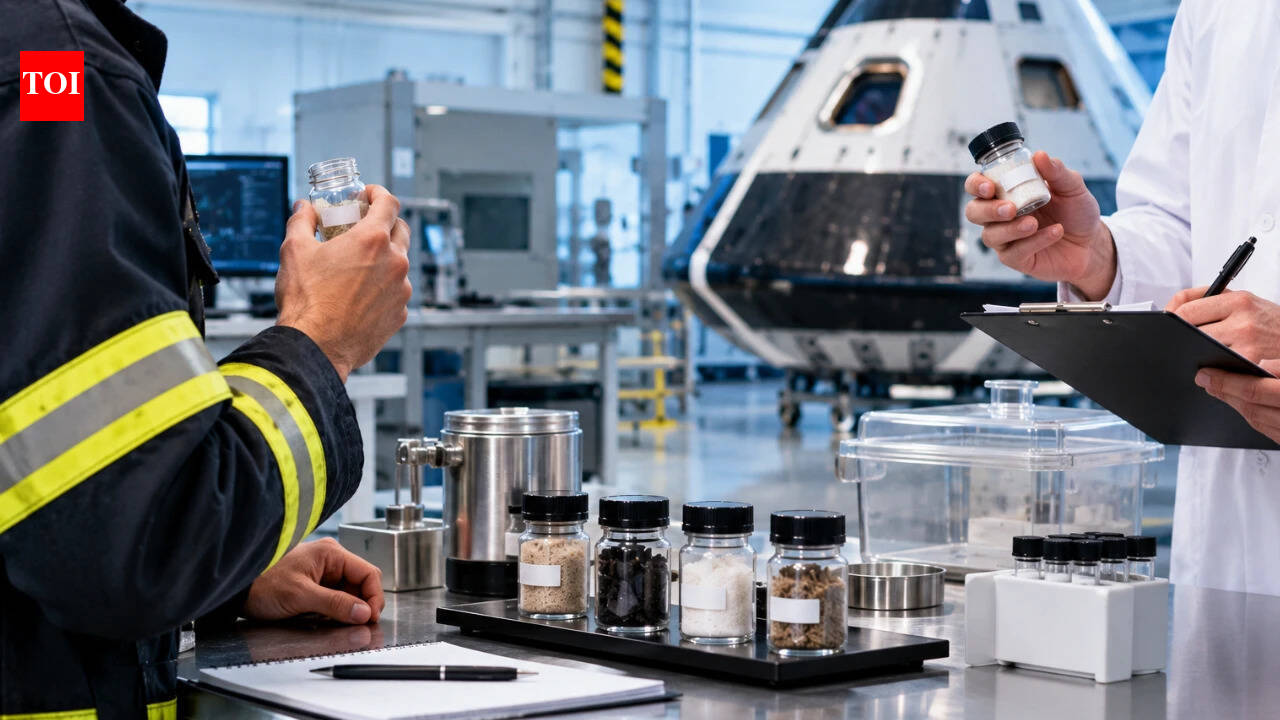
George Aldrich joined NASA’s White Sands Test Facility in 1973 at age 18. He started as a firefighter but soon joined the agency’s odor panel. He spent decades testing spacecraft materials for smells before astronauts took them to space. By 2005, he had smelled well over 780 substances for NASA.
Spacecraft cabins are sealed spaces where air is cleaned and recirculated rather than replaced, so a material that gives off a strong or irritating smell cannot simply be aired out. For this reason, space agencies test the odours of materials and equipment before use, along with other tests such as toxicity and flammability. Some of this testing is done by people rather than machines, because the human nose is still the best way to judge whether a smell is acceptable. One such person started as a firefighter at the test facility in the American Southwest, where an older colleague recommended that he join the agency's odor panel because of his youth and good health. The volunteer position eventually became a decades-long commitment alongside his day job of testing materials for toxicity.
George Aldrich joins White Sands Test Facility in 1973 Chemistry World reported in 2018 that George Aldrich joined NASA's White Sands Test Facility in New Mexico in 1973, straight after graduating from high school, at the age of 18. He is not a chemist and never attended university. His father used to work at the facility and gave information about five temporary employees and Aldrich got one of them before becoming a fire guard.
The fire chief, who belonged to NASA's first odour panel, told him about it. By 2005, he had been working at NASA for more than 30 years, and
ABC News reported that he had smelled well over 780 substances by then.How five panelists rate a sample from 0 to 4NASA's Johnson Space Center describes an odor mission as a test run by five certified panel members, chosen randomly from a larger pool and screened for sensitivity of smell. Under NASA's standard odor-assessment procedure, the material is placed in a specimen container and heated to 50°C (±3°C) for 72 (±1) hours before the container is cooled to ambient temperature. The panelists then enter one by one and are exposed to the vapour three times. Each panel member rates the odor on a scale from 0, meaning "undetectable," to 4, meaning "revolting." Under NASA's standard, an average score of 2.5 or higher is considered objectionable or revolting. In NASA-STD-6001B, a material is considered to be failing if the average odor rating of the panel is 2.5 or higher. Aldrich discussed his work at White Sands in an interview featured by ScienceAlert.An extended 15-minute odor test developed at White Sands The NASA technical report Elaborated Odor Test for Extended Exposure describes a test that grew out of an incident. Accidental exposure to a proprietary bonding material revealed that it had an irritating odor. This test refers to Test 6, Odor Assessment, which is an additional test for NASA-STD-6001B. After obtaining permission from the Johnson Space Center Industrial Hygienist, White Sands conducted a 15-minute test to create realistic conditions. The gas was first proven to be non-toxic during Test 7, Determination of Offgassed Products. The panelists were then placed in a small chamber near the material with closed air handlers and doors. They wafted the gas toward themselves and documented odour and physiological effects during the 15-minute test and afterward.More than 780 materials by 2005 ABC News reported in 2005 that Aldrich had smelled well over 780 substances and had not missed NASA's calibration test, in which panelists must detect seven basic odors: musky, minty, floral, ethereal, camphoraceous, pungent and putrid. During the visit, he was evaluating a cork NASA planned to use in its shuttle while a chemist pumped air from the chamber into a facemask. In October 2018, Chemistry World reported that George Aldrich had completed more than 900 odour tests during his 45 years on NASA's odour panel. ScienceAlert has reported that he received a Silver Snoopy Award. Chemistry World alsonoted that the smelling is volunteer work, separate from his official role of conducting toxicity tests on objects before they go into space.A 1970s aborted mission and the olfactory effects of spaceflight analoguesChemistry World reported that in the 1970s, the Russians abandoned a space mission soon after lift-off because of an unpleasant smell in the capsule and that humans are used in odour detection tests because they are the best predictors of how a smell will affect astronauts. Separate research has explored whether smell perception may change under simulated spaceflight conditions, although the findings are based on an analogue rather than direct evidence from spaceflight. The study Marked olfactory impairment in idiopathic intracranial hypertension points out that many long-duration astronauts develop signs of raised intracranial pressure and that some report nasal congestion and subjective olfactory impairment.The researchers prospectively tested 19 IIH patients and 19 matched controls using both the University of Pennsylvania Smell Identification Test and Sniffin' Sticks threshold testing, then repeated the measures upright and in a 6° head-down tilt. They found significantly worse thresholds and identification scores in IIH and noted that head-down tilt also mildly reduced threshold detection, supporting a microgravity-relevant mechanism.The study compared smell perception in patients with idiopathic intracranial hypertension and healthy controls to investigate whether the condition was associated with changes in olfactory function. The researchers used head-down tilt as a ground-based analogue of fluid shifts in microgravity. The study found impaired smell function in patients with idiopathic intracranial hypertension, with greater impairment under simulated microgravity conditions. Because head-down tilt is only a ground-based analogue of microgravity, the findings raise questions about how smell perception might change during spaceflight, but they do not show that astronauts' sense of smell changes in space.What the supplemental odor assessment covers under NASA-STD-6001BThe same NASA report describes Test 6 as an optional additional test for programs where odour is a concern, rather than a requirement for every program. It also notes that the typical supplementary exposure lasts less than 10 seconds, which is why White Sands developed the 15-minute exposure test. In practice, items that pass toxicity testing go on to the odour panel, so panelists such as Aldrich act as a human check late in the screening process. Aldrich's work fits into this narrow niche: a brief human test of materials that have already passed every other examination.