
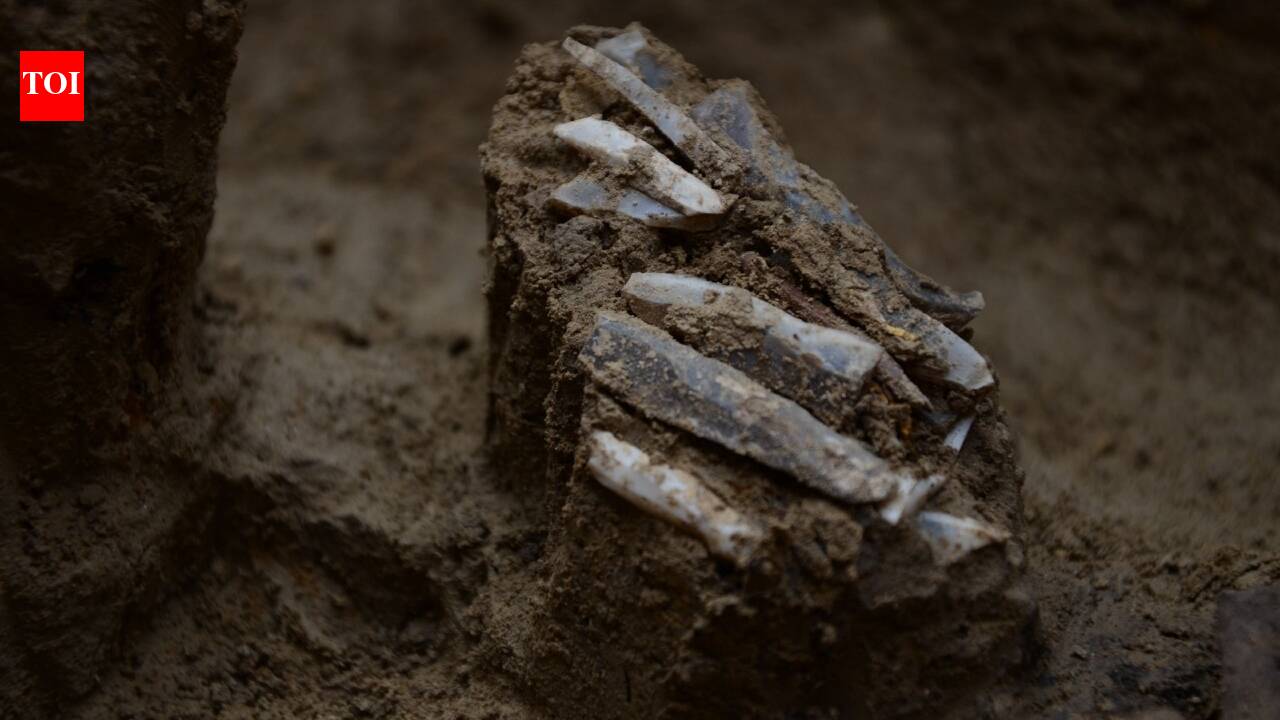
In 2007, a Czech man found a strange stone in his garden that turned out to be a 3,000-year-old Bronze Age weapon-making tool. The mould, used to forge spearheads, sat in a barn foundation for years. Experts from the Moravian Museum finally identified the volcanic rock as a prehistoric treasure.
Sometimes, history slips into our lives without any dramatic entrance. Take the case of a worn-out stone, tucked away in the foundation of a barn in a little Czech village. For years, it simply held up the building. If anyone thought about it at all, they probably saw it as just another chunk of rock. But here's the twist: when archaeologists finally got their hands on it, they realized this slab wasn't just ordinary. It was a 3,000-year-old Bronze Age casting mould, used to forge weapons!
This story began back in 2007, though the stone itself dates to around 1350 BCE. The barn stood in Morkůvky, South Moravia, and nobody suspected their foundations were built atop a relic of prehistoric industry. You can imagine the archaeologists' surprise when they identified this volcanic rock as a tool used to make bronze spearheads. And the stone had its own passport, as it's believed to have journeyed hundreds of kilometers from the Carpathian region, probably northern Hungary, before ending up beneath the Czech barn.The artefact itself is about 23 centimeters long, weighing just over a kilo. It's got a negative impression carved into one side, scorch marks from repeated heating, and traces of old metalwork.
There's a whole story written in these details -- the story of ancient craftsmen and weapon making during the Late Bronze Age.
Discovering the mould: one homeowner's garden surprisePer Futura Sciences, the tale really got rolling when a local, J. Tomanec, spotted a rectangular stone poking out from his garden in Morkůvky. It turned out this stone had been used in the barn's foundation, and nothing about it screamed 'archaeological treasure.' But its unusual shape caught the attention of specialists from the Moravian Museum's Archaeological Institute.When they took a closer look, they found a perfectly preserved impression of a spearhead. This wasn't some random groove or accident; rather, it was a carefully carved cavity meant for shaping molten metal. After years of acting as a construction worker, the mould got a second life. It was handed over to the Moravian Museum in 2019, and officially added to their collection in 2024.Researchers wanted to know everything. So, they dove into scientific studies, published their findings in Archeologické rozhledy in 2025, and drew in geologists from Masaryk University. The discovery made headlines, first in Czech Radio International, then in international science journals.
How ancient metalworkers turned stone into weapons
The mould wasn't just a relic; it was an industrial tool from prehistory. It originally came as a pair of stone halves, though only one side survived. The halves would have been wired together, copper wire holding them upright. Bronze would be poured into the cavity, with a core added to form a hollow space for the spear's shaft.
The result? Socketed, lance-shaped spearheads, with a blade featuring raised ridges that made them easy to identify. Modern tech, like X-ray fluorescence, found traces of copper and tin -- just what you'd expect in Bronze Age metalwork. The stone itself shows signs of being exposed to serious heat, and not just one time. It was likely used again and again, maybe dozens of times.Permanent stone moulds let ancient metalworkers churn out weapons with consistent shapes and sizes, making manufacturing quicker and more reliable.The stone: a link to ancient HungaryNow, here's where things really get interesting: the mould's volcanic rock, rhyolite tuff, grew in the Carpathian region, not the Czech area where it was found. Antonín Přichystal, a geologist, traced its basic source to northern Hungary, mostly around the Bükk Mountains, with a bit of similar stone also found in southeastern Slovakia.That means the mould made a long journey, probably carried along ancient trade routes. Nobody knows exactly who carved it, or how it got to Moravia, but the evidence points to Bronze Age people moving materials over huge distances.This hints at connections between distant communities more than 3,000 years ago. And it shows that these ancient craftsmen were savvy, as they had access to specialised materials and knowledge sometimes found far from home.
What does the mould tell us about the Urnfield culture?
Researchers think this mould ties in with the Urnfield culture, a group that spread across Central Europe in the Late Bronze Age. The name comes from their unique burial practice, i.e., cremating the dead and placing ashes in urns buried in fields. The Urnfield culture was a hotbed for advances in metalworking, weapons production, and regional exchange networks.
Typically, these sorts of casting moulds surface during digs at settlements or burial sites. Finding one in a barn foundation is unusual. It might have traveled from an Urnfield site nearby before ending up in its new home.The mould also hints at the period's military gear. Milan Salaš, from the Moravian Museum, described Late Bronze Age warriors as heavily equipped: think spears, shields, helmets, and leg armor. He even compared them to Homeric warriors in the Trojan War, who carried two spears so they'd have a backup after throwing one.
Why this discovery matters
This isn't just an archaeological oddity. The Morkůvky mould shows how ancient workers manufactured weapons, traded specialised materials, and shared technological know-how across regions. Its preservation is special, as stone moulds from the Bronze Age are pretty rare finds.
But maybe the most profound lesson is about how we picture the past. Production with reusable tools, standardised weapons, and sourcing materials from far-off places aren't modern inventions. People 3,000 years ago already had these practices down.The most charming part? This ancient tool spent decades beneath a barn, quietly doing construction work, invisible to everyone around it. History sometimes hides in plain sight, just waiting for someone curious to look a little closer.