
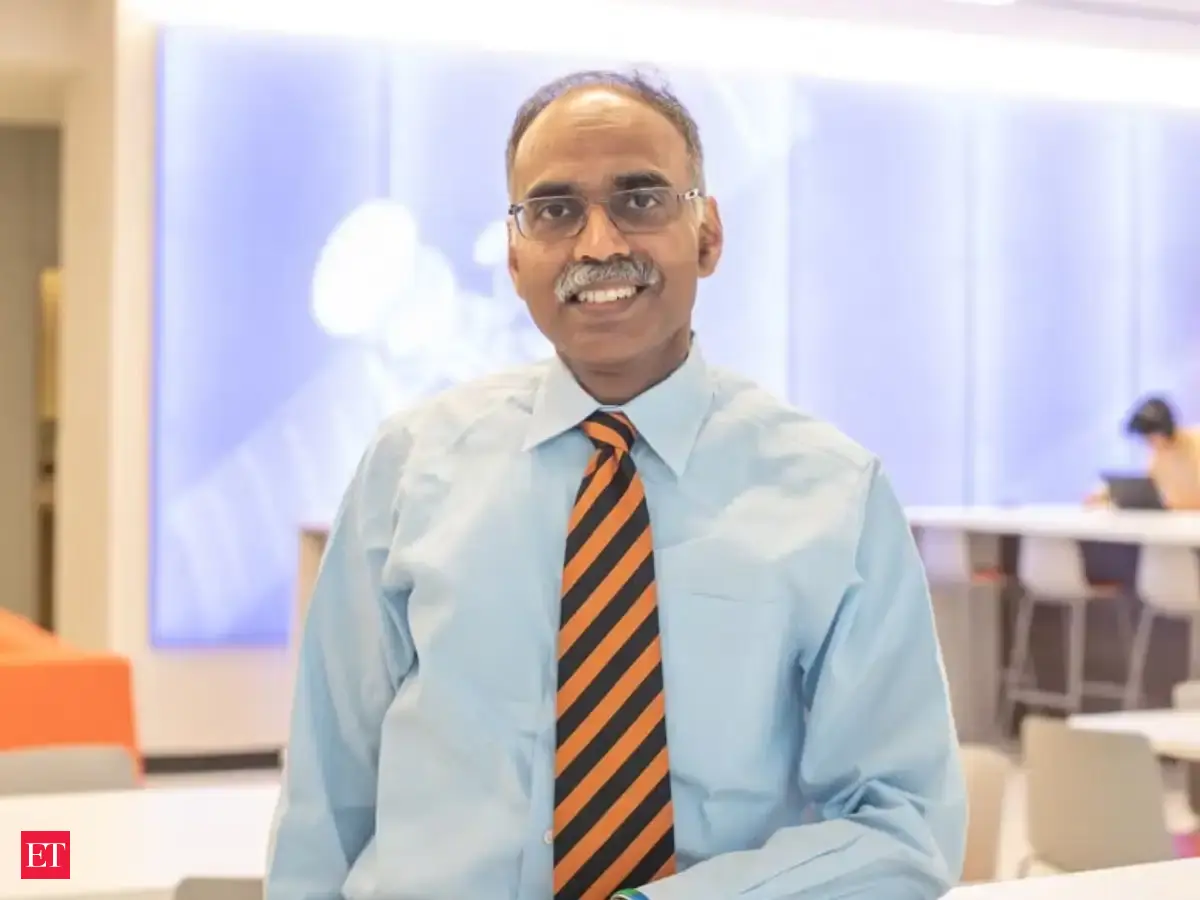
IISc alumnus Maruthi S. Akella is among eight scientists selected for the institute’s annual alumni honours. His research group helped guide the Intuitive Machines IM-1 mission, the first US Moon landing in over 50 years. In October 2024, the International Astronomical Union named an asteroid after him for his work.
Maruthi S. Akella, a University of Texas professor and IISc alumnus, is among eight scientists and engineers selected for IISc's annual alumni honours. His research group contributed to the onboard guidance algorithm for the Intuitive Machines IM-1 mission, which achieved the first US Moon landing in more than 50 years. An asteroid has also been named after him.
Maruthi S. Akella, an aerospace engineering professor at the University of Texas at Austin whose research group contributed to the onboard guidance algorithm for the first US Moon landing in more than 50 years, is among eight scientists and engineers being honoured by the Indian Institute of Science (IISc) this year.
Akella is receiving recognition as part of IISc's Distinguished Alumnus/Alumna Awards and Young Alumnus/Alumna Medals. His work focuses on the guidance, navigation and control of complex systems, including autonomous spacecraft, robotics and other advanced aerospace technologies.
His research group contributed to the onboard guidance algorithm for Intuitive Machines' IM-1 mission, which achieved the first US Moon landing since the Apollo era. The mission marked a significant milestone in American lunar exploration, more than five decades after the last Apollo Moon landing.
From IISc alumnus to aerospace engineering professor in the USAkella has been a faculty member at the Cockrell School of Engineering at the University of Texas at Austin since 1999. He directs the Controls Group for Distributed and Uncertain Systems (C-DUS Group) in the university's Department of Aerospace Engineering and Engineering Mechanics.
He completed his Master of Engineering in Aerospace Engineering at IISc after earning a Bachelor of Technology degree in Mechanical Engineering from the National Institute of Technology Calicut. He later obtained a PhD in Aerospace Engineering from Texas A&M University.
His research covers autonomous space vehicles, spacecraft navigation, cislunar astrodynamics, hypersonic vehicle control, miniature robots operating in environments without GPS connectivity, and cooperative systems involving robot swarms.
The work combines theoretical research with experimental validation and has found applications in spacecraft systems, astrodynamics and vision-guided robotics.
Asteroid named Maruthiakella in recognition of his researchAkella's contributions to astrodynamics have also received recognition beyond the engineering community. In October 2024, the International Astronomical Union designated asteroid number 5376 as Maruthiakella in his honour.
The minor planet, located in the main asteroid belt, was named in recognition of his contributions to astrodynamics and their applications.
More than 260 research papers and major international awardsAkella has published more than 260 research papers in peer-reviewed journals and conference proceedings. His work in aircraft and spacecraft guidance, navigation and control, particularly nonlinear attitude estimation and control, has earned him several international honours.
These include the AIAA Mechanics and Control of Flight Award, the American Astronautical Society's Dirk Brouwer Award, the IEEE Control Systems Society Award for Technical Excellence in Aerospace Control and the IEEE Judith A. Resnik Space Award.
His other distinctions include being named a Fellow of the American Institute of Aeronautics and Astronautics, the Institute of Electrical and Electronics Engineers and the American Astronautical Society. He is also an Academician of the International Academy of Astronautics.
In 2026, he received the AIAA von Kármán Lecture in Astronautics Award and the Joe J. King Professional Engineering Achievement Award. He was also named a VAIBHAV Fellow by the Indian government's Ministry of Science and Technology in 2025.
Akella currently serves as Editor-in-Chief of the Journal of the Astronautical Sciences and is on the editorial board of the AIAA Journal of Guidance, Control, and Dynamics.