
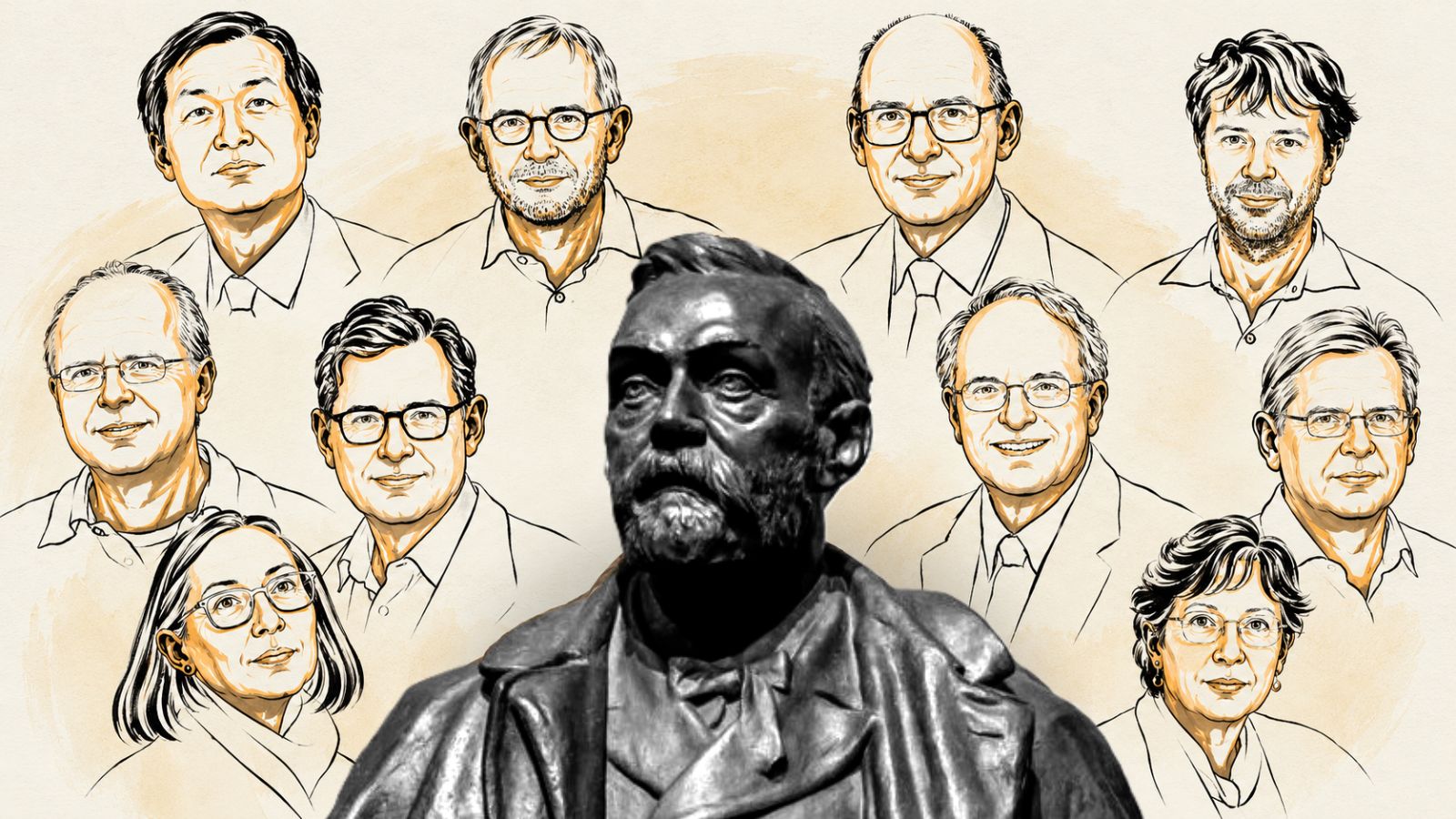
The 2026 Nobel Prizes recognized winners across six categories for their scientific and academic contributions. These laureates studied at institutions ranging from KU Leuven to Harvard University. Their long journeys through various global universities shaped the groundbreaking research that eventually got them these prestigious awards in their respective fields today.
The 2026 Nobel Prizes have been announced across six categories, recognising discoveries in science, contributions to literature and peace, and advances in economic research.
Behind this year's laureates are years of education and research at universities across the world. From KU Leuven in Belgium to Harvard University and the Massachusetts Institute of Technology (MIT) in the US, their academic journeys span institutions that have shaped their work.
Here's a look at where the 2026 laureates studied and the institutions they were associated with.
Nobel Prize in Physics 2026: Francis Halzen
Why did he win? Halzen was recognised for his work on the IceCube Neutrino Observatory, which uses Antarctic ice to detect high-energy neutrinos and investigate distant astrophysical sources.
Born in Belgium, Halzen completed his master's degree in physics and mathematics in 1966 and his PhD in physics in 1969 at KU Leuven. After working at CERN, he joined the University of Wisconsin-Madison in 1972. At the time of the award, he was the Gregory Breit Professor and Vilas Research Professor at the University of Wisconsin-Madison.
Nobel Prize in Chemistry 2026: Henri B. Kagan and Kenso Soai
Why did they win? Kagan and Soai were recognised for discoveries showing how chemical reactions can amplify an imbalance between mirror-image molecules, helping produce molecules with specific structures.
French chemist Henri B. Kagan graduated from the École Nationale Superieure de Chimie de Paris in 1954 and completed his doctorate at the College de France in 1960. He joined the academic staff at what became Université Paris-Sud in 1967, becoming a professor in 1973. He was professor emeritus at Université Paris-Saclay when the award was announced.
Japanese chemist Kenso Soai earned his bachelor's degree in chemistry from the University of Tokyo in 1974, followed by a master's degree in 1976 and a doctorate in 1979. He joined Tokyo University of Science in 1981, became an associate professor in 1986 and a full professor in 1991. He is professor emeritus at Tokyo University of Science at the time of the award.
Nobel Prize in Physiology or Medicine 2026: Karl Deisseroth, Peter Hegemann and Georg Nagel
Why did they win? Their discoveries helped scientists use light-sensitive proteins to control nerve-cell activity, creating optogenetics, a technique that has transformed research into the brain and nervous system.
American neuroscientist Karl Deisseroth graduated from Harvard University with a bachelor's degree in biochemical sciences in 1992. He earned his PhD in neuroscience in 1998 and MD in 2000 from Stanford University. He established his laboratory at Stanford in 2004 and was a professor of bioengineering and psychiatry and behavioural sciences there when he received the prize.
German biophysicist Peter Hegemann studied chemistry at the University of Münster and biochemistry at Ludwig Maximilian University of Munich, completing his doctorate at the Max Planck Institute of Biochemistry in 1984. He later joined Humboldt University of Berlin, where he became a professor of experimental biophysics.
Georg Nagel studied biology and biophysics at the University of Konstanz before completing his doctorate at Goethe University Frankfurt in 1988. He undertook postdoctoral research at Yale University and Rockefeller University before returning to Germany. He was associated with the University of Würzburg, where he held a professorship in molecular plant physiology and later continued as a senior professor.
Nobel Prize in Literature 2026: Anne Carson
Why did she win? Canadian poet and classicist Anne Carson was honoured for inventive writing that brings classical traditions into dialogue with contemporary literature, blending poetry, prose and translation.
Carson enrolled at the University of Toronto's St Michael's College in 1968. After briefly leaving university, she returned to study Greek poetry and earned a bachelor's degree in 1974, a master's degree in 1975, and a PhD in classics in 1981. Her academic training informs works such as Eros the Bittersweet and Autobiography of Red. She later taught at McGill University and the University of Michigan.
Nobel Peace Prize 2026: Navanethem 'Navi' Pillay
Why did she win? South African jurist Navi Pillay was recognised for promoting peace and international law through decades of work on human rights and international justice.
Born in Durban in 1941, Pillay earned a BA in 1963 and an LLB in 1965 from the University of Natal. She later completed an LLM at Harvard Law School in 1982 and a Doctor of Juridical Science degree in 1988. Her career included serving as a judge of South Africa's High Court, president of the International Criminal Tribunal for Rwanda and United Nations High Commissioner for Human Rights from 2008 to 2014.
Nobel Prize in Economic Sciences 2026: Robert E. Hall and Michael Woodford
Why did they win? Hall and Woodford were recognised for research connecting individual economic decisions with wider economic fluctuations, helping explain how policy affects inflation, spending and employment.
Robert E. Hall earned a bachelor's degree in economics from the University of California, Berkeley, before completing his PhD at MIT in 1967. He joined Stanford University in 1978, where his research examined consumption, employment and economic fluctuations. At the time of the award, he was a professor of economics at Stanford and a senior fellow at the Hoover Institution.
Michael Woodford earned his bachelor's degree from the University of Chicago, a law degree from Yale University and a PhD in economics from MIT in 1983. After academic appointments at several universities, he returned to Columbia University in 2004. He was the John Bates Clark Professor of Political Economy at Columbia when he received the award.