
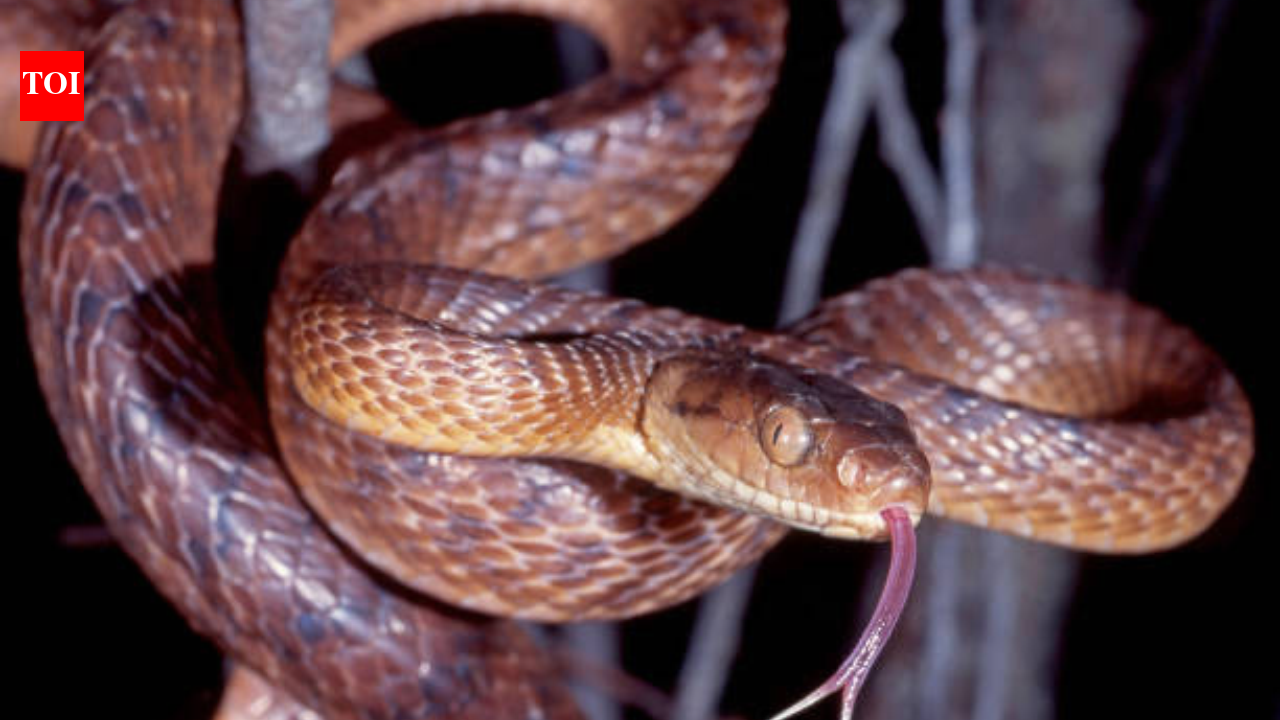
In February 2026, an experiment in Guam showed invasive brown tree snakes can swim over 3 km. This discovery worries experts protecting endangered ko'ko' birds on nearby Cocos Island. While the study was informal, it proved these predators could potentially cross the water, threatening the birds' fragile new breeding grounds.
Imagine a snake slipping into the sea, its slender body cutting through the water as a tiny island sits just beyond the shore. On that island, a flightless bird that vanished from Guam's wild landscape is beginning to breed again. The distance between the two shores is only a few kilometres. For the bird, that narrow stretch of ocean may be the difference between survival and another devastating setback.
This is not simply a hypothetical wildlife thriller. In February 2026, an unusual experiment in Guam examined whether invasive brown tree snakes could swim far enough to reach nearby Cocos Island, where conservationists have been rebuilding a population of the endangered ko'ko', or Guam rail. The results offered an unsettling glimpse into how difficult it can be to protect vulnerable wildlife on small islands.
A question from social media led to an unusual experiment
The person behind the trials was Farron "The Guam Guy" Taijeron, a local content creator and environmental enthusiast. What began as a question on social media developed into an experiment involving 21 brown tree snakes. Taijeron released and followed the snakes in the water across different locations and weather conditions, documenting how they behaved.
The results varied considerably. Some snakes remained in the water for nearly two hours, while others sank within three minutes. One swam more than three kilometres, farther than the approximately 2.4-kilometre distance between the coast near Malesso' and Cocos Island.Other observations were equally striking: the snakes were filmed climbing onto floating objects, including a coconut and a kayak.However, the experiment was an informal investigation rather than a controlled scientific study. It demonstrated that some brown tree snakes can remain afloat and travel through water for considerable distances, but it did not establish how frequently they cross open water or prove that swimming was responsible for any particular snake reaching Cocos Island.That distinction matters because the island's conservationists have already faced the threat they are trying to prevent.
The snake that nearly erased Guam's native birds
Brown tree snakes (Boiga irregularis) are native to parts of Australia, Papua New Guinea, Indonesia and the Solomon Islands. They were accidentally introduced to Guam in the years following World War II, probably through military cargo shipments.
Over subsequent decades, the nocturnal, tree-climbing predators spread across the island. Their diet includes birds, eggs, lizards and small mammals, prey that had evolved without this particular predator.The ecological consequences were devastating. The US Geological Survey reports that brown tree snakes contributed to the loss of nine of Guam's 11 native forest bird species, along with severe declines in other wildlife. The Guam rail, known locally as the ko'ko', was among the species pushed to the brink of extinction in the wild.The ko'ko' is a small, flightless bird that moves quickly through dense vegetation. Its ground-nesting habits leave eggs and young vulnerable to predators. By 1985, only 21 birds remained in the wild on Guam, and they were captured to establish a conservation breeding programme.For a species that once lived widely across the island, survival came to depend on captive breeding, careful management and finding safe places where populations could be restored.
Cocos Island became a lifeline for the ko'ko'
Located just off Guam's southern coast, Cocos Island offered conservationists an opportunity to re-establish a wild population away from the island's devastating snake pressure.
In 2010, conservationists began reintroducing ko'ko' to the island as part of a long-term recovery effort.The effort has yielded encouraging signs. At a Guam Museum presentation in February 2026, wildlife biologist Lauren Thompson of the Guam Department of Agriculture's Division of Aquatic and Wildlife Resources estimated that between 24 and 36 ko'ko' were thriving on Cocos Island.But the recovery remains vulnerable.
Cocos Island has already faced a brown tree snake invasion
The swimming experiment attracted attention because it suggested one possible way snakes might reach nearby islands. Yet the documented history of Cocos Island shows that the danger is not hypothetical.
In 2020, the US Geological Survey confirmed that a population of invasive brown tree snakes had become established on Cocos Island. Following reports from a local fisherman, response teams removed four adult snakes capable of breeding and five juveniles. Surveys and efforts to control and eradicate the snakes followed.The discovery nevertheless demonstrated how quickly an invasive predator can threaten a conservation site.For an island supporting endangered wildlife, even a small number of invasive snakes can have serious consequences. The priority is therefore not simply to respond when a snake is spotted, but to detect arrivals early and prevent a breeding population from becoming established.