
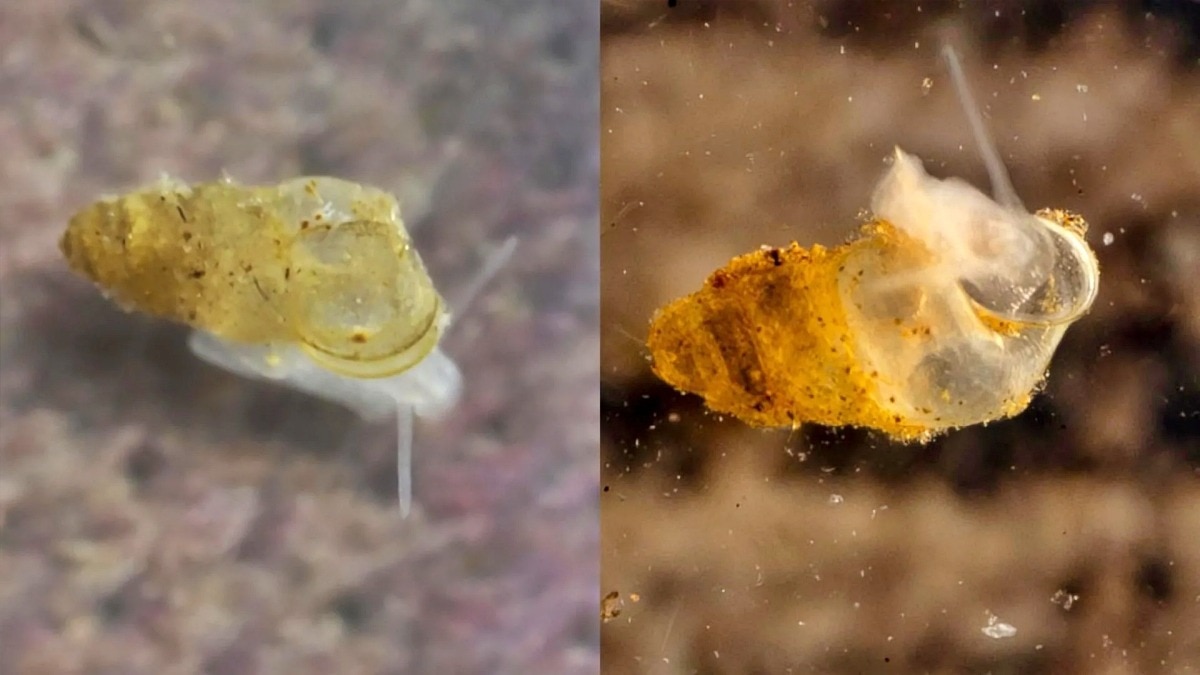
Scientists discovered a tiny, eyeless snail named Erhaia dijiang in a Chinese mountain cave. The creature has a translucent shell and lives in total darkness. During an August 2025 investigation, researchers found only three living specimens. Experts said the species' conservation outlook is "far from optimistic" due to its tiny population.
A tiny, nearly transparent creature that has lost its eyes and appears to have been built for life in complete darkness has been discovered in a mountain cave in China, offering scientists a rare glimpse into the mysterious world of underground freshwater ecosystems.
Named Erhaia dijiang, the newly identified freshwater snail has evolved remarkable adaptations to survive in a habitat where sunlight barely penetrates. Its delicate, unpigmented body, cone-shaped translucent shell and long, slender tentacles give it an almost ghostly appearance.
The discovery, published in the journal Subterranean Biology, marks an important milestone in the study of China's underground biodiversity.
Until now, freshwater cave snails had not been documented in the country, highlighting how little scientists know about the aquatic life thriving beneath its landscapes.
The snail's name draws inspiration from ancient Chinese mythology. Researchers named it after Di Jiang, a faceless mythical creature described in the ancient text Classic of Mountains and Seas (Shan Hai Jing). The reference reflects the snail's unusual appearance, particularly its complete loss of eyes.
Laboratory observations revealed just how strongly the species is adapted to darkness. When exposed to light, the snails consistently retreated into dark spaces beneath rocks, suggesting an extreme sensitivity to illumination.
A LIFE HIDDEN BENEATH THE MOUNTAINS
Scientists discovered Erhaia dijiang at an elevation of 2,062 metres, making it the highest-altitude cave snail recorded in the family Erhaiidae.
The tiny mollusks inhabit shallow underground waters less than a metre deep, living among submerged gravel and broken rocks. Water temperatures remain close to 20 degrees Celsius, offering a relatively stable environment.
Despite seasonal heavy rains that increase water flow and occasionally wash snails out of the cave entrance, researchers have not found them in nearby streams. Their known distribution remains restricted to within two metres of the cave entrance.
Observations suggest that the snails feed on diatoms, microscopic algae growing on rock surfaces. In laboratory conditions, they also consumed fish food provided by researchers.
JUST THREE LIVING SPECIMENS FOUND
The discovery has also raised concerns about the species' survival. During the team's first field investigation in August 2025, researchers found only three living adult snails and one empty shell. No juveniles were discovered.
The researchers described the species' conservation outlook as "far from optimistic", given its apparently tiny population and extremely restricted habitat.
Because cave-dwelling animals often depend on specialised environments, even local disturbances could threaten their survival. Their limited distribution also makes it difficult to assess population size and reproductive success.
Scientists are calling for more extensive surveys of China's cave systems to identify other undiscovered species and establish conservation measures before fragile underground ecosystems are irreversibly damaged.
The discovery of Erhaia dijiang points to the fact that some of Earth's most unusual life forms may remain hidden in darkness, waiting to be found.