
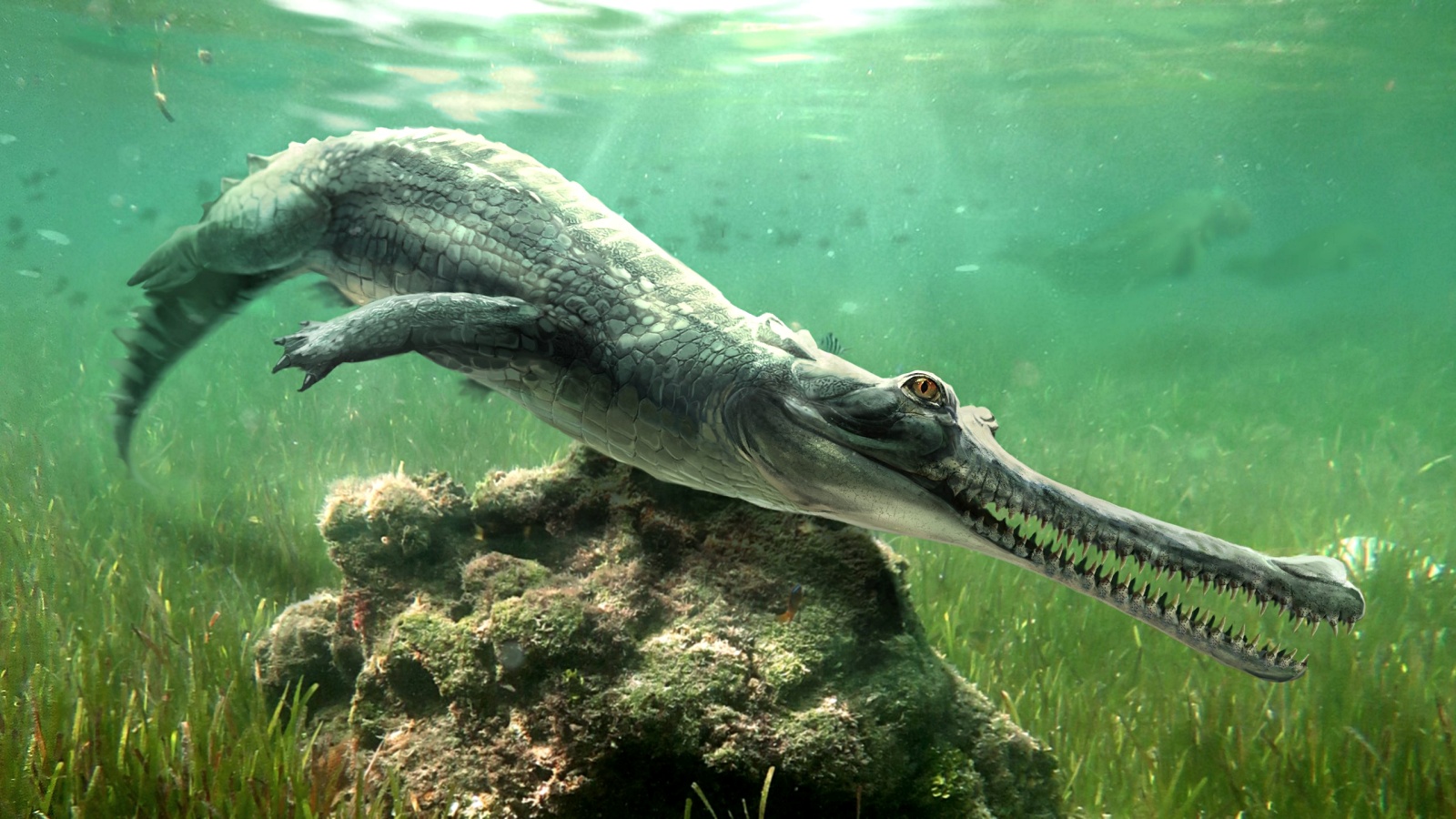
Scientists identified a new extinct crocodile species, Herugavialis cairensis, in 45-million-year-old Egyptian fossils. These remains, found in the rocks used for the Great Sphinx, resemble India’s gharial. Lead researcher Paul Burke said, "We named the new crocodile species Herugavialis cairensis, after the Egyptian god Heru, who may have inspired the monument."
Scientists have identified a new extinct crocodilian species in 45-million-year-old Egyptian fossils. Named Herugavialis cairensis, it resembles India's gharial.
The rocks used to build Egypt's famous Great Sphinx of Giza hold a surprising secret: they contain fossils of an extinct crocodile species that resembles India's long-snouted gharial.
Named Herugavialis cairensis, the ancient reptile lived around 45 million years ago. Scientists identified it by re-examining fossils discovered in Egypt nearly a century ago, including a remarkably well-preserved skull. One unusual detail caught their attention: the tip of the snout was missing, much like the Sphinx's nose.
How did scientists discover the new species?
Paul M. J. Burke, lead scientist of the study, posted this on Linkedin while sharing his paper published in The Royal Society:
"In this study, we evaluated the internal cranial anatomy of over 43 crocodylians, including alligators, caimans, gharials and 'true' crocodiles. We describe the variation in the internal cranial anatomy features, such as the encephalic endocast, where the brain would've been housed, the endosseous labyrinth (or inner ear), as well as the paratympanic sinus and nasal cavity structures. This work was completed over the last 4 years, where I would spend numerous hours segmenting crocodile skulls, and I am so pleased to see it finally be published."
The scientists found the fossils in the 1920s in Egypt's Mokattam Formation, a geological formation dating back about 45 million years. Researchers initially thought they belonged to Tomistoma, a genus that includes the false gharial found in Southeast Asia.
However, using computed tomography (CT), scientists examined the inside of the fossil skull and identified differences that set it apart from Tomistoma. Their findings established that the remains belonged to a previously unknown species.
The name Herugavialis cairensis draws on both its resemblance to gharials and its Egyptian connection. Heru, also known as Horus, is an ancient Egyptian god who may have inspired the Sphinx.
"Given this similarity to the Sphinx, we named the new crocodile species Herugavialis cairensis, after the Egyptian god Heru, who may have inspired the famous monument," said Paul Burke, a researcher at the Swedish Museum of Natural History and the study's lead author.
What makes it similar to India's gharial?
The gharial (Gavialis gangeticus), found in rivers across North India, is recognisable by its long, narrow snout. Its close resemblance to the extinct Egyptian species offers a glimpse into a time when gharial relatives were much more widespread.
Today, two living species belong to this group: the gharial, found in South Asia, and the false gharial (Tomistoma schlegelii), found in Southeast Asia. Fossils show that their ancient relatives once lived across much of the world for more than 100 million years, including in shallow seas.
Herugavialis cairensis was not alone in ancient Egypt. At least two other gharial species lived in the shallow marine environments that covered much of the region at the time.
"The Mediterranean region has had a great diversity of crocodiles over the last 50 million years," Burke said.
That diversity changed alongside shifts in global temperatures and sea levels. Eventually, crocodiles disappeared from the region around six million years ago.
The findings were published in the journal Royal Society Open Science on October 7, 2026, in a study titled Cranial anatomy of the Middle Eocene Egyptian crocodylian Herugavialis cairensis provides new insights into gavialoid diversity in the Mediterranean region. The research involved scientists from the UK, Sweden, Germany and Egypt.
Explore more captivating stories about pets and animals here, and make us your daily stop for the latest from the animal kingdom.