
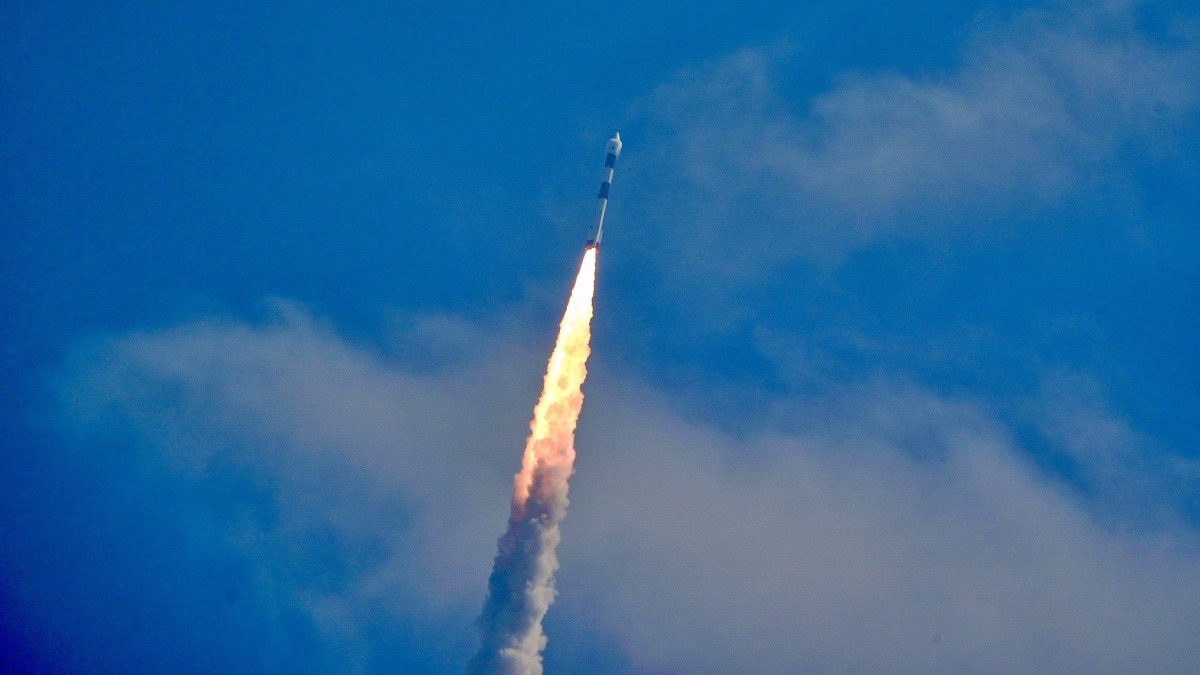
Isro Chairman Dr V. Narayanan announced on Tuesday that the L&T-HAL consortium received five PSLV missions. "Now the L&T and HAL consortium has been given five PSLV missions. So the rocket is getting ready," he said. This move helps private firms build rockets while Isro focuses on complex space missions.
ISRO has assigned five PSLV missions to the L&T-HAL consortium, with rocket preparations under way. The move expands private-sector participation as Gaganyaan preparations enter their final phase.
India's private space industry is preparing for a major milestone, with the Larsen & Toubro (L&T) and Hindustan Aeronautics Limited (HAL) consortium receiving five Polar Satellite Launch Vehicle (PSLV) missions, Isro Chairman Dr V. Narayanan announced on Tuesday.
Speaking at the fifth India International Space Conclave, organised by the Indian Space Association (ISpA), Isro and IN-SPACe, Narayanan said the consortium was already preparing the rocket, with the first launch targeted for the first quarter of 2027.
"Now the L&T and HAL consortium has been given five PSLV missions. So the rocket is getting ready. We are targeting the first launch in the first quarter of next year," the Isro chief said.
The announcement marks another important step in India's efforts to increase private sector participation in the country's space programme.
The consortium's involvement in PSLV production is expected to support India's growing launch requirements while allowing Isro to focus on advanced research, development and more complex space missions.
The PSLV, often described as Isro's workhorse rocket, has played a crucial role in India's satellite launch capabilities, including several international commercial missions.
GAGANYAAN IN FINAL PHASE
Providing an update on India's ambitious human spaceflight programme, Narayanan said the Gaganyaan mission was in its final phase of preparation, with all rocket-related components ready.
"As for Gaganyaan, we are in the final phase; all the rocket items are ready. We are working on the orbital module, and at the earliest opportunity, it will be launched," he said.
The Gaganyaan programme aims to demonstrate India's capability to send astronauts into low Earth orbit and bring them safely back to Earth. The mission involves developing critical technologies, including a human-rated launch vehicle, crew escape systems and life-support mechanisms.
The orbital module, which houses the crew and supports their activities during the mission, remains a key component of the preparations.
INDIA'S GROWING SPACE AMBITIONS
Narayanan also highlighted the expanding Indian space ecosystem and its role in the country's ambition of becoming a developed nation by 2047.
He described the India International Space Conclave as an important platform for interaction between government agencies, industry representatives and international partners.
"With the guidance of the Prime Minister of India, the space ecosystem in the country is growing to a major level, and we are contributing to Viksit Bharat 2047," he said.
The growing involvement of private companies in launch vehicle manufacturing, satellite development and space applications is expected to strengthen India's position in the global commercial space market.