
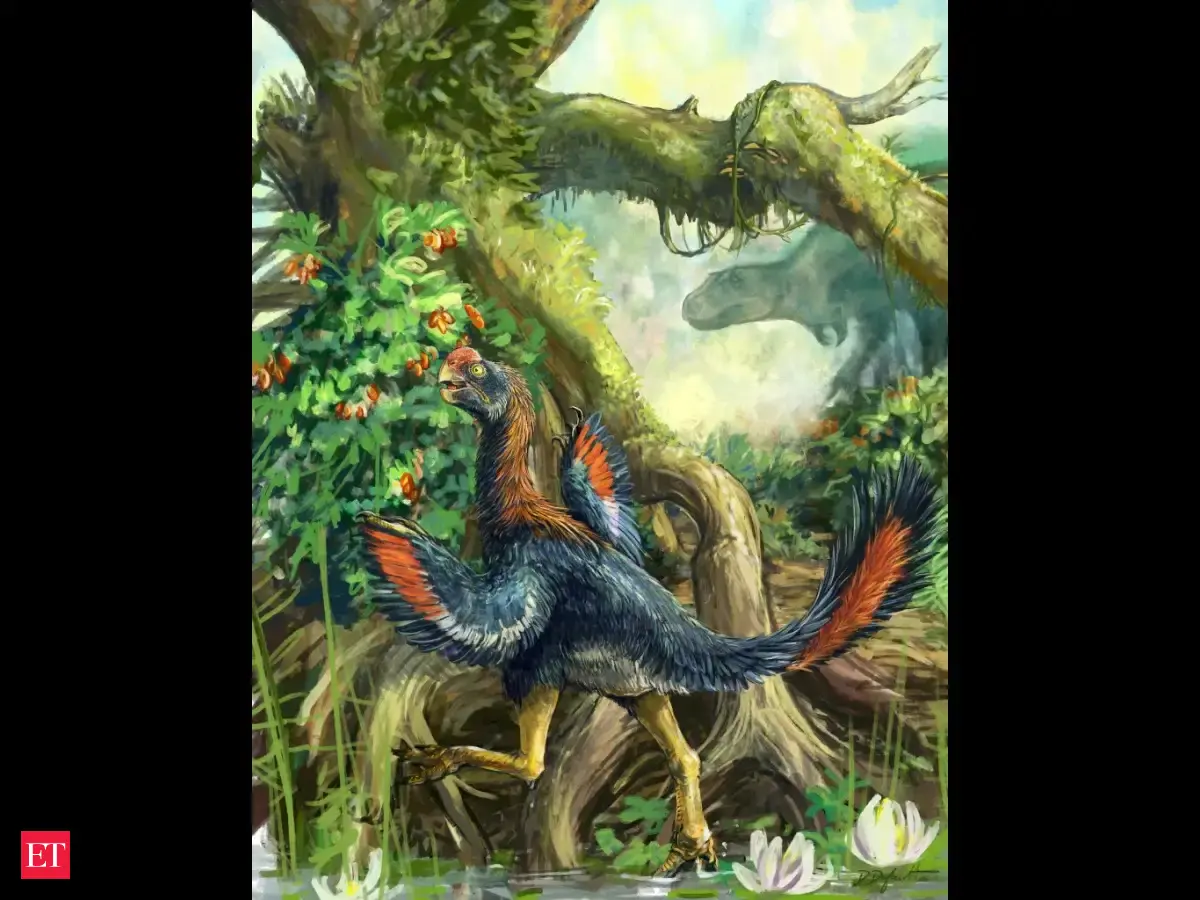
Researchers identified Infernogallus jamesi, a turkey-sized dinosaur from the T. rex era, as the first known fruit-eating species. Published on October 10, 2026, the study showed it had unique chewing muscles like parrots. Dr. Greg Funston said, "We never expected to discover fruit-eating dinosaurs," which lived in the Hell Creek.
Fruit-eating dinosaur: Researchers have unearthed a fascinating find with the identification of Infernogallus jamesi, a newly discovered fruit-eating dinosaur from the same era as the T. rex. Resembling a modern turkey in size, its distinctive skull suggests a diet rich in fruits rather than meat. This discovery provides valuable perspectives on the evolution and ecological roles of dinosaurs, hinting at their potential contribution to seed dispersal in prehistoric ecosystems.
Paleontologists identified a newly discovered dinosaur species that roamed the Earth around the T. rex age and lived a very different lifestyle than many of its famous neighbors.
The international research team, led by a Stony Brook University researcher, the Royal Ontario Museum, and the North Dakota Geological Survey, says "Infernogallus jamesi," the bird-like species, was a small one with specialized chewing muscles for soft foods, "the first known dinosaur that specifically ate fruit."
Researchers were shocked to find a fruit-eating dinosaur
The study was led by Dr. Greg Funston, Assistant Professor in the Department of Anatomical Sciences at Stony Brook University, and published in the journal Nature Communications on October 10, 2026; the research analyzed the chewing muscles of the new species, which showed that it had a "unique arrangement only seen in fruit-eating parrots today," The Royal Ontario Museum said in a news release on October 28.
"We knew dinosaurs evolved to fill so many different roles in ecosystems in the Cretaceous, but we never expected to discover fruit-eating dinosaurs," Funston said in a statement. "For more than 100 years, we didn't know what the skulls of these animals looked like. Now, we know they were even weirder than we could have predicted," he added.
Fruit-eating dinosaurs named Hell Chicken for a reason
The name Infernogallus means "hell chicken," because the fossils, which consist of a nearly complete, articulated skull and partial skeleton, were found in the Hell Creek Formation in the US, which spans Montana, North Dakota, South Dakota, and Wyoming. The dinosaur fossil currently on display at the Royal Ontario Museum which lived alongside T. rex and Triceratops, the final chapter of the dinosaur era.
Hell Chicken Infernogallus belongs to a group of toothless feathered dinosaurs called caenagnathids and would have been sized like a modern-day turkey: 5 feet (1.5 meters) long, weighing around 12 kg (25 lbs) - which also makes it one of the smallest members of its group even as a fully grown adult.
Hell Chickens were evolved from a meat eating family
Researchers also found that Infernogallus evolved from the family of meat-eating dinosaurs like T. rex. But with time, its skull evolved to crush fruits and separate the edible pulp from large seeds instead of hunting prey.
"It's pretty rare for animals to become specialized for a diet of fruit, so when it happens, it comes with some remarkable adaptations," Dr. Thomas Dudgeon, current Rebanks Postdoctoral Research Fellow at ROM and one of the co-authors of the research paper, said. "The anatomy of Infernogallus is bizarre among dinosaurs, and we quickly realized that we were dealing with something special."
The researchers reconstructed the skull using a CT scan and found that the bones arched downward into the mouth, which caused certain muscles to face front-to-back rather than up and down. This resulted in a chewing motion in which the beak slid back and forth, as in humans, rather than the rigid, vertical bite of T. rex and other dinosaurs.
These frontal muscles, which helped them chew, are only found in mammals like humans with complex chewing, and in some birds that specialize in fruit-eating, like the Vulturine Parrot (Psittrichas), a ferocious fruit eater.
Hell Chicken Infernogallus were a seed dispersers
Scientists concluded that the reason for this adaptation is processing soft foods - such as fruit - in the mouth instead of the gut. As the discovery suggests, the Hell chicken, Infernogallus, was a fruit-eating dinosaur, which is additionally significant, as it suggests that dinosaurs may have acted as seed dispersers like today's birds, reptiles and small mammals.
"Complete remains of small dinosaurs like Infernogallus are very rare in the fossil record. The strange skull of Infernogallus is an exciting find because it reveals surprising insights into dinosaur evolution and feeding specialization," Dr. David Evans, Chief Curator, Natural History & Temerty Chair in Vertebrate Paleontology at ROM and senior author of the paper, said, adding, "This discovery shows that we still have a lot to learn about the world of T. rex, and about dinosaurs more generally."