
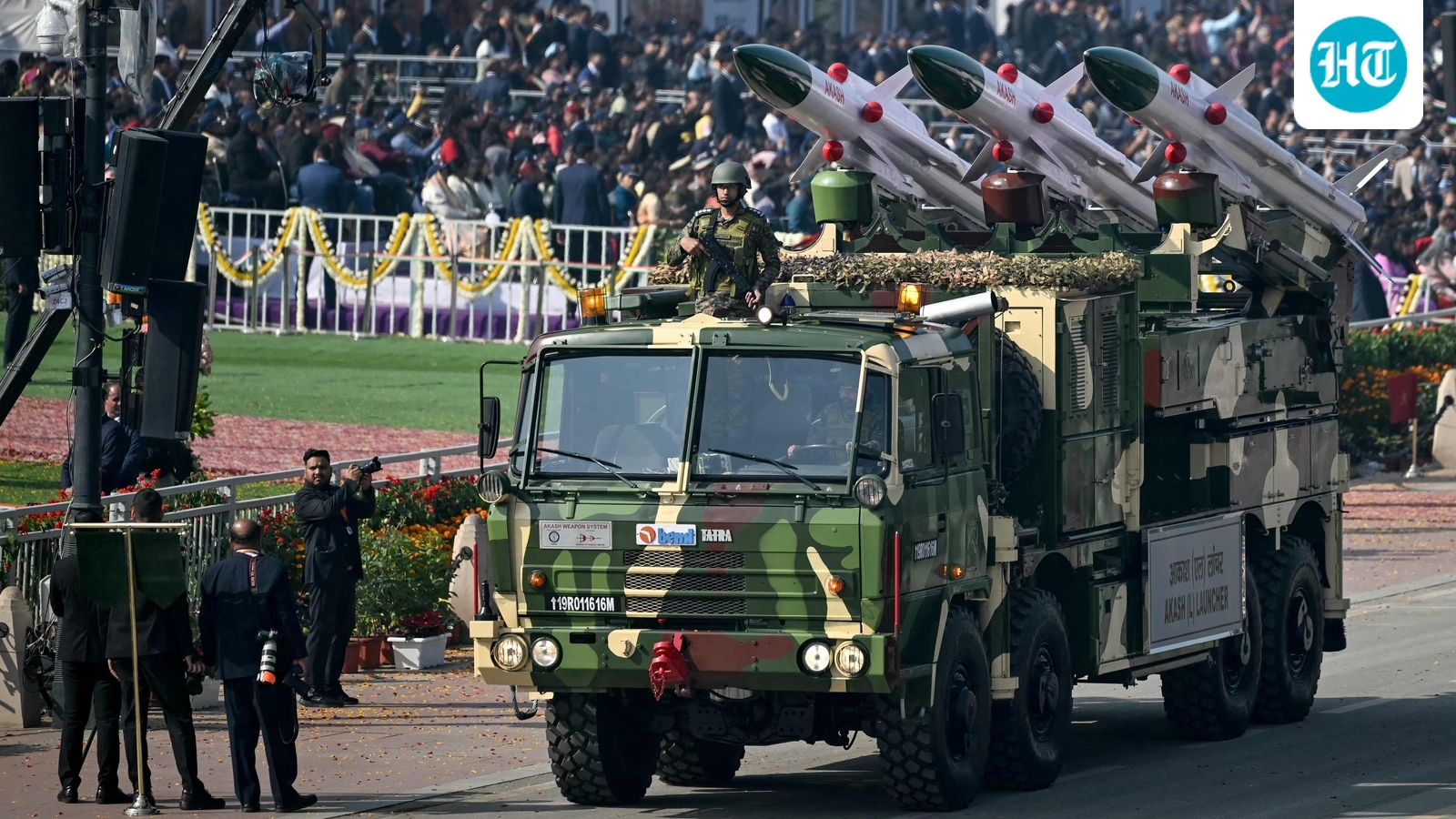
Defence secretary Rajesh Kumar Singh confirmed on October 1, 2026, that India exported the Akash missile system to Armenia, Tajikistan, and Turkmenistan. This move marks a major shift as these nations move away from Russian equipment. India’s defence exports reached ₹38,424 crore in FY26, showing a massive growth in global reach.
In a recent event on October 1, 2026, defence secretary Rajesh Kumar Singh confirmed that the Akash surface-to-air missile system, which is India's indigenously developed short-range air-defence platform, has been exported to three countries, including Armenia, Tajikistan, and Turkmenistan. To add on to this, the former DRDO Chairman Samir V Kamat separately verified the Tajikistan and Turkmenistan deliveries. The confirmation was notable as much for its geography as for the system itself. Armenia had already been known as Akash's first foreign customer, having signed a $720 million agreement in 2022 with deliveries commencing in 2024. Tajikistan and Turkmenistan are different. Both sit within what Russia has long treated as its exclusive defence-industrial sphere in Central Asia. Both have relied overwhelmingly on Russian air-defence equipment for decades. Their decision to acquire Akash, at a moment when Moscow's own war in Ukraine has visibly strained its arms export commitments, marks the furthest geographic reach yet of India's indigenously developed air-defence capability.
Taken alongside India's defence exports reaching ₹38,424 crore in FY26, a 63% increase over the previous year's ₹23,622 crore and more than 5,500% above the ₹686 crore recorded in 2013-14, the Akash export confirmation is not an isolated event. It is a data point in a structural change that has been building for over a decade.
There is no denying that India's defence export credibility in recent times has been built primarily on one system: The BrahMos supersonic cruise missile, jointly developed by DRDO and Russia's NPO Mashinostroyenia. It got its first success as the Philippines became its first export customer, followed by Vietnam and Indonesia, while negotiations with the UAE are ongoing. It is certainly true that the BrahMos established the commercial logic that has since driven India's export ambitions: that a system developed indigenously or in close partnership, validated in service by Indian forces during an operation, and combat-relevant in the security environment of potential buyers, can command the same premium that western systems have historically enjoyed.
Here it is very clear that the Akash export to three countries demonstrates that BrahMos was not a one-off. India is now exporting the Pinaka multi-barrel rocket launcher, for which Armenia signed a ₹2,000 crore contract and France is evaluating the system for its own artillery modernisation programme. Similarly, Swathi weapon-locating radars, Dornier 228 transport aircraft, lightweight torpedoes, and electronic warfare equipment have also found foreign buyers. In addition to this, the export authorisation count tells the institutional story: 1,762 licences issued in 2024-25, up nearly 17% from the prior year, with the number of active defence exporters growing by 17.4% in the same period. This has resulted in a tremendous success where India's domestic defence production hit a record ₹1.78 lakh crore in FY26. The government has set a target of ₹50,000 crore in defence exports by 2029.
However, it is important to acknowledge that the transformation from import dependence to export capability did not happen through market forces alone. India was, for most of its post-Independence history, one of the world's largest arms importers. The Stockholm International Peace Research Institute consistently ranked India among the top three global importers through much of the 2000s and 2010s. What changed was a combination of policy intent and institutional investment: The defence procurement procedure reforms creating preferential treatment for indigenously manufactured systems, the establishment of iDEX to bring private startups into the supply chain, the Make in India incentive structure that created domestic market guarantees for DRDO-developed systems, and the political commitment at the highest levels to treat Atmanirbhar Bharat in defence as a programme requirement rather than an aspirational phrase.
To demonstrate its real capability, during Operation Sindoor, India's aerial engagement with Pakistan in 2025, accelerated this story in ways that no amount of policy messaging could have achieved. Both BrahMos and Akash gained genuine battlefield exposure. A system with combat proof is a fundamentally different commercial proposition from one with only test-range credentials.
The most stark observation in this context is that the public conversation about artificial intelligence in India focuses overwhelmingly on its generative form: large language models, chatbots, coding assistants, image generators. But, in contrast, the Akash missile system is a demonstration of a different kind of AI, one that does not generate text or images but performs real-time signal classification, multi-target tracking, and threat prioritisation at timescales human operators cannot match.
For instance, the Akash Mark-1 uses the Rajendra PESA (Passive Electronically Scanned Array) radar, capable of simultaneously tracking up to 64 aerial targets and directing up to eight missiles at once. In a similar way, the Akash-NG variant, whose user evaluation trials were completed by DRDO in late 2025, deploys an Active Electronically Scanned Array (AESA) multi-function radar with an active RF seeker developed by a DRDO laboratory in Hyderabad. Here, in both cases, the radar signal processing chain relies on algorithms that perform automatic target recognition, clutter rejection, and countermeasure identification faster than any human decision loop could operate.
It is interesting to observe that this is the defence application of AI that rarely appears in summit speeches but matters most operationally. It is AI as embedded cognition: Running inside the seeker, inside the radar processor, inside the engagement management software that determines which of the 64 tracked targets to prioritise for intercept. The ECCM (Electronic Counter-Countermeasures) capability, which gives Akash immunity against jamming, depends on adaptive algorithms that respond to electronic attack in real time. When Tajikistan and Turkmenistan acquire the Akash system, they are acquiring this AI layer, whether or not that is how the purchase is described publicly.
Akash is, therefore, a more concrete indicator of India's defence-AI maturity than any programme disclosure or summit statement. It is AI that has already been exported, already been paid for by sovereign customers operating under genuine threat conditions, and already been validated in the kind of environment, Operation Sindoor, that commercial benchmark tests do not replicate. To add its strengths, the 70-billion-parameter language model DRDO is currently developing for cyber operations represents India's frontier AI ambition. Akash represents what India's embedded defence AI actually does today.
The Akash export to Tajikistan and Turkmenistan is consequential not primarily because of contract values that remain undisclosed, but because of what it signals about the depth of India's defence-export ecosystem. There is no denying that the Akash is the output of sustained investment in radar development, seeker technology, propulsion, command guidance, and field-level support infrastructure accumulated over three decades. But, it did not become export-ready through a single procurement cycle.
Here, two risks are worth naming. The first is product concentration: if BrahMos and Akash account for a disproportionate share of export revenue, the ₹50,000 crore target depends on a narrow base vulnerable to geopolitical disruption in key buyer markets. The private sector's contribution, which reached ₹15,233 crore in FY26, needs to diversify beyond components and sub-systems toward complete platforms. The second risk is the talent pipeline: the engineers who design Akash's AESA radar and DRDO's AI systems are in demand from commercial technology firms paying multiples of government scale. Without a structured retention mechanism, the R&D advantage that produces exportable systems will erode faster than the export targets can be met.
If these two risks are addressed, just like India built a software industry by combining engineering talent, cost advantage, and a moment of global demand that its competitors were slow to recognise, similarly the conditions for a defence-technology industry of comparable weight are assembling. The Akash reaching Central Asia is one data point in that assembly. Whether the institutions, DRDO, iDEX, the Defence Acquisition Council, the private sector supply chain, build the rest of the structure around it is the question the next decade will answer. It would be definitely interesting to keep an eye on all these events and observe the evolution of Indian defence tech industry.