
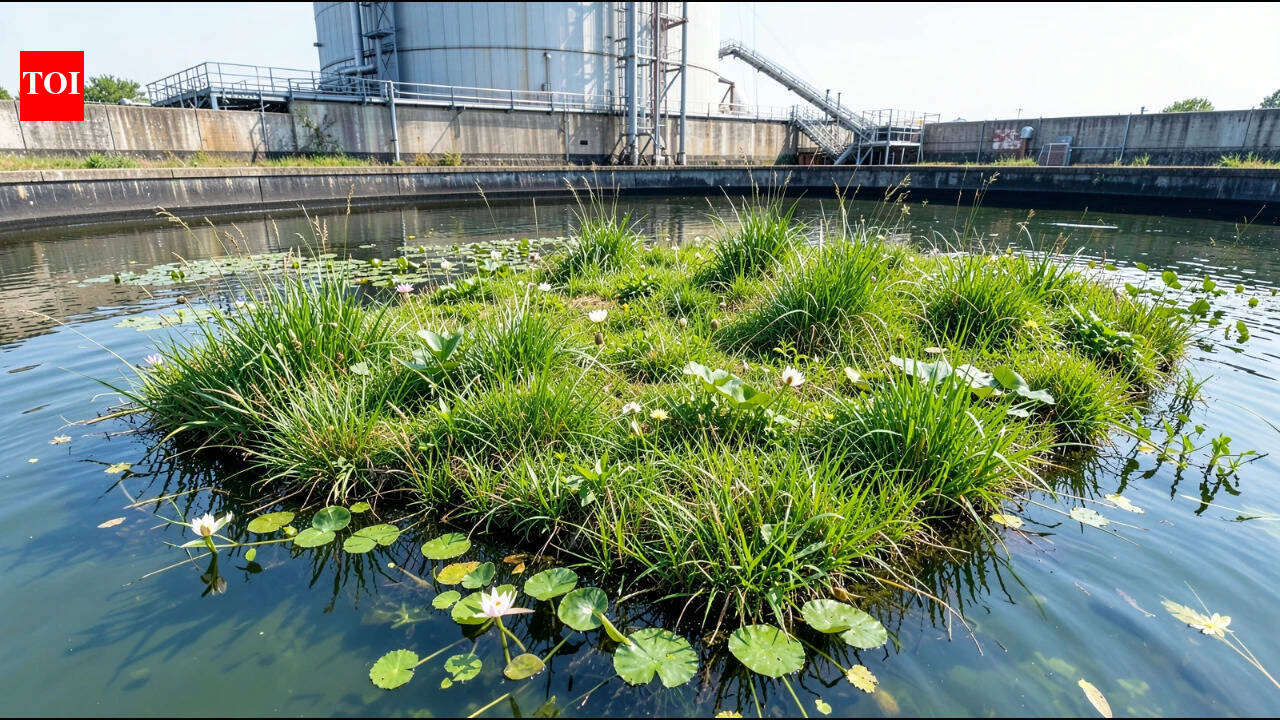
In May 2026, Biomatrix Water turned an unused wastewater tank in Somerset into a floating wetland with 3,296 plants. The project aims to clean stormwater before it reaches local watercourses. Nick Schreiner said sampling was starting at that point to test if the plants effectively remove pollutants from the water.
An unused wastewater tank in Somerset, England, has been repurposed as a floating wetland designed to improve water quality and create habitat for wildlife. In May 2026, Biomatrix Water worked with YTL Construction UK to install 275 square metres of floating wetlands at Cheddar Water Recycling Centre for Wessex Water. The floating wetland sits on a retired aeration ditch and consists of 82 interlocking modules supporting 3,296 aquatic plants. Their submerged roots provide surfaces for microbial communities that can help remove pollutants from water. The installation is intended to improve the quality of water from stormwater overflows before it reaches a nearby watercourse. Within 3 months, a pair of ducks had also settled on the wetland and raised a brood, according to Biomatrix Water. However, the site's treatment performance has yet to be established through water sampling.
Floating wetland at Cheddar Water Recycling Centre: how 82 modules support 3,296 plants
The project was constructed and installed by Biomatrix Water, with engineering services provided by Mott MacDonald, working alongside YTL Construction UK on behalf of Wessex Water. Rather than removing the retired aeration ditch, the team adapted it to support a nature-based treatment system. Biomatrix Water says the installation covers 275 square metres and uses its Geomatrix design, made up of 82 interlocking modules.
Together, these support 3,296 aquatic plants.
The plants' roots hang into the water and provide surfaces for biofilm to develop. Biofilm is a community of microorganisms, including bacteria, algae and fungi, that grows on submerged surfaces. These organisms can contribute to the breakdown and transformation of organic matter and nutrients in water. The floating structure allows the plants to grow above the water while their roots remain in contact with it. The system is intended to improve water quality before stormwater overflows leave the site and reach a watercourse. It is important, however, to distinguish the wetland's intended function from measured results. Alistair Barlow of YTL Construction UK said, in comments quoted in Biomatrix Water's September 10, 2026, case study, that water samples would be taken at the inlet and outlet to assess the wetland's performance. Biomatrix Water's Nick Schreiner also said sampling was starting at that point. The results had not yet been reported in the case study.
Floating treatment wetlands: what scientific research says
The underlying technology has been studied beyond Somerset. A 2021 review published in Science of the Total Environment, titled
Application of floating treatment wetlands for stormwater runoff: A critical review of the recent developments with emphasis on heavy metals and nutrient removal, examined how floating treatment wetlands can help manage stormwater pollution. Researchers Rozi Sharma, Jan Vymazal and Piyush Malaviya described how plants growing on floating rafts and biofilms attached to their submerged roots contribute to pollutant removal. The review examined the potential for these systems to remove nutrients and heavy metals and discussed the role of hydraulics and other design parameters in treatment performance.A second review, published in Applied Sciences in 2025, is titled The Bioremediation of Nutrients and Heavy Metals in Watersheds: The Role of Floating Treatment Wetlands. It examines floating treatment wetlands used in settings including stormwater, agricultural runoff and wastewater. The authors identify factors such as the time water spends in the system, the thickness of the floating mat, plant species and microbial interactions as important influences on treatment performance. The review also highlights seasonal variation and the need to evaluate systems under different operating conditions. These findings provide scientific context for the Cheddar installation, but they do not establish how effectively that particular wetland will perform. Its inlet and outlet measurements will be needed to assess changes in water quality under local conditions, including variations in weather and water flow.
Reusing a retired aeration ditch
The Cheddar installation is also an example of adapting existing infrastructure instead of removing it. Biomatrix Water explains that treatment works are periodically upgraded, leaving older tanks and other assets redundant. Removing them can be expensive, so some structures remain unused. Retrofitting such a space with floating wetlands offers another option: an existing asset can be adapted to support a nature-based treatment system. The approach is not entirely new for Wessex Water. In 2024, the company worked with Biomatrix Water on a floating wetland at Ubley Water Recycling Centre in Bristol. That earlier project was installed in a stormwater lagoon as part of a trial to assess whether nature-based solutions could improve the quality of stormwater overflows at sites affected by high groundwater infiltration. The project description said water sampling would be used to assess changes in quality before water entered a local stream.
At Cheddar, the wildlife response provides an early sign that the floating structure is offering habitat. Biomatrix Water reported that a pair of ducks settled there and raised a brood within 3 months of installation. That observation is distinct from evidence of water-treatment effectiveness, which remains to be measured. The next stage is therefore monitoring. Samples taken at the wetland's inlet and outlet can help establish whether water quality changes as water passes through the system. Those results will be important in determining the installation's performance and informing decisions about similar projects. For now, Cheddar demonstrates how a retired wastewater structure can be repurposed for a new ecological use, while the extent of its contribution to water treatment awaits measurement.